Artwork
Hough End Hall, Manchester
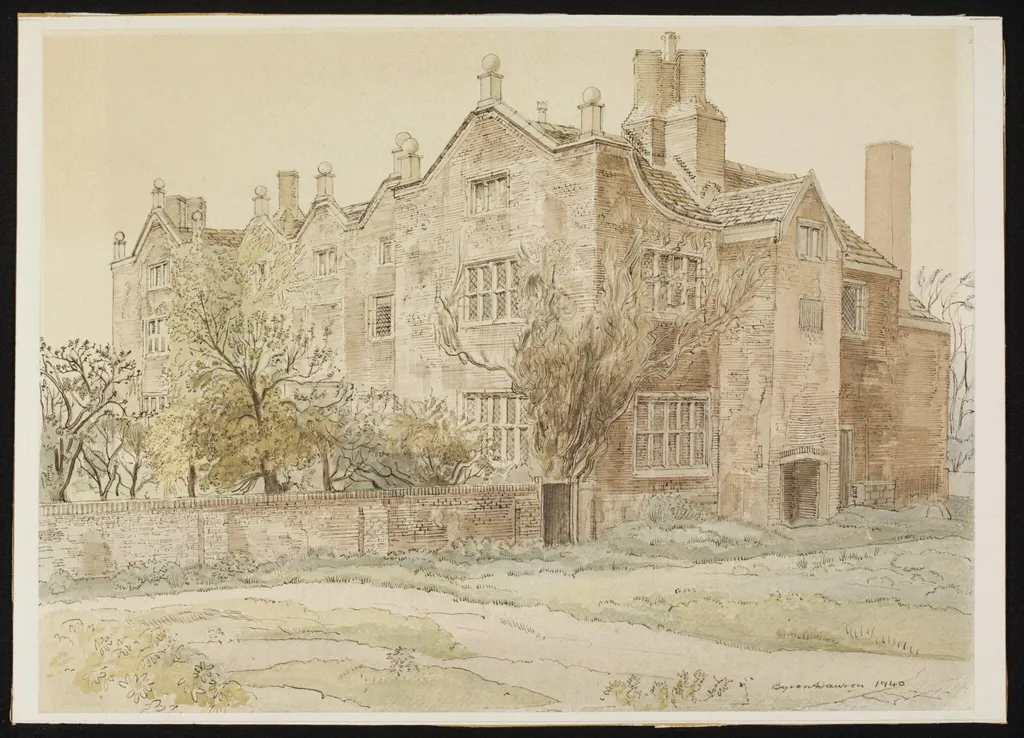
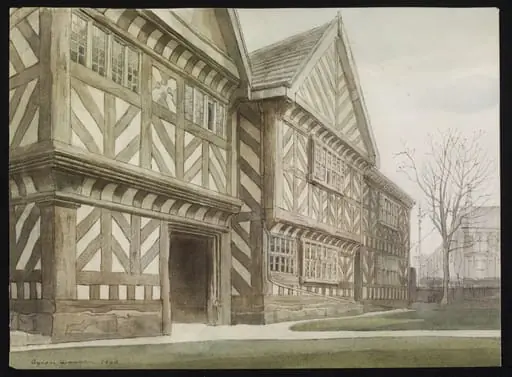
Hough End Hall, Manchester is a watercolor work on paper by the Social Realist artist Dawson. It dates from 1940 and is held in the collection of the Victoria and Albert Museum.
About this work
Trees with bare branches stand in front, and a low brick wall runs along the yard, which looks a little overgrown.
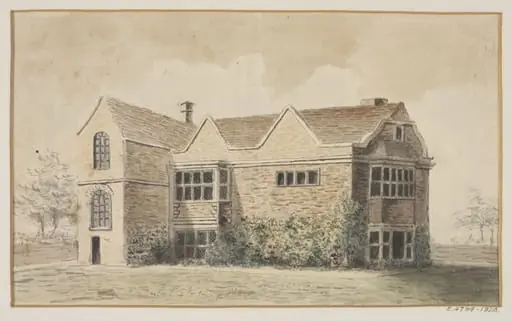
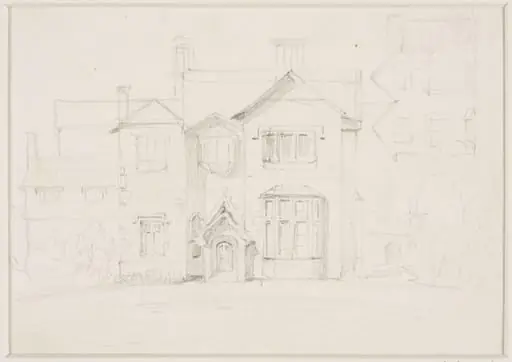
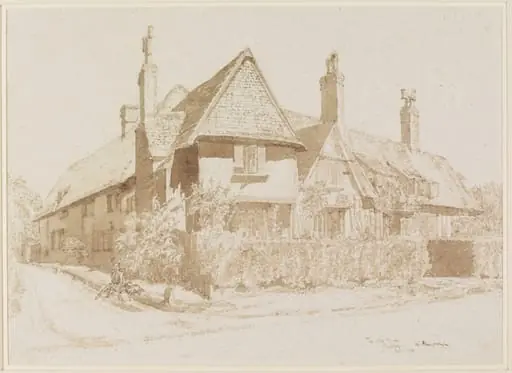
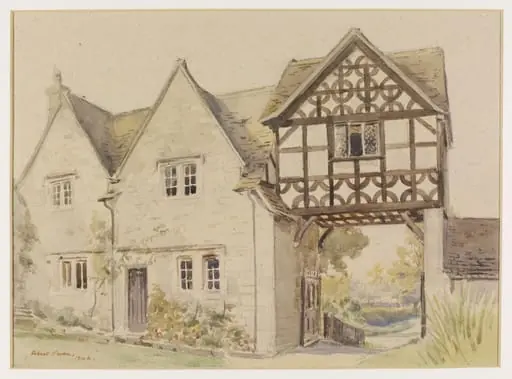
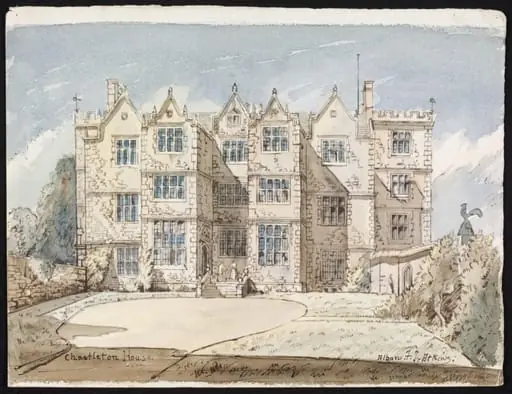
This sketch shows an old brick house with steep roofs and tall chimneys. The building has a mix of small windows, some with wooden shutters, and a big arched window in the center. Trees with bare branches stand in front, and a low brick wall runs along the yard, which looks a little overgrown.
The artist focused on the house’s details, like the way the bricks and wood look worn. The date "1940" is signed in the corner, and the place is called Hough End Hall.
Check out the Victoria and Albert Museum to see more works like this.
Overview
Painted in 1940, this watercolour by Dawson captures Hough End Hall, a historic Elizabethan manor in Manchester. Executed in delicate washes, the work is one of many produced under the Recording Britain project, a government-backed effort to visually archive the nation’s architectural heritage during the Second World War. The piece reflects a quiet, observant approach to place, emphasizing structure over drama.
Subject & Meaning
Hough End Hall, with its five gabled roofs, mullioned windows, and ball finials, represents a fading strain of domestic architecture. The inclusion of a weathered garden wall and sparse, leafless trees suggests a landscape in transition, neither fully cultivated nor abandoned. The scene conveys a sense of endurance, capturing a building that had outlived its original function yet remained physically present amid wartime uncertainty.
Technique & Style
Dawson employed transparent watercolour to render the brickwork’s texture and the subtle gradations of light on weathered surfaces. Fine brushwork defines the wooden shutters and the irregularities of the central arched window. The composition avoids idealization, favoring a restrained, documentary tone. Bare branches and overgrown foliage are suggested with minimal strokes, reinforcing the work’s observational integrity.
History & Provenance
The painting was created as part of the Recording Britain initiative, funded by the Pilgrim Trust and directed by Sir Kenneth Clark. Commissioned by the Ministry of Labour and National Service, the project enlisted artists to record buildings and landscapes deemed vulnerable to wartime destruction or postwar redevelopment. Dawson’s work entered the Victoria and Albert Museum’s collection as part of this curated archive.
Context
During the early years of the Second World War, Britain faced widespread disruption, and cultural preservation became a quiet act of resistance. Recording Britain responded to fears that historic sites might vanish under bombing or urban renewal. Artists like Dawson were sent across the country to document vernacular architecture, creating a visual inventory of a nation’s material past at a moment of profound fragility.
Legacy
The Recording Britain collection endures as a vital historical record, offering insight into the country’s architectural landscape before large-scale modernization. Dawson’s watercolour of Hough End Hall remains a quiet testament to the value placed on ordinary heritage during crisis. Today, it serves researchers and the public as both an artistic document and a marker of cultural memory.
Artist & collection
Artist
This artist painted watercolours of grand old buildings and riverside mills around Manchester and Lancashire in the early 1940s.