Artwork
I Saw the Figure 5 in Gold
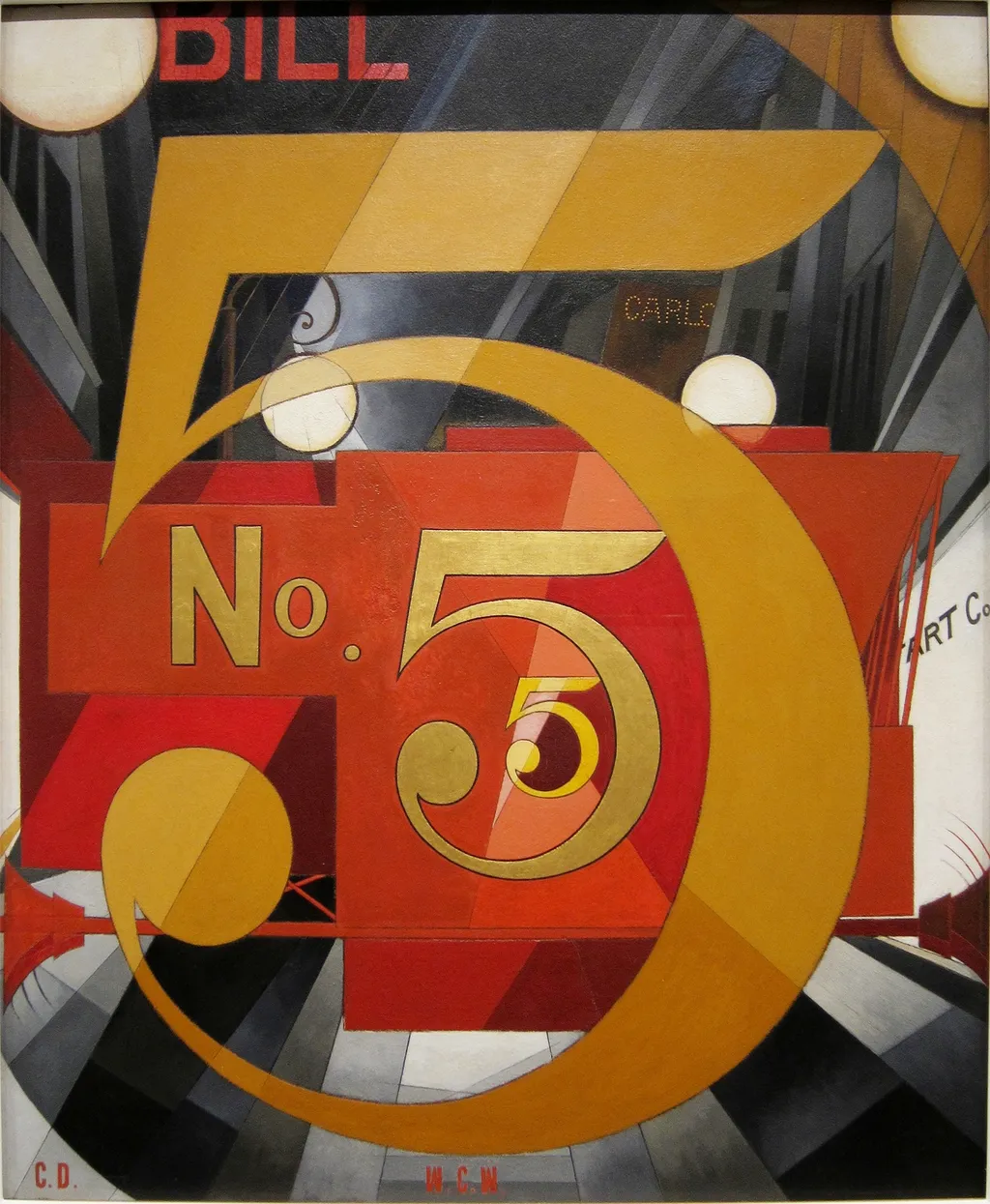
I Saw the Figure 5 in Gold is an oil painting by the Precisionist artist Charles Demuth. It dates from 1928 and is held in the collection of the Metropolitan Museum of Art.
About this work
Subject & Meaning
The painting renders a fleeting urban moment by translating William Carlos Williams's poem "The Great Figure" into visual form.
The painting renders a fleeting urban moment by translating William Carlos Williams's poem "The Great Figure" into visual form. Three descending, gold-leaf numerals "5" evoke a fire engine in motion, its red rectangles and hint of a ladder and axle compressing the vehicle into an abstracted, cubist-futurist composition. The arc in the upper right suggests the vehicle's arc of travel, while the muted cityscape, globular street lamps, sidewalks, and buildings, anchors the scene in a rainy Manhattan night.
Demuth encoded homage by fragmenting Williams's name across the canvas: "Bill" at the top and "CARLO" in yellow dots, the latter referencing illuminated theater signs, while "W.C.W." appears at the bottom alongside the artist's own initials "C.D." The work functions as a Precisionist portrait and a visual echo of Williams's poem, embodying transatlantic stylistic exchange and the cross-disciplinary friendships of 1920s American Modernism.
Technique & Style
Created in 1928, I Saw the Figure 5 in Gold is executed in oil paint, graphite, ink, and gold leaf on a paperboard support. The work exemplifies the Precisionist style, characterized by clean lines and geometric forms that incorporate influences from Cubism and Futurism. Visually, the composition reduces a fire engine to abstracted red rectangles, hinting at a ladder and axle, while flanking streetlamps and buildings are rendered in blacks and grays.
A defining formal quality is the dynamic depiction of motion: a large, fragmented number five in the upper right recedes into three progressively smaller, complete fives, creating an illusion of the vehicle speeding away. The piece also integrates text as a stylistic element, featuring the poet's name "Bill" and "CARLO" in yellow dots resembling theater signage, alongside the initials "C.D." and "W.C.W." at the base.
History & Provenance
The work titled I Saw the Figure 5 in Gold was painted by Charles Demuth in 1928 using oil, graphite, ink and gold leaf on paperboard. It measures 90.2 × 76.2 cm and belongs to a series of five abstract poster‑portraits that Demuth created between 1924 and 1929 to honor close friends, including poet William Carlos Williams. The painting was first shown at the Intimate Gallery in New York in 1929.
After Demuth's death in 1935 he bequeathed the piece to Georgia O'Keeffe, who donated it to the Metropolitan Museum of Art in 1948 as part of the Alfred Stieglitz Collection; it has remained in the museum's permanent holdings and has never been sold.
Context
Charles Demuth's 1928 oil‑on‑cardboard work I Saw the Figure 5 in Gold functions as a seminal "poster portrait" that translates William Carlos Williams's poem The Great Figure into visual form. The painting, documented in the Metropolitan Museum of Art collection and first shown at the Intimate Gallery in 1929, exemplifies Precisionist aesthetics through crisp geometry, a fragmented gold‑leaf numeral five, and references to fire‑engine motifs, while drawing on Cubist and Futurist influences. It belongs to a series of five abstract portraits of Demuth's artistic and literary friends, reflecting his personal ties to Williams and other modernist figures.
Critics have highlighted its role in American modernism, its anticipatory link to pop art, and its status as a key example of the genre. Scholarship situates the work within trans‑Atlantic modernist exchange and its enduring cultural resonance, evident in later homages such as Robert Indiana's 1963 print and a 2013 U.S. postage stamp.
Overview
I Saw the Figure 5 in Gold, completed by Charles Demuth in 1928, is a seminal work of American Precisionism that functions as a visual tribute to the poet William Carlos Williams. The painting depicts the numeral 5, rendered in overlapping layers of gold and metallic paint, dominating the composition to symbolize the repeated sound of a fire truck's bell in Williams' poem "The Great Figure." Demuth integrates the text of the poem's title and the artist's name within the geometric structure, blending literary reference with abstract form.
The background features a stylized cityscape suggested by red and orange shapes and white circles, evoking the dynamic motion of urban night life. Influenced by the rhythmic fragmentation of Futurism and the structural analysis of Cubism, the work translates the auditory experience of a passing vehicle into a static, painted plane. This piece stands as a defining example of Demuth's "poster portraits," a series where he honored friends through abstracted, symbolic imagery rather than traditional likeness, marking a high point in his career and the broader American modernist movement.
Own this work as a print
Artist & collection
Artist
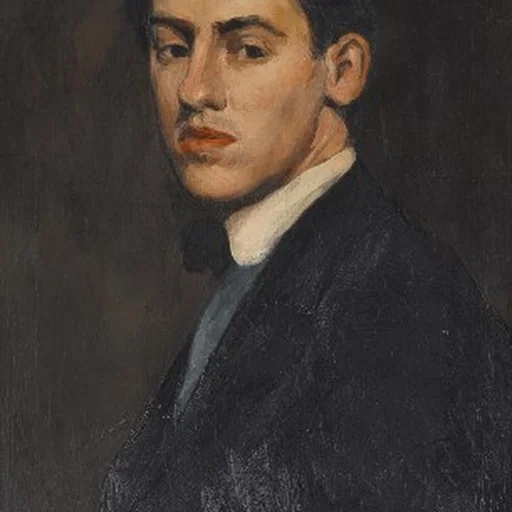
Charles Henry Buckius Demuth (November 8, 1883 – October 23, 1935) was an American painter who specialized in watercolors and turned to oils late in his career, developing a style of painting known as Precisionism.