Artwork
Portrait of Elisabetta Gonzaga
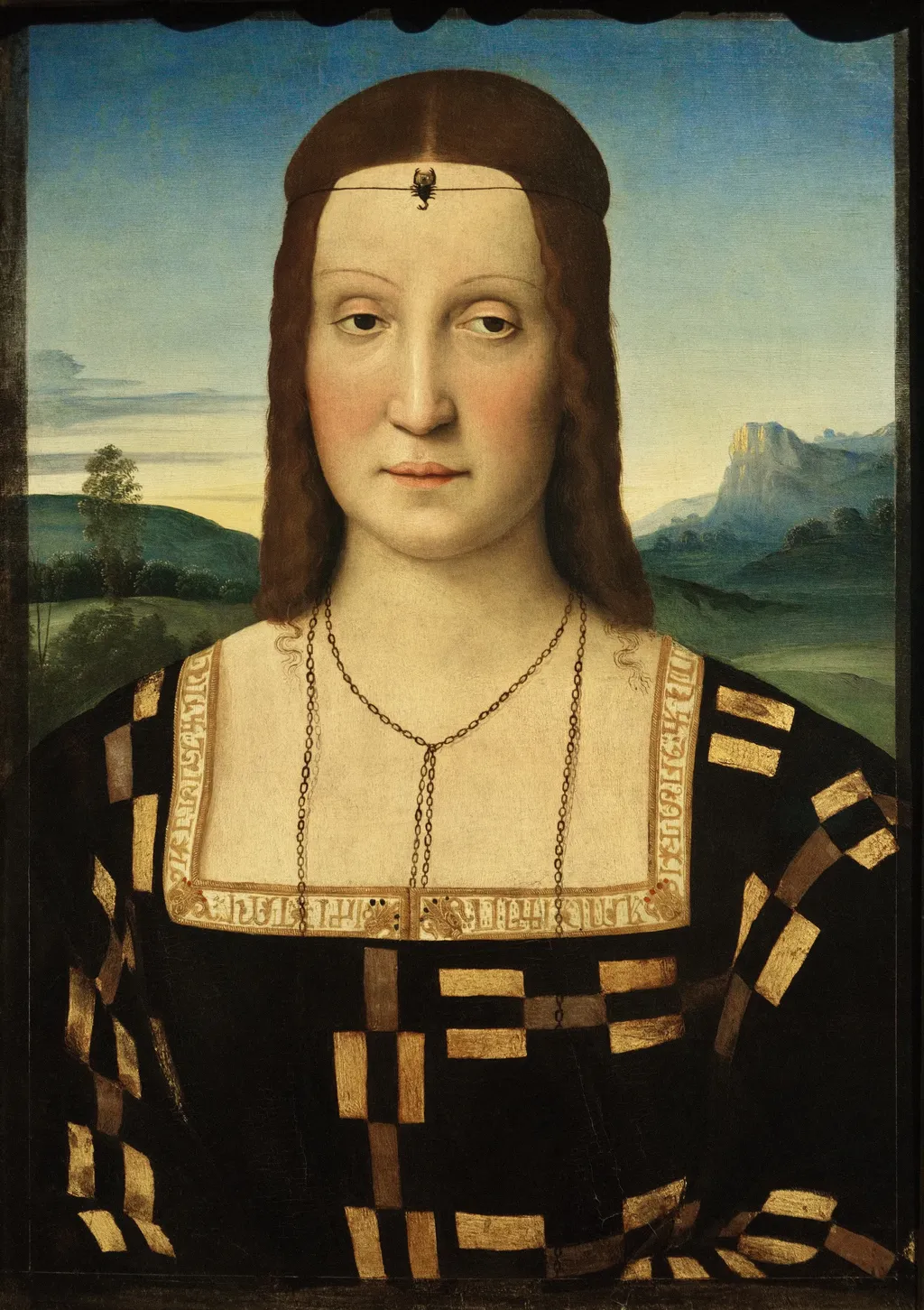
Portrait of Elisabetta Gonzaga is an oil painting by the High Renaissance artist Raphael. It dates from 1504 and is held in the collection of the Uffizi Gallery.
About this work
Subject & Meaning
The painting depicts Elisabetta Gonzaga, wife of Duke Guidobaldo I of Montefeltro and Duchess of Urbino, a learned patron of letters and the arts.
The painting depicts Elisabetta Gonzaga, wife of Duke Guidobaldo I of Montefeltro and Duchess of Urbino, a learned patron of letters and the arts. She is shown in a frontal, half-length pose that carries an archaic, medieval flavor.
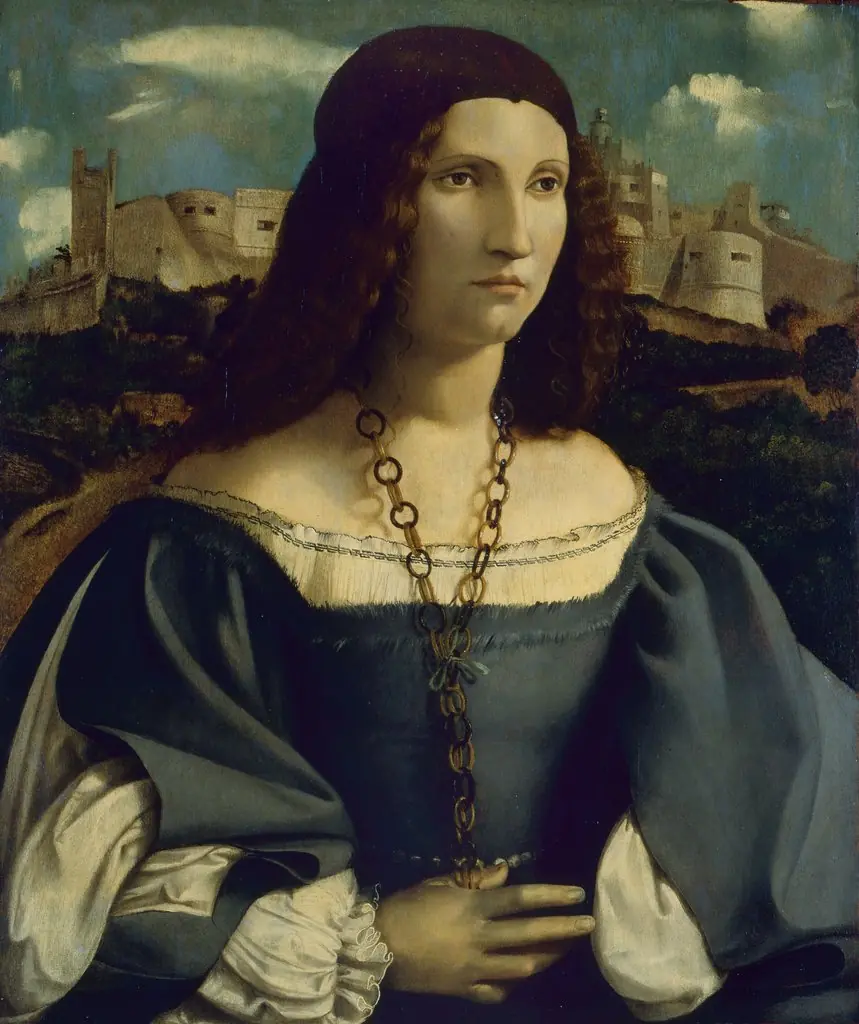
Her iconography emphasizes status and intellect. She wears a dark dress with refined horizontal and vertical patterned inserts and a square neckline bordered with light trim and gold embroidery, possibly with allegorical subjects. Her hair is arranged in the fashionable coazzone, a long plait also seen on her portrait medal at the British Museum. Most striking is the scorpion-shaped jewel on her forehead, an impresa (personal emblem) with likely apotropaic significance, connected to the "Scorpio" jewel that Baldassare Castiglione records among her possessions in *The Book of the Courtier*.
The background landscape features Leonardesque elements, notably a rocky spur on the right resembling that in Raphael's *Madonna Terranuova*, situating the sitter within a broader natural world and linking her to contemporary artistic innovation.
Technique & Style
The Portrait of Elisabetta Gonzaga is an oil on wood panel measuring 52.5 cm in height by 37.3 cm in width, painted by Raphael around 1504-1505 and currently housed in the Uffizi Gallery, Florence. The work depicts Elisabetta Gonzaga, wife of Duke Guidobaldo I of Urbino, in a half-length frontal pose rendered with refined objectivity that preserves her dignity. She wears a dark fabric garment with alternating horizontal and vertical decorative bands, a square neckline bordered by gold embroidery with probable allegorical motifs, and a scorpion-shaped ferronière on her forehead serving as an apotropaic emblem linked to her personal insignia. Her hair is styled in a coazzone, a long braid also seen in a British Museum medal of her. The background landscape echoes Leonardo-esque compositional models, particularly the rocky outcrop on the right that parallels that in Raphael’s Madonna della Terranuova. Formal stylistic analysis notes the archaic, almost medieval frontal treatment and static composition, while the precise rendering of physical details and rich material handling demonstrate Raphael’s mastery of oil paint on panel, blending narrative symbolism with controlled realism.
History & Provenance
The portrait was commissioned by Elisabetta Gonzaga herself, a cultivated patron of the arts and letters, and is documented as a Raphael portrait of the duchess in contemporary sources, including Antonio B. Negrini's Elogi di Castiglione. Stylistic analysis and an assessment of the sitter's age, Elisabetta was born in 1471, place the work around 1504-1505. The painting is thought to have belonged to the ducal collection at Urbino before being transferred to Florence in the early seventeenth century as part of Vittoria della Rovere's dowry (sources differ between 1625 and 1635). It is recorded with certainty on 14 August 1773, when it was moved from Palazzo Pitti to the Grand Ducal wardrobe of the Uffizi. A 1784 inventory attributed it to the school of Giovanni Bellini, while an 1825 inventory assigned it to Andrea Mantegna, an attribution that persisted through the nineteenth century. Émile Durand-Gréville was the first to propose Raphael in 1905, a view subsequently endorsed by Gronau, Ortolani, Longhi, Volpe, Camesasca, and Meyer zur Capellen (2001). Other proposed attributions include Francesco Bonsignori, Giovan Francesco Caroto, Cesare Tamaroccio, Albrecht Dürer, and Francesco Francia. The verso bears the inscription "Isabella Mantovana, moglie del duca Guido[baldo]". The painting is now displayed at the Uffizi as a pendant to Raphael's Portrait of Guidobaldo da Montefeltro. The painting is housed in the Uffizi Gallery in Florence. It likely originated in the Ducal collection of Urbino before arriving in Florence in 1625 or 1635 as part of Vittoria della Rovere's dowry. The work was first definitively recorded on August 14, 1773, upon its transfer from the Palazzo Pitti to the Grand Ducal wardrobe. Historical inventories reflect shifting attributions: an 1784 catalog listed it under the school of Giovanni Bellini, while an 1825 inventory identified it as a work by Andrea Mantegna. The attribution to Raphael was first proposed by Émile Durand-Gréville in 1905. Today, the portrait is displayed alongside the portrait of Guidobaldo I da Montefeltro, forming a pendant pair within the museum's collection.
Context
The attribution of the Portrait of Elisabetta Gonzaga has a complex critical history. First documented in 1773 when transferred to the Uffizi's grand ducal wardrobe, the painting was initially assigned to the school of Giovanni Bellini in 1784 and later to Andrea Mantegna in 1825, a name that persisted throughout the nineteenth century. Other scholars proposed artists such as Francesco Bonsignori, Giovan Francesco Caroto, Cesare Tamaroccio, Francesco Francia, and Albrecht Dürer. Émile Durand-Gréville first attributed the work to Raphael in 1905, an assignment subsequently supported by art historians including Gronau, Ortolani, Roberto Longhi, Volpe, Camesasca, and Jürg Meyer zur Capellen in 2001. The Francia hypothesis is considered closely related to the Raphael attribution, as some scholars identify an indirect influence of the Bolognese painter mediated through Timoteo Viti.
Stylistically, the painting's background landscape reveals Leonardesque models, particularly the rocky spur on the right which resembles Raphael's contemporary Madonna Terranuova. The work is characterized by an abstract staticism and an archaic frontal pose, though its classical restraint aligns it with Raphael's style. It is exhibited as a pendant to the Portrait of Guidobaldo da Montefeltro and relates closely to the Portrait of Emilia Pia da Montefeltro.
Legacy
The portrait's legacy rests on its contested attribution history and enduring scholarly discussion. Early inventories from 1784 and 1825 assigned it to Giovanni Bellini's school and Andrea Mantegna, respectively, before its 1905 attribution to Raphael gained traction through Émile Durand-Gréville's work. Subsequent critics like Gronau, Longhi, and Meyer zur Capellen reinforced this view, though alternative attributions to Francesco Francia persisted. The painting's symbolic elements, such as the scorpion-shaped ferronière linked to Castiglione's writings, and its stylistic parallels to Leonardo's landscapes, contribute to its significance. Today, it is displayed alongside Raphael's Portrait of Guidobaldo da Montefeltro at the Uffizi, reflecting its role in Renaissance portraiture studies.
Own this work as a print
Artist & collection
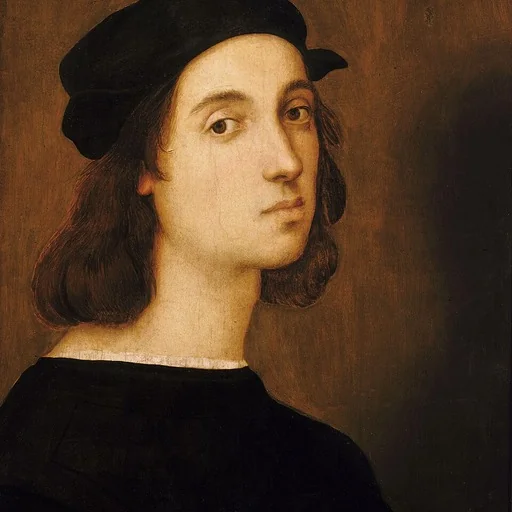
Artist
Raphael was born Raffaello Sanzio in Urbino on April 6, 1483, the son of Giovanni Santi, a painter and poet attached to the ducal court.

![Ginevra de' Benci [obverse], by Leonardo da Vinci](https://artifactworldgallery.com/img/leonardo-da-vinci--ginevra-de-benci-obverse--afb6ec3a3e65f392-w320.webp)