Artwork
Saint Margaret and the Dragon
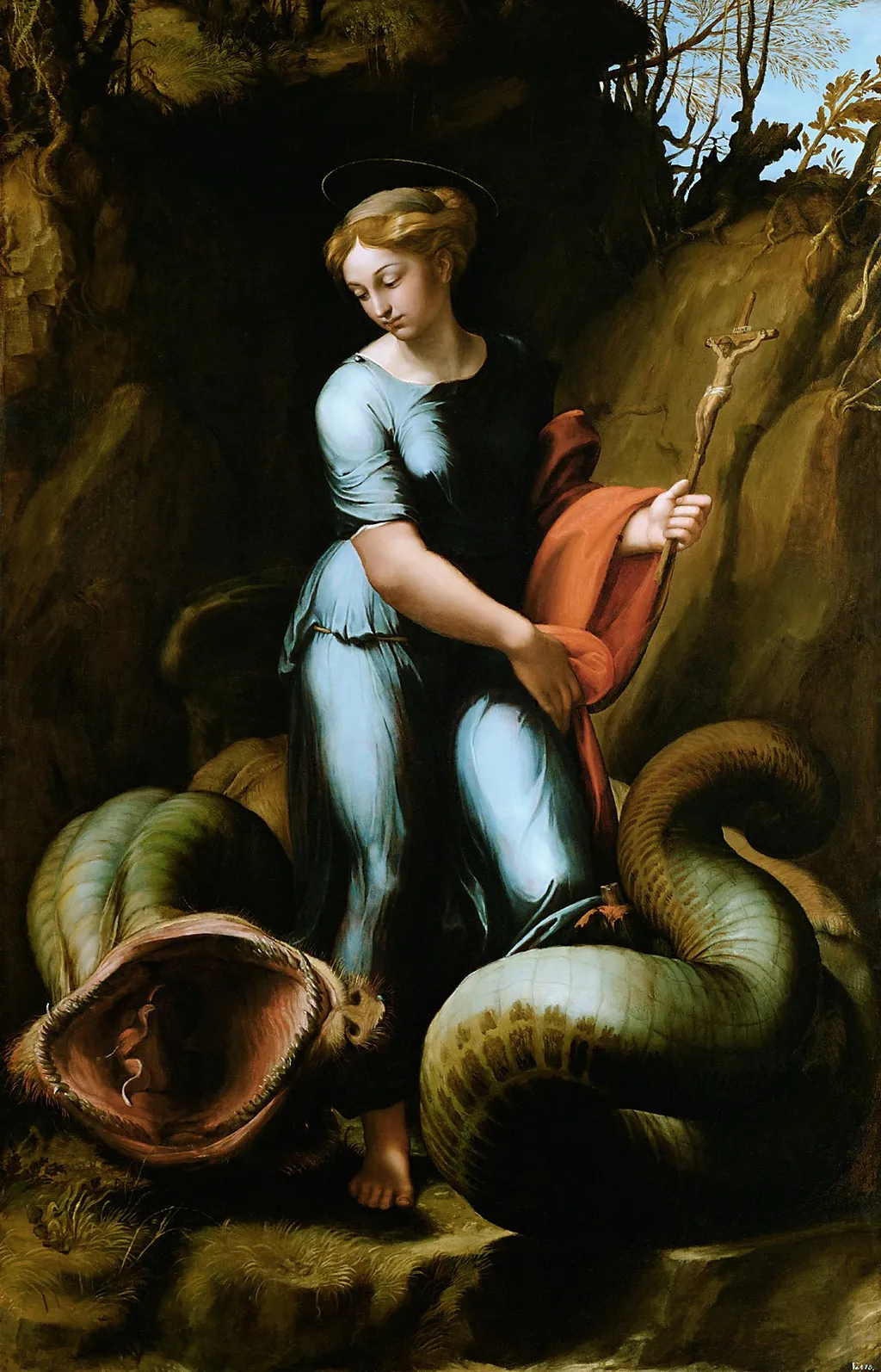
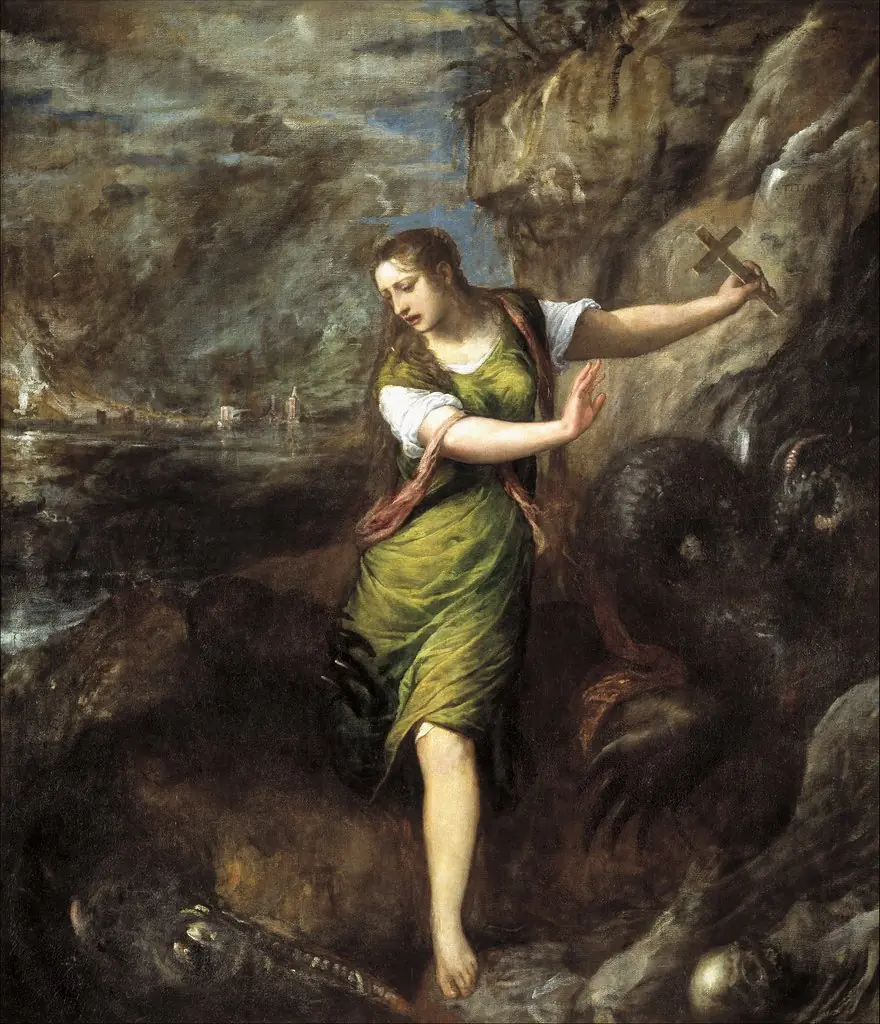
Saint Margaret and the Dragon is an oil painting by the High Renaissance artist Raphael. It dates from 1518 and is held in the collection of the Kunsthistorisches Museum.
About this work
Subject & Meaning
The dragon, shown with its mouth open and tail coiled on the ground, symbolizes the demon that attempted to devour her during her martyrdom.
The painting depicts Saint Margaret of Antioch at the moment before she is swallowed alive by a dragon, representing the devil or Satan. She is portrayed as unafraid, holding a crucifix which, according to legend, will save her once she is ingested. The dragon, shown with its mouth open and tail coiled on the ground, symbolizes the demon that attempted to devour her during her martyrdom. In some accounts referenced by the work's iconography, the saint triumphs by bursting from the creature's belly, while other traditions show her trampling the beast. The setting is a rocky crevice at the edge of a forest, emphasizing her isolation during this spiritual trial. A golden halo identifies her sanctity, and her gaze is fixed upon the monster she is about to confront.
Technique & Style
The Vienna version of *Saint Margaret and the Dragon* is an oil painting executed on an oak panel, measuring 178 cm in height and 122 cm in width. While the preparatory drawing is attributed to Raphael, the physical execution is largely credited to his disciple Giulio Romano, reflecting the workshop practices of the High Renaissance. The composition depicts the saint in a narrow, brown-toned ravine with a glimpse of blue sky, standing defiantly before the open mouth of a coiled dragon. She wears a form-fitting blue garment and holds a red cloth and a crucifix, her gaze fixed on the beast at her feet. A fine golden halo crowns her head, which is partially covered by a coif. The painting documents a moment of impending martyrdom, contrasting the saint's calm demeanor with the chaotic form of the dragon.
History & Provenance
The Saint Margaret and the Dragon now in the Kunsthistorisches Museum was commissioned around 1518 by Pope Leo X for Marguerite d’Angoulême (source 4). The preparatory drawing is attributed to Raphael, while the painting’s execution has been ascribed to his pupil Giulio Romano (sources 4,5). Dated to circa 1518, the work first entered the collection of the abbot of San Benedetto in Venice; it is recorded in 1528 in the hands of Zuanantonio Venier (source 6). By 1638 it had passed to the English lord Hamilton and then joined the Brussels collection of Archduke Leopold Wilhelm of Austria, where it was documented in David Teniers the Younger’s Theatrum Pictorium of 1659 and 1673 (sources 2,3,5,6). The painting subsequently entered the Kunsthistorisches Museum, Vienna, where it remains today (sources 2,3,5).
The Vienna version of Saint Margaret and the Dragon is held in the collection of the Kunsthistorisches Museum in Vienna. Its provenance traces back to the collection of Archduke Leopold Wilhelm of Austria in Brussels, where it held a preeminent place. The painting was documented in David Teniers the Younger's Theatrum Pictorium catalog of the Archduke's collection in 1659 and again in 1673. Teniers also depicted the painting in several portraits of the Archduke's collection, and produced a reduced copy for the engraving in the Theatrum Pictorium.
A second version of the composition, showing Saint Margaret holding a palm branch, is held in the collection of the Louvre in Paris.
Context
Painted around 1518 during Raphael's final years, *Saint Margaret and the Dragon* reflects the High Renaissance movement and the enduring medieval popularity of Saint Margaret of Antioch. While traditionally attributed to Raphael, modern scholarship often assigns the preparatory drawing to the master and the execution to his disciple Giulio Romano, with some critics noting influences from Leonardo da Vinci's *Leda*. The work's art-historical significance is anchored by its prominent presence in Archduke Leopold Wilhelm's collection, where it was featured in David Teniers the Younger's *Theatrum Pictorium* and depicted in portraits as a prized piece covered by a curtain. Although 19th-century critics frequently questioned its autograph status, favoring the Louvre version or assigning it to Giulio Romano alone, the Vienna painting remains a key example of Raphael's workshop production and the transmission of his designs.
Legacy
The painting occupied a place of preeminence within the Archduke Leopold Wilhelm's collection in Brussels, a status reflected in David Teniers the Younger's portraits of that gallery. In Teniers' depiction now in the Prado, the Raphael canvas appears in the foreground as the closest painting to the Archduke and the only one veiled by a cloth, a convention reserved for the most prized works. Teniers also produced a reduced copy, now in Glasgow, which served as a model for Jan van Troyen's engraving included in the Theatrum Pictorium, the 1660 publication that publicized the Archduke's Italian holdings.
Despite this earlier prestige, nineteenth-century critics questioned Raphael's authorship and generally reassigned the execution to Giulio Romano, sometimes in collaboration with Luca Penni. Jean-Pierre Cuzin, who favored the Louvre version, attributed only the preparatory drawing to Raphael while noting influences from Leonardo's Leda.
Artist & collection
Artist
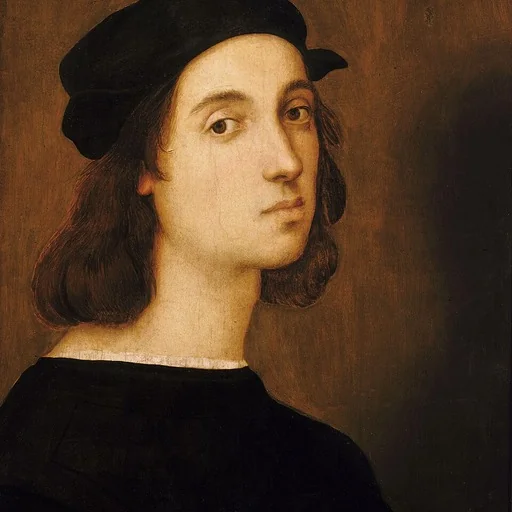
Raphael was born Raffaello Sanzio in Urbino on April 6, 1483, the son of Giovanni Santi, a painter and poet attached to the ducal court.