Artwork
Saint Margaret and the Dragon
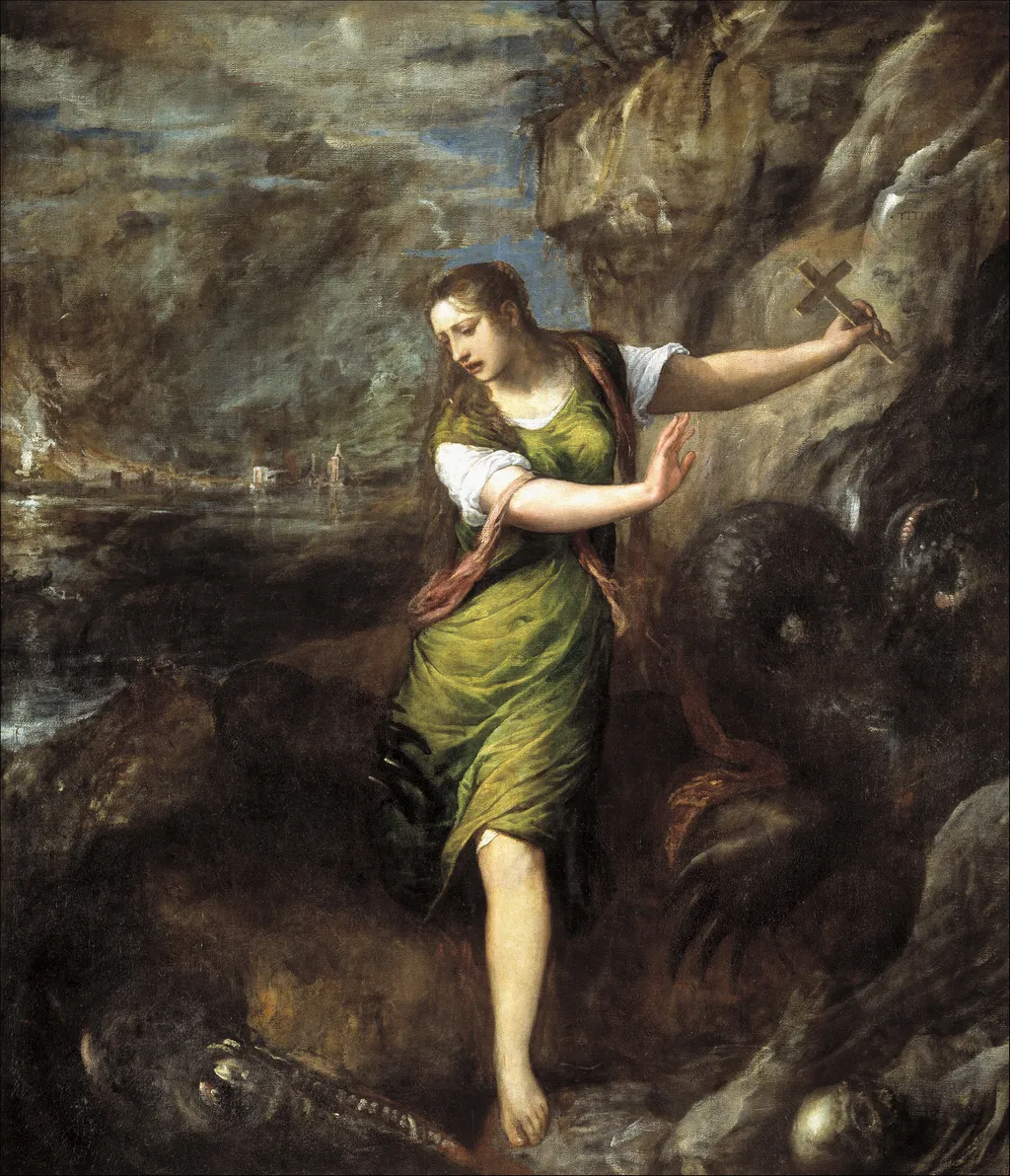
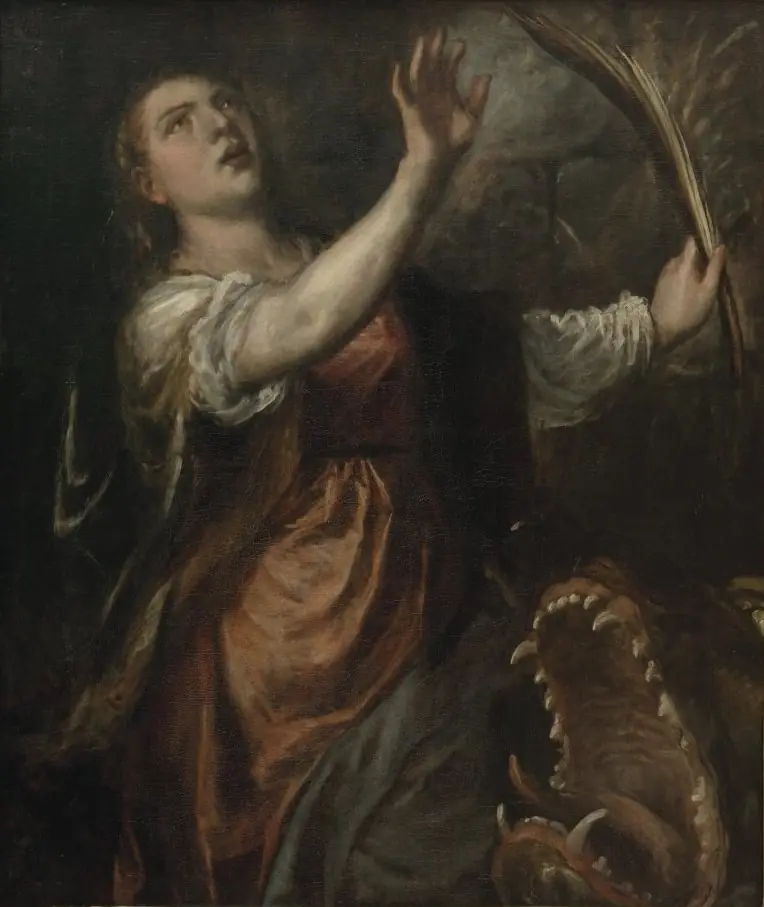
Saint Margaret and the Dragon is an oil painting by the Mannerist artist Titian. It dates from 1565 and is held in the collection of the Museo del Prado.
About this work
Subject & Meaning
The painting illustrates the legend of Margaret of Antioch, depicting the saint alongside a dragon and a Christian cross.
The painting illustrates the legend of Margaret of Antioch, depicting the saint alongside a dragon and a Christian cross. According to art historian Erwin Panofsky, Titian's composition drew on Giulio Romano's treatment of the same subject, while the saint's dynamic pose was modeled on the "avenging Orestes" figure from a Roman sarcophagus panel at the Vatican.
Panofsky further observed that Titian's mature style achieved a "coexistence of opposites", abundance and discipline, passion and severity, rendering the saint in a moss-green robe against a landscape of browns and reds devoid of green. A skull in the lower right corner, a motif more typical of Saint George iconography, signals the medieval fusion of Margaret's legend with that of Martha of Bethany, who tradition holds confronted a dragon called the Tarasque. The burning city in the background, sometimes identified as Venice, alludes to the dragon's devastation of towns.
Technique & Style
Saint Margaret and the Dragon is an oil on canvas painting by Titian. The Prado version measures 213 cm in height (of which 31 cm is an addition made to the upper edge of the original) and 211 cm in width, while the earlier Escorial version measures 210 × 170 cm. Erwin Panofsky, describing the Prado canvas, observed that it represents a figure in a moss-green tunic set against a landscape background rendered in every possible shade of brown and red, but without a trace of green, a deliberate disruption of normal color relationships.
Panofsky further characterized Titian's late style in this work as a "coexistence of opposites": abundance and discipline, passion and severity, distinguishing it from his earlier, more plastic and sinuous manner. He noted that the saint's pose was modeled on the "avenging" Orestes from a Roman sarcophagus panel in the Vatican, and that Giulio Romano's treatment of the same subject likely inspired the composition.
History & Provenance
A first version of the composition was commissioned by Prince Philip of Spain and delivered in 1552; it entered the collection of the Royal Monastery of San Lorenzo de El Escorial, where it remains.
The second, more widely recognized version, signed “Titianus”, was completed between 1560 and 1565 and has been in the Museo del Prado, Madrid, since at least the early nineteenth century. It measures 213 cm in height (including a 31 cm later addition at the top) and 211 cm in width. A letter by Titian confirms the 1552 delivery, while traditional art-historical assessment places the Prado painting circa 1565.
Two authenticated versions of Titian's Saint Margaret and the Dragon are held in Spain. The first, delivered to Prince Philip in 1552, resides at the Royal Monastery of San Lorenzo de El Escorial with dimensions of 210 cm by 170 cm. The second, more renowned version is located in the Museo del Prado in Madrid; it measures 213 cm in height (including a 31 cm upper addition) and 211 cm in width, and bears the signature "Titianus."
A third version, stylistically similar to the Prado work and measuring 198 cm by 168 cm, is held in a private collection in Kreuzlingen, Switzerland. In 2018, a version of the painting was sold at Sotheby's auction for $2,175,000. No specific accession numbers or detailed exhibition histories are provided in the available records.
Context
Within Titian's late production, the Prado Saint Margaret and the Dragon is regarded as a culminating example of his mature style. Erwin Panofsky praised it as a "marvellous" work in which the painter achieved a "coexistence of opposites", abundance and discipline, passion and severity, that distinguished it from his earlier, more plastic and sinuous manner. Panofsky argued that Titian drew inspiration from Giulio Romano's treatment of the same subject and modelled the saint's pose on the "avenging" Orestes of a Roman sarcophagus in the Vatican.
He also read the skull in the lower right corner and the burning city in the background as iconographic references linking Margaret's legend with that of Martha and the Tarasque dragon.
The painting belongs to the Venetian school and is held in the Museo del Prado in Madrid, where it was preceded by an earlier version delivered in 1552 to Prince Philip, later Philip II of Spain, now at El Escorial. A third, closely related version in the Heinz Kisters collection in Kreuzlingen, Switzerland, has been attributed to the master by some experts since the 1950s. The work features in Paul Veyne's Mon musée imaginaire, underscoring its lasting place in the art-historical imagination.
Legacy
The legacy of Saint Margaret and the Dragon stems from its multiple authenticated versions and scholarly attention to their stylistic and historical significance. The earliest version, documented in a 1552 letter from Titian to Prince Philip (later Philip II), was delivered to the future monarch and initially housed at the Royal Monastery of San Lorenzo de El Escorial. A second, larger version signed Titianus, measuring 2.13 meters in height with a 31 cm upper border addition, was completed between 1560 and 1565 and now resides in the Museo del Prado.
This version, noted for its innovative use of color and complex composition, influenced later interpretations, including Panofsky's observation of its departure from earlier stylistic norms. A third version, stylistically close to the Prado painting, entered private ownership and was later attributed to Titian in the 1950s, now held in a Swiss collection. The work's significance was further amplified when a version sold at Sotheby's in 2018 for $2,175,000, underscoring its market and cultural resonance.
Scholarship on the painting, including contributions by Panofsky and Gentili, emphasizes its role in the evolution of Titian's style and its representation of Renaissance iconography, particularly through its integration of narrative elements like the dragon motif and symbolic landscape.
Overview
Created around 1559, this oil on canvas by Titian portrays the legendary Saint Margaret confronting a dragon. The composition places the saint on a rocky outcrop, clutching a cross, while a looming, dark-scaled creature dominates the background, its presence casting a shadow over a distant waterfront settlement. The work is part of the Prado Museum’s collection in Madrid.
Own this work as a print
Artist & collection
Artist
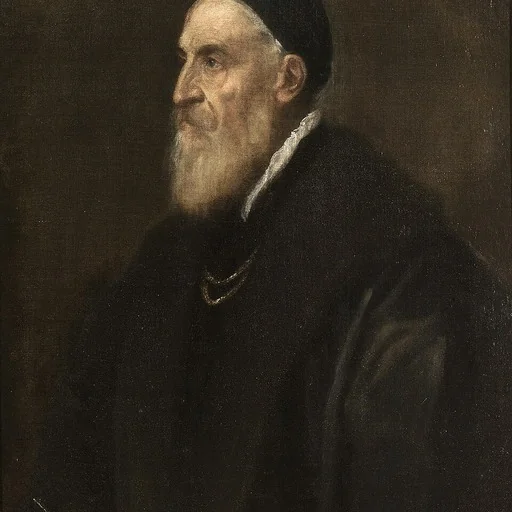
Tiziano Vecellio (Italian:; c. 1488/1490 – 27 August 1576), Latinized as Titianus, hence known in English as Titian ( TISH-ən), was an Italian Renaissance painter. The most important artist of Renaissance Venetian…