Artwork
Ahasuerus and Haman at the Feast of Esther
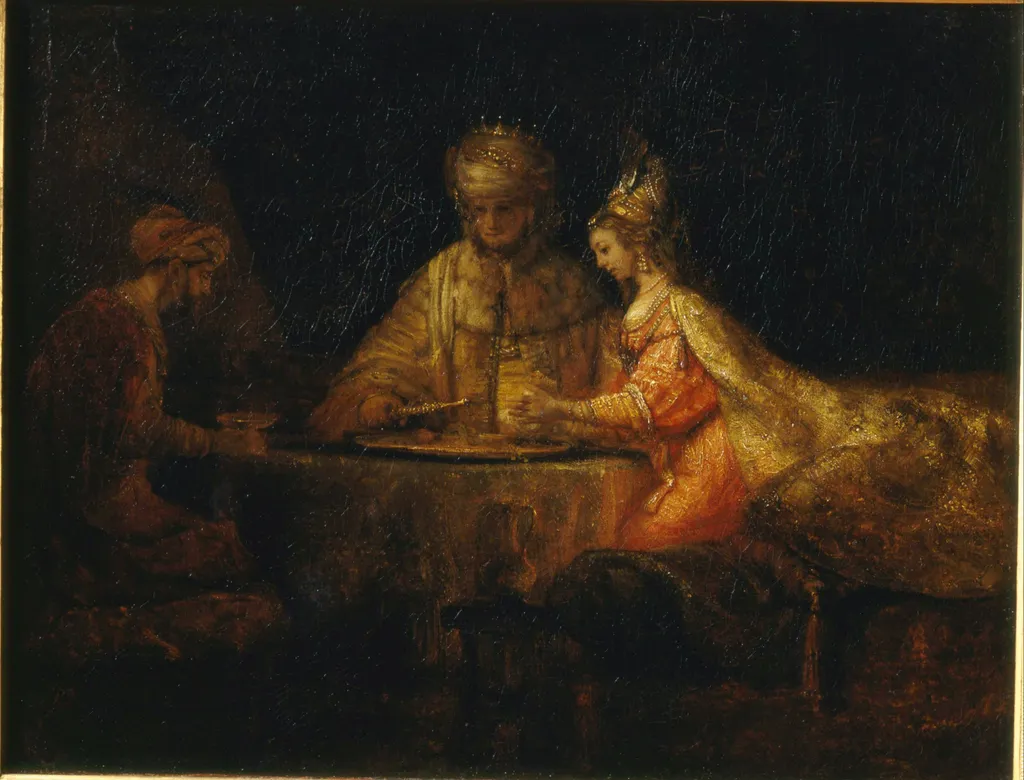
Ahasuerus and Haman at the Feast of Esther is an oil painting by the Dutch Golden Age artist Rembrandt van Rijn. It dates from 1660 and is held in the collection of the Pushkin Museum of Fine Arts.
About this work
Subject & Meaning
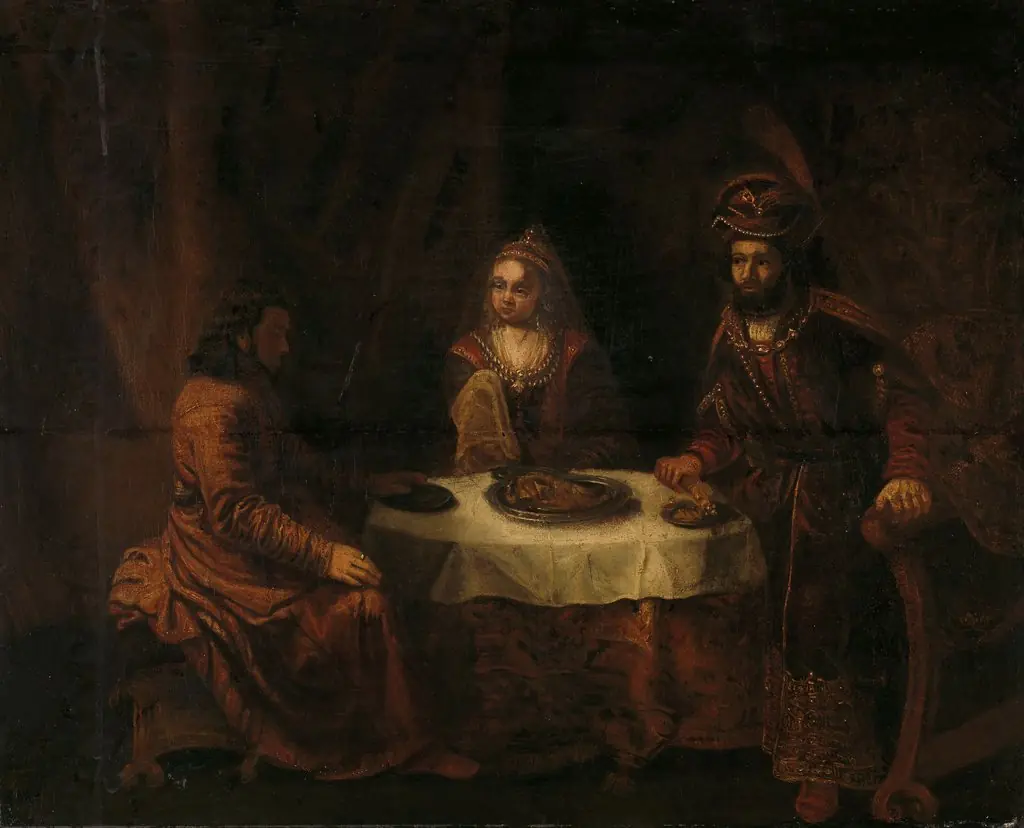
The visual gulf between king and vizier, contrasted with the united pairing of king and queen, reinforces Esther's moral triumph.
The painting depicts an episode from chapters 5 through 7 of the Old Testament Book of Esther, in which Esther, the Jewish queen of the Persian king Ahasuerus, reveals the plot of his vizier Haman to annihilate the Jewish people. Rembrandt concentrates the drama on the three figures at the feast: Esther lowers her arms apprehensively after finishing her accusation, Ahasuerus sits with pursed lips of anger, and Haman is overcome with a sense of doom. The visual gulf between king and vizier, contrasted with the united pairing of king and queen, reinforces Esther's moral triumph.
Iconography is shaped by Rembrandt's signature chiaroscuro. Esther is the most luminous figure, her gleaming robe suggesting precious stones, while Haman is immersed in shadow, staring into his wine cup, a pictorial exile that marks him as the villain. The restrained yet eloquent gestures of the three figures create a tense atmosphere of suspense, expressing their inner spiritual states through light and posture alone.
The subject of Esther's deliverance of the Jews is still celebrated in the Jewish festival of Purim, where Haman is remembered as the archetypal enemy, and Rembrandt's depiction reflects that tradition.
Technique & Style
Created in 1660, this work is an oil painting executed on canvas. The composition relies heavily on a marked chiaroscuro technique to establish a tense atmosphere and reveal the inner psychological states of the three figures. Light is strategically employed to illuminate Esther, whose vermillion dress and golden cloak appear radiant and gleaming as if studded with precious stones.
In contrast, the king is positioned slightly further back with reduced luminosity, while Haman is largely submerged in shadow to signify his doom and hidden regret. The banquet setting itself is rendered sketchily, serving primarily as a backdrop for the dramatic conflict expressed through restrained, eloquent gestures. The artist achieves significant depth in depicting the spiritual energy of the characters through these subtle handling of light and shadow.
History & Provenance
The work was painted by Rembrandt in 1660 and depicts a scene from the Book of Esther. After its completion it entered the collection of Jan Jacobsz. Hinlopen, who owned it until his death in 1666.
Following Hinlopen's death the painting passed to his daughter Sara Hinlopen, who later bequeathed it to Nicolaes Geelvinck. In 1764 it was acquired by Catherine the Great through the intermediary Johann Ernst Gotzkowsky, entering the Hermitage collection. The work was subsequently moved to the Museum Rumyantsev in 1862 and has been on display at the Pushkin Museum of Fine Arts in Moscow since 1924.
Its provenance is fully documented from the artist’s sale to Hinlopen through successive owners to its present location.
The painting is held by the Pushkin Museum of Fine Arts in Moscow, where it has been since 1924. It is displayed in Room 10.
Earlier, the work was part of the Hermitage collection after Catherine the Great acquired it in 1764, likely through the German entrepreneur Johann Ernst Gotzkowsky. In 1862 it was transferred to the Rumyantsev Museum in Moscow, remaining there until its move to the Pushkin Museum.
Context
Critical reception of Rembrandt’s Ahasuerus and Haman at the Feast of Esther emphasizes its psychological depth and mastery of chiaroscuro, with scholars noting the restrained gestures that convey tension among the three figures. The painting is regarded as a pinnacle of Rembrandt’s late period, celebrated for its spiritual energy and nuanced portrayal of Esther’s radiance against Haman’s shadowed despair. Scholarship situates the work within Dutch Golden Age painting and highlights its unique provenance, being one of the few Rembrandt works with a fully documented ownership history from 1662 onward.
The painting’s place in art history is reinforced by its reflection of contemporary Jewish themes, particularly the Purim narrative, and its influence on later artistic discourse, as evidenced by references in 17th-century poetry and 18th-century art historical accounts.
The work’s reception has been shaped by its dramatic composition and psychological realism, with the Pushkin Museum identifying it as one of Rembrandt’s finest late creations. The dramatic conflict expressed through gestures and lighting underscores the spiritual dimensions of the Esther story, aligning with scholarly analyses of Rembrandt’s engagement with biblical subjects.
Legacy
Rembrandt’s late painting was recognized in its own time: the poet Jan Vos included a verse in 1662 that reads the king’s rage and Haman’s inner torment, and Arnold Houbraken later reproduced the poem in his 1719 Rembrandt biography, preserving the work’s dramatic reputation across generations. By the mid-eighteenth century the canvas entered Catherine the Great’s holdings via Gotzkowsky and became part of the nucleus of the future Hermitage, anchoring its status among the tsarina’s key Dutch acquisitions. After transfer to the Rumyantsev Museum in 1862 and its move to the Pushkin Museum in 1924, the painting has remained a touchstone of Rembrandt’s late oeuvre, cited by the Pushkin as one of his finest late works for its psychological depth and restrained yet eloquent figuration.
Overview
Rembrandt’s oil painting titled Ahasuerus and Haman at the Feast of Esther presents a dimly lit banquet scene with three central figures. The king, crowned and fur‑trimmed, leans over a ledger; beside him sits Esther in a gold dress, her gaze directed downward; a third figure, Haman, stands behind them in darker attire, his head bowed. The composition isolates the trio against a shadowy backdrop, emphasizing their emotional tension.
Own this work as a print
Artist & collection

Artist
Rembrandt Harmenszoon van Rijn, known mononymously as Rembrandt, was a Dutch Golden Age painter, printmaker, and draughtsman.