Artwork
Flora
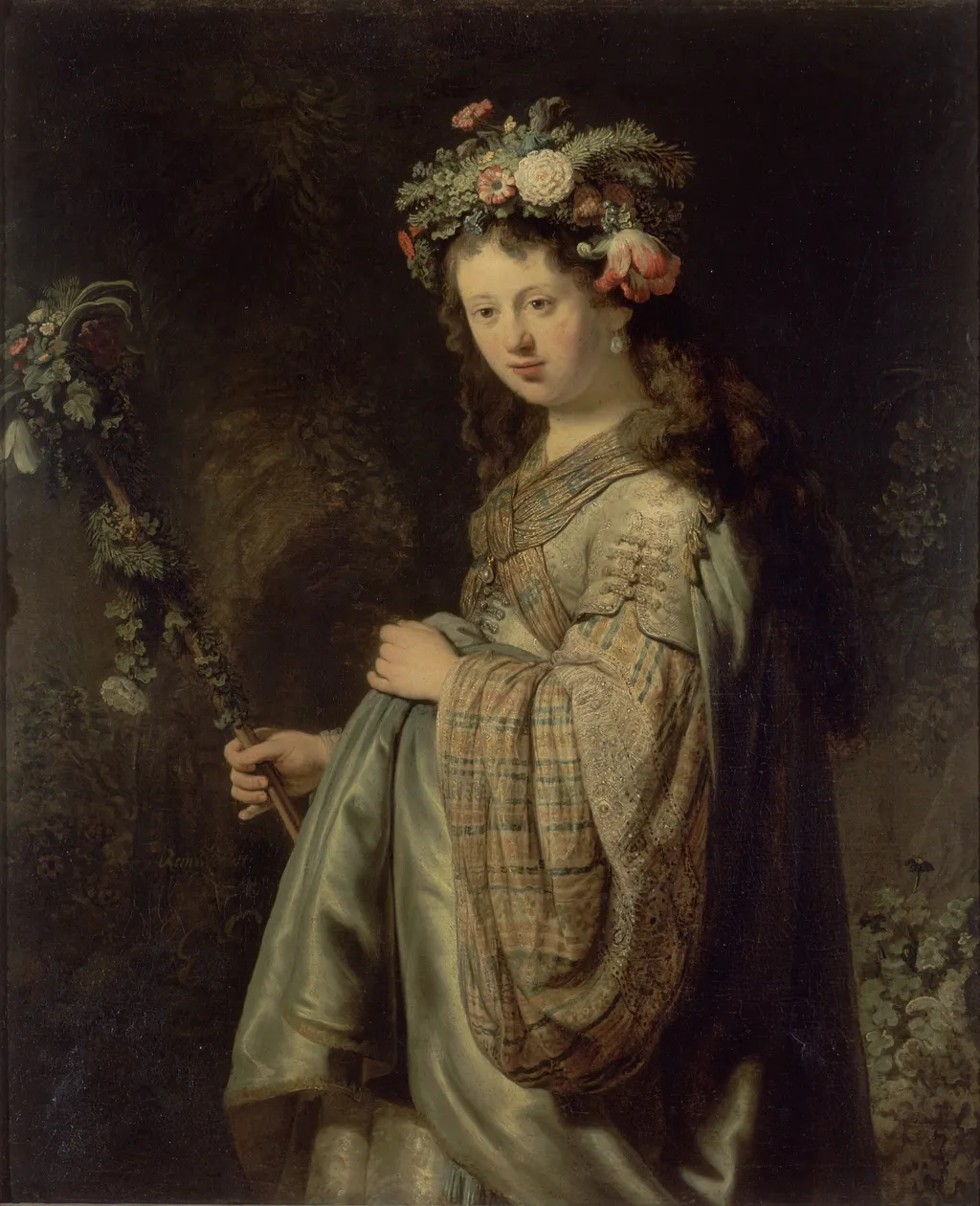
Flora is an oil painting by the Dutch Golden Age artist Rembrandt van Rijn. It dates from 1634 and is held in the collection of the Hermitage Museum.
About this work
Subject & Meaning
The identification of the sitter as Saskia is widely accepted, though the Rembrandt Research Project has expressed reservations about the resemblance.
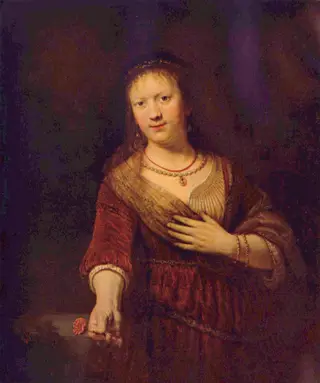
The painting depicts Rembrandt's wife Saskia van Uylenburgh in the guise of Flora, the Roman goddess of spring and flowers, painted in the year of their marriage. The identification rests on the lavish floral attributes that mark the figure unmistakably as Flora: a wreath of flowers in her long hair, including a multicoloured "broken" tulip, and a staff decorated with leaves and blossoms held in her hand.
She stands in a dark grotto, gazing toward the viewer, dressed in an opulent costume of silk and satin with silver embroidery, long hanging sleeves, a blue mantle, and a large pearl earring. The contrast between the brightly lit figure and the shadowy background draws attention to her face.
The work belongs to a series of mythological character portraits Rembrandt made of Saskia, alongside depictions of her as Bellona and Minerva. The identification of the sitter as Saskia is widely accepted, though the Rembrandt Research Project has expressed reservations about the resemblance.
Technique & Style
Rembrandt executed Flora as an oil‑on‑canvas portrait, measuring roughly 125 × 101 cm, on a canvas support typical of Dutch Golden Age easel painting. He applied thin, translucent layers of oil paint to model Saskia’s flesh and drapery, using chiaroscuro to accentuate the pearl earring and the silver embroidery on her blue mantle. The work is signed and dated Rembrandt f (...)
34 in the lower right, indicating contemporary handling of the wet paint. Stylistically, the composition draws on Titian’s Flora, evident in the floral headdress, multicoloured tulip, and the figure’s poised stance within a dark grotto, while the opulent costume and delicate brushwork convey both intimacy and allegorical grandeur.
History & Provenance
Flora was painted in 1634 in Amsterdam shortly after Rembrandt’s marriage to Saskia van Uylenburgh, depicting her as the Roman goddess of spring. The work is an oil‑on‑canvas portrait measuring about 125 × 101 cm and is signed “Rembrandt f. 1634” on the lower right.
Its early ownership is unclear, but it appeared in an Amsterdam sale of Herman Aarentz’s estate in 1770, was purchased for 2600 florins, and acquired by Catherine II for the Hermitage collection before 1774.
The painting has remained in the Hermitage ever since, with a temporary loan to the Amsterdam branch in 2017.
The painting is held in the collection of the Hermitage Museum in St. Petersburg, where it is displayed in hall 254 (the Rembrandt hall). The sources do not provide an inventory or accession number for the work, but they note that it entered the Hermitage before 1774 and remains there. Its exhibition history includes a loan to the H'ART museum in Amsterdam in 2017 and inclusion in the "Dutch masters from the Hermitage" exhibition.
Context
Painted in 1634, the year of Rembrandt's marriage to Saskia van Uylenburgh, Flora belongs to a cluster of mythological character portraits (tronies) through which the young artist explored female archetypes. The work is one of several paintings in which Rembrandt depicted Saskia as the Roman goddess of spring, alongside later variants held by the National Gallery, London (1635), and the Gemäldegalerie Alte Meister, Dresden (1641). The Rembrandt Research Project expressed reservations in its 1986 corpus about whether the sitter is actually Saskia, though proponents cite facial similarities with a 1633 drawing and the London portrait.
The painting also connects to Rembrandt's broader practice of casting intimate subjects as mythological figures, seen in contemporaneous works such as Bellona (1633) and Minerva (1635). Hofstede de Groot's 1915 catalogue documented the work, noting it had been erroneously titled "The Jewish Bride." Its acquisition by Catherine II for the imperial collection before 1774 secured its place among the Hermitage's foundational Dutch holdings.
Overview
Rembrandt's 1634 oil-on-canvas painting, titled Flora, portrays the artist's wife, Saskia van Uylenburgh, in the guise of the Roman goddess of spring. This work is part of a series of portraits where Rembrandt depicted Saskia in various mythological or historical roles. The painting is currently housed in the collection of the Hermitage Museum in St. Petersburg, Russia, offering a glimpse into Rembrandt's personal life and artistic practice during this period.
Own this work as a print
Artist & collection

Artist
Rembrandt Harmenszoon van Rijn, known mononymously as Rembrandt, was a Dutch Golden Age painter, printmaker, and draughtsman.



 Heroine from the Old Testament
 Moses ter Borch Holding a Kolf Stick
 Portrait of a Young Woman
 Portrait of a Young Woman
 Saskia as Flora
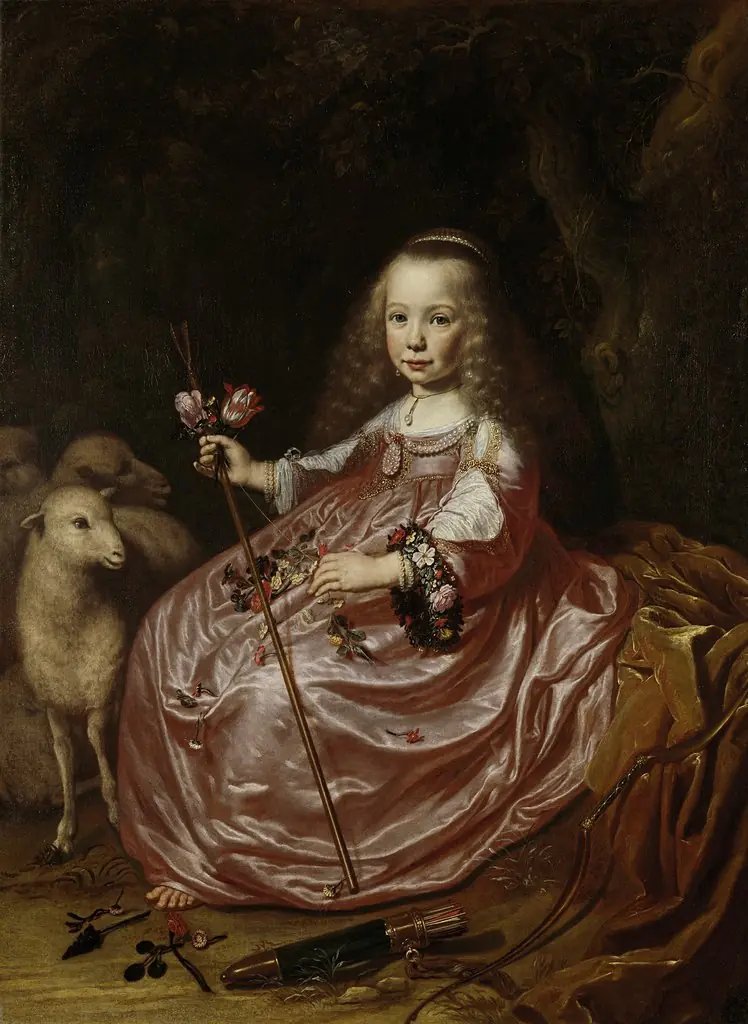 Clara Alewijn (1635-74). Daughter of Abraham Alewijn and Geertruid Hooftman
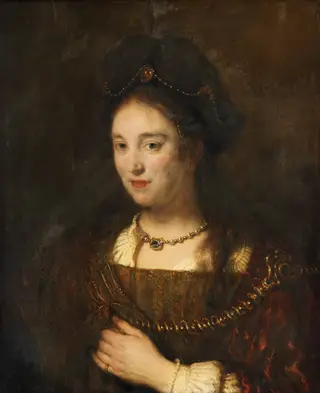 Half-figure of a woman with a beret
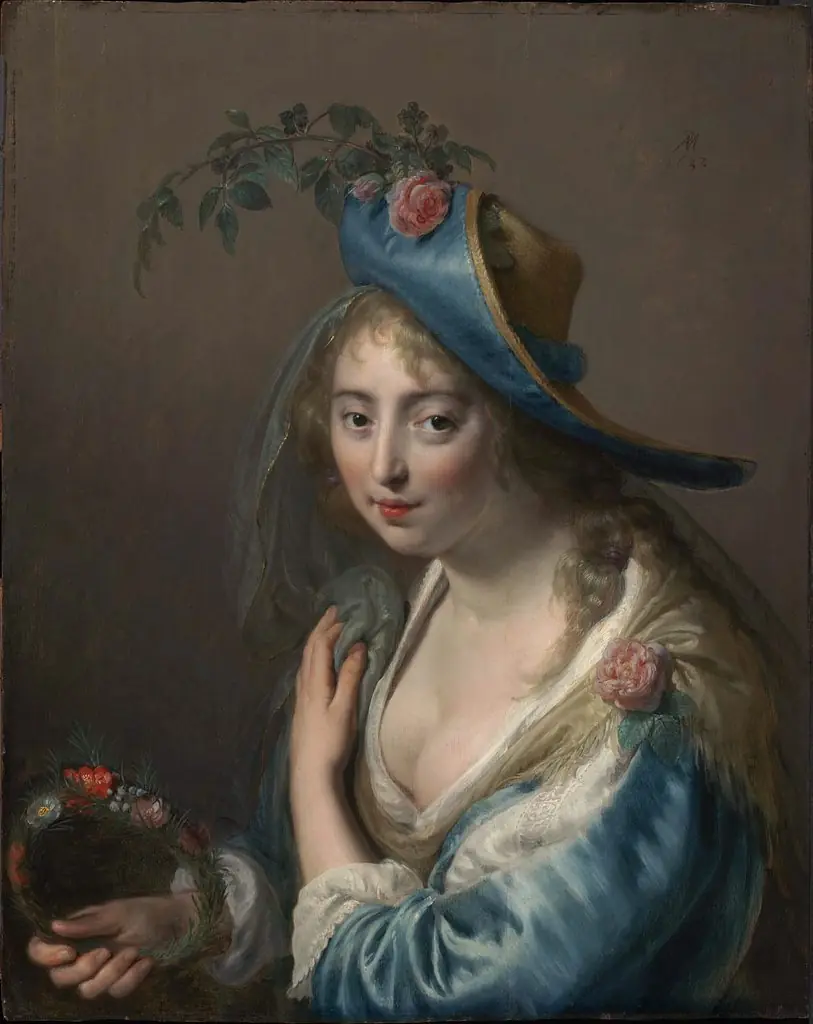 Portrait of a Young Woman as Flora
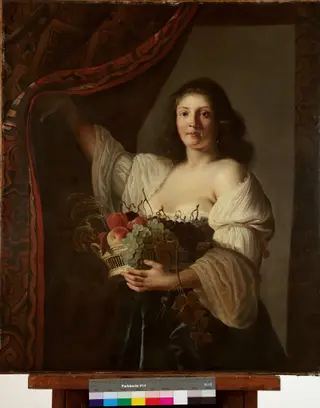 Junge Frau mit Früchtekorb