Artwork
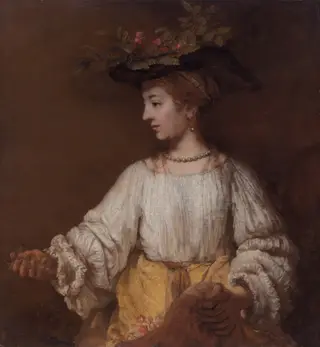
Saskia as Flora
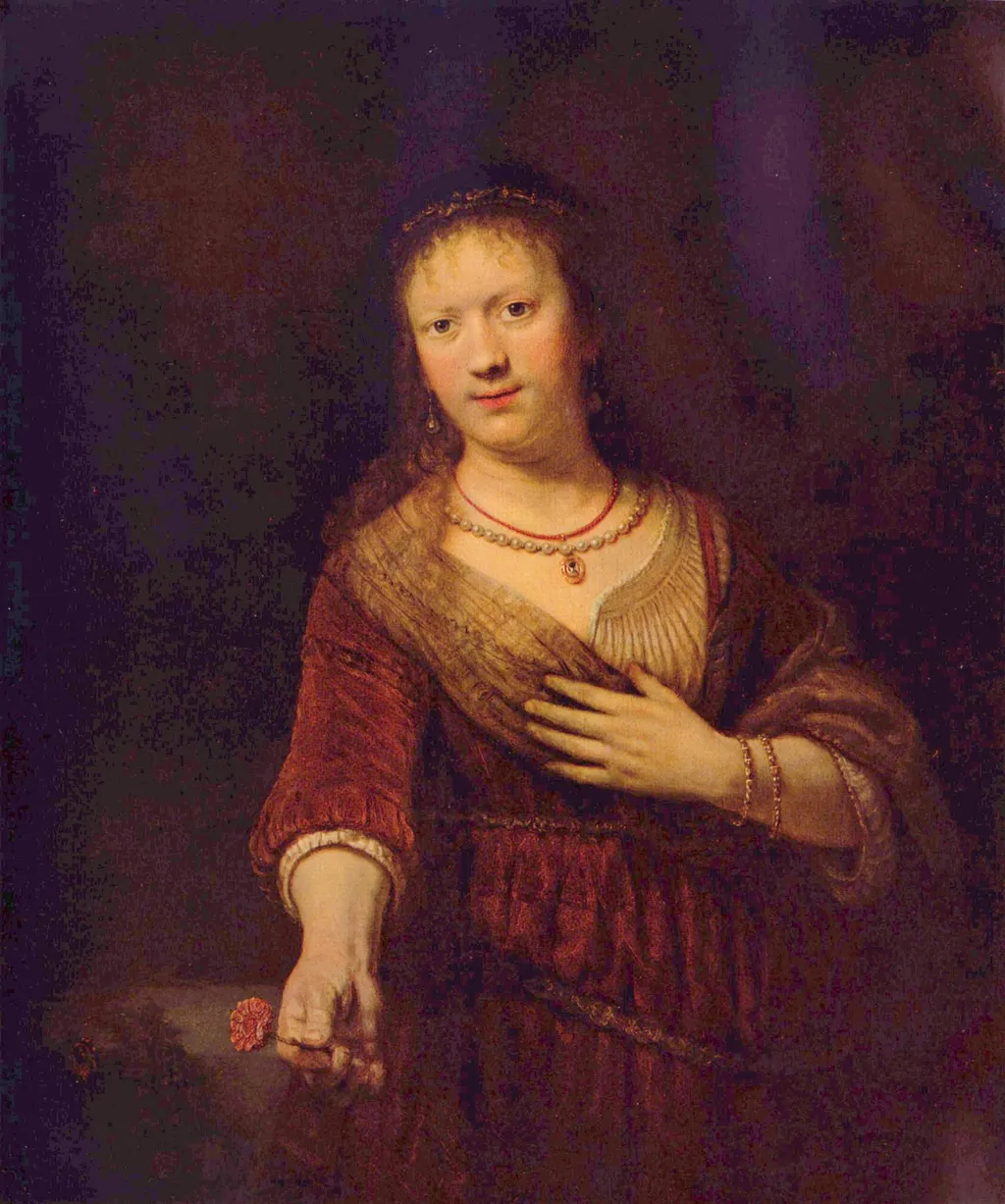
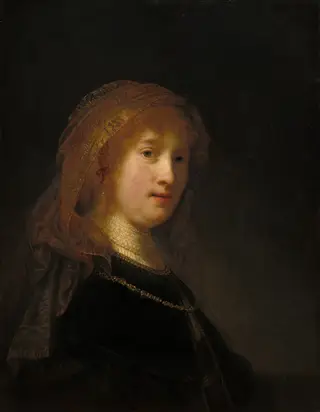
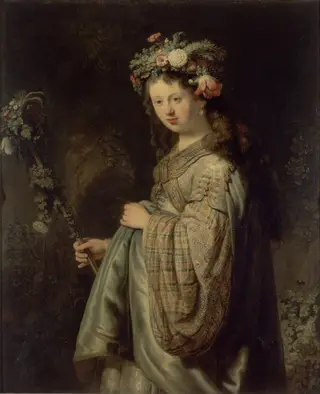
Saskia as Flora is an oil painting by the Dutch Golden Age artist Rembrandt van Rijn. It dates from 1641 and is held in the collection of the Staatliche Kunstsammlungen Dresden.
About this work
Rembrandt painted this portrait of his wife, Saskia, in 1641. It shows her dressed as Flora, the Roman goddess of flowers. The oil paint brings her face and dress to life.
This isn’t just a pretty picture. Rembrandt and Saskia were married in real life. He often painted her, making this a rare glimpse of his personal world.
Look up Rembrandt to see more of his work.
Subject & Meaning
In this 1641 painting, Saskia is shown holding a flower, likely a carnation, while wearing a dress with a décolletage, a necklace, a bracelet, and an earring.
The work depicts Rembrandt's wife, Saskia van Uylenburgh, portrayed as Flora, the Roman goddess of spring and flowers. In this 1641 painting, Saskia is shown holding a flower, likely a carnation, while wearing a dress with a décolletage, a necklace, a bracelet, and an earring. By dressing his wife in the attributes of Flora, Rembrandt merges a personal portrait with mythological allegory, presenting her not merely as a woman but as a personification of the season of spring and floral abundance.
The inclusion of the flower and classical attire transforms the domestic likeness into a symbolic representation of fertility and the fleeting beauty of life.
Technique & Style
The work is executed in oil paint on a wooden panel, measuring 98.5 centimeters in height and 82.5 centimeters in width. It depicts Saskia van Uylenburgh as the allegorical figure of Flora, adorned with a flower, a necklace, bracelet, earrings, and a partially open décolletage. The formal qualities combine a portrait-like rendering of the sitter with mythological symbolism, characteristic of Dutch Golden Age painting.
The handling of light and texture emphasizes the delicate rendering of fabric and floral detail, while the composition maintains a naturalistic yet idealized presence. The painting remains in its original support and has been preserved within the collection of the Gemäldegalerie Alte Meister in Dresden since its acquisition by Augustus III of Poland in 1742.
History & Provenance
The painting is currently housed in the Gemäldegalerie Alte Meister, part of the Staatliche Kunstsammlungen Dresden in Germany. Its provenance traces back to 1741, when it was owned by the Dutch nobleman Gerard Bicker van Zwieten and subsequently auctioned on April 12 of that year. In 1742, Augustus III of Poland acquired the work from the Araignon collection in Paris for his Kunstkammer in Dresden, where it remains today.
The provided sources detail this ownership history and current location but do not record specific exhibition histories for the work.
Context
Created in 1641, Saskia as Flora represents one of the final portraits Rembrandt painted of his wife, Saskia van Uylenburgh, before her death. The work synthesizes the genres of portraiture and mythological painting, depicting Saskia as the Roman goddess of flowers within the broader context of Dutch Golden Age art. Art historical scholarship identifies the piece as a significant example of Rembrandt's tendency to allegorize his wife, blending intimate domestic likeness with classical iconography.
The painting's provenance traces a path from the collection of Dutch nobleman Gerard Bicker van Zwieten to the Dresden Kunstkammer under Augustus III of Poland in 1742. Today, it is held in the Gemäldegalerie Alte Meister, where it stands as a key document of the artist's personal life and his integration of mythological themes into portraiture during the mid-17th century.
Legacy
The painting's legacy is anchored in its long‑term scholarly attention and institutional presence. After its 1741 auction by Gerard Bicker van Zwieten, it entered the collection of Augustus III of Poland and was installed in the Kunstkammer that later became the Gemäldegalerie Alte Meister in Dresden, where it remains on view. Its repeated identification with the allegorical figure Flora has inspired numerous art‑historical studies of Rembrandt’s portraiture and of Dutch Golden Age mythological portraiture, reinforcing its reputation as a key example of Rembrandt’s late portrait work.
Overview
Created in 1641, this oil on canvas portrays Saskia van Uylenburgh, the wife of the Dutch artist Rembrandt van Rijn. Depicted as the Roman goddess Flora, she holds a red carnation, a motif that underscores the work’s allegorical dimension. The painting is part of the collection of the Gemäldegalerie Alte Meister in Dresden, where it remains on display.
Own this work as a print
Artist & collection

Artist
Rembrandt Harmenszoon van Rijn, known mononymously as Rembrandt, was a Dutch Golden Age painter, printmaker, and draughtsman.