Artwork
John the Baptist Preaching
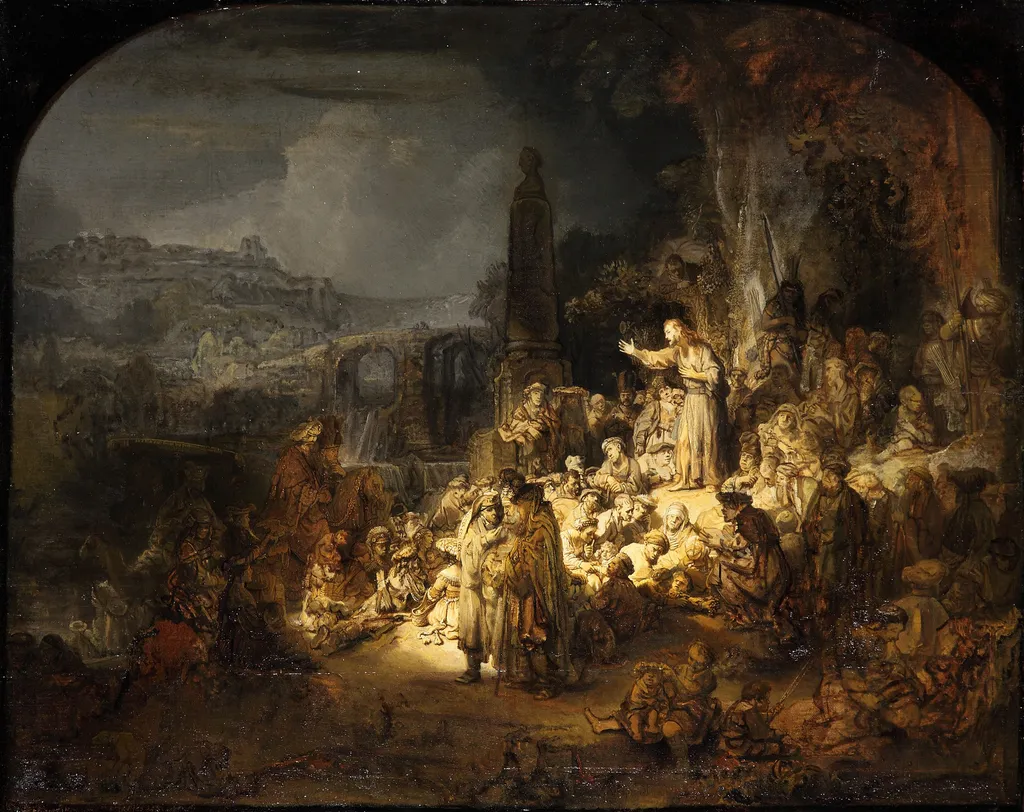
John the Baptist Preaching is an oil painting by the Dutch Golden Age artist Rembrandt van Rijn. It dates from 1635 and is held in the collection of the Gemäldegalerie Berlin.
About this work
Overview
John the Baptist Preaching is an oil painting by Rembrandt van Rijn, executed around 1634 and now held in the Gemäldegalerie, Berlin.
John the Baptist Preaching is an oil painting by Rembrandt van Rijn, executed around 1634 and now held in the Gemäldegalerie, Berlin. Measuring approximately 62 by 80 centimeters, the work exemplifies the artist's early biblical compositions, combining dramatic chiaroscuro with a densely populated narrative scene. It occupies a significant place in Rembrandt's oeuvre as one of his key religious paintings from the 1630s, a decade in which he established many of the compositional and lighting strategies that would define his mature style.
Technique & Style
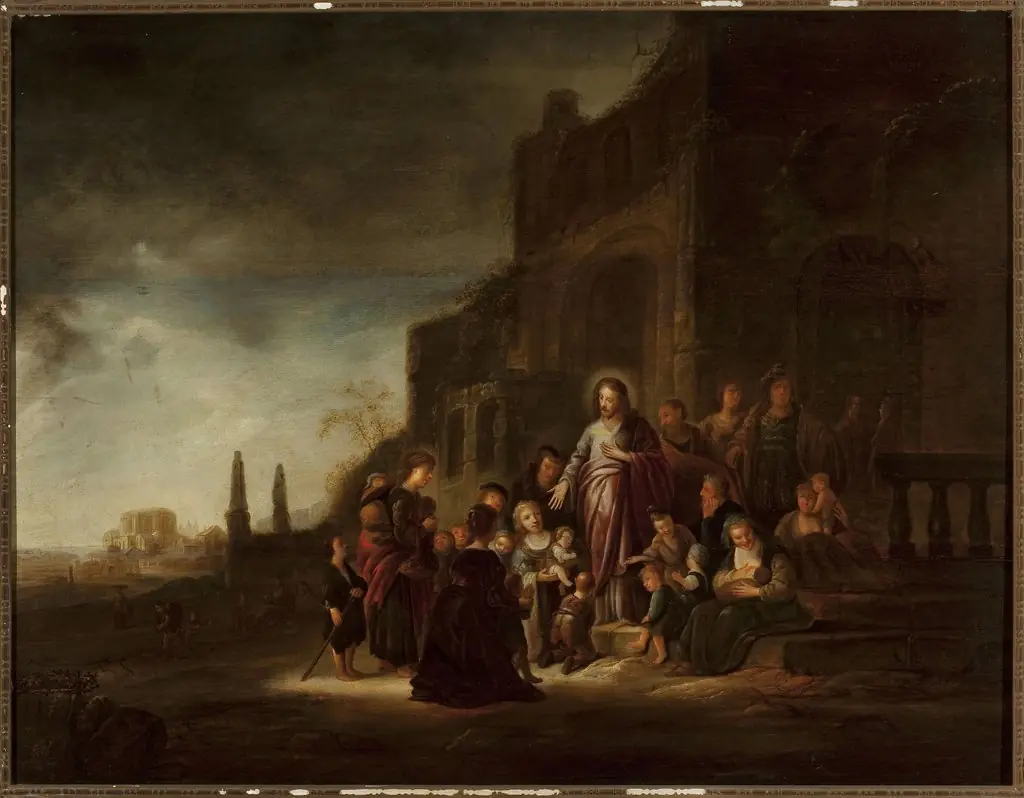
Rembrandt executed the work in oil on canvas, subsequently laid down on panel, with dimensions recorded variously as 62 x 80 cm, 62.7 x 82.1 cm, and 63 x 81.3 cm across sources. The painting exhibits the strong chiaroscuro characteristic of Rembrandt's Baroque manner, with the foreground and right side plunged in shadow while the preacher and immediate surrounding figures emerge into warm, concentrated light. The palette is dominated by deep browns, warm ochres, and muted greens, with the central figure rendered in brighter cream and white tones. Brushwork varies from thick, textured impasto in illuminated areas to thinner, more atmospheric handling in the background distances. The composition is arranged in a loose semicircle that draws the eye toward the illuminated preacher. The work has a rounded top edge, suggesting an arched or oval format.
History & Provenance
The painting is dated to 1634 by most sources, though some extend the range to 1634-1635. Its provenance includes notable collectors: Jan Six I, the Amsterdam patrician and Rembrandt's patron and friend, acquired the painting from the artist. Subsequent owners included Jan Six III, Jan Six van Hillegom, Bernard Coclers, Cardinal Joseph Fesch, Charles Lucien Bonaparte, William Ward, 1st Earl of Dudley, and the dealer Colnaghi. The work is now in the collection of the Gemäldegalerie, Berlin, as part of the Staatliche Museen. A later drawing by Rembrandt, dated circa 1655 and now in the Musée du Louvre, represents a study for a frame designed for the painting after its sale to Jan Six.
Context
The painting belongs to Rembrandt's prolific period of biblical production in the 1630s, when he was establishing himself in Amsterdam after his Leiden beginnings. During this decade, landscapes typically remained in the background of his biblical works, functioning as views punctuated by architectural elements. Scholarly assessment, as represented by the catalogue of Bredius (number 555), notes that these landscape backgrounds succeeded in varying measure at avoiding the appearance of mere backdrop. In this painting, the wilderness setting integrates more fully with the narrative: the countryside itself becomes part of John's message. Preparatory drawings connected with the composition attest to Rembrandt's working process. The work's acquisition by Jan Six I signals its place within the circle of Rembrandt's most sophisticated Amsterdam patrons.
Legacy
John the Baptist Preaching has maintained its position as a significant work within Rembrandt's early biblical corpus, preserved in one of Europe's major museum collections. The existence of the circa 1655 frame study in the Louvre provides unusual documentation of the artist's continued engagement with the painting's presentation long after its original execution. The work's passage through distinguished collections, from Jan Six to Cardinal Fesch and beyond, testifies to its sustained recognition. Its influence on subsequent approaches to biblical narrative painting lies in its successful integration of landscape and figure, and in its deployment of light as a dramatic and spiritual agent. The painting continues to be cited in Rembrandt scholarship and reproduced in comprehensive studies of the artist's career.
Own this work as a print
Artist & collection

Artist
Rembrandt Harmenszoon van Rijn, known mononymously as Rembrandt, was a Dutch Golden Age painter, printmaker, and draughtsman.