Artwork
Samson betrayed by Delilah
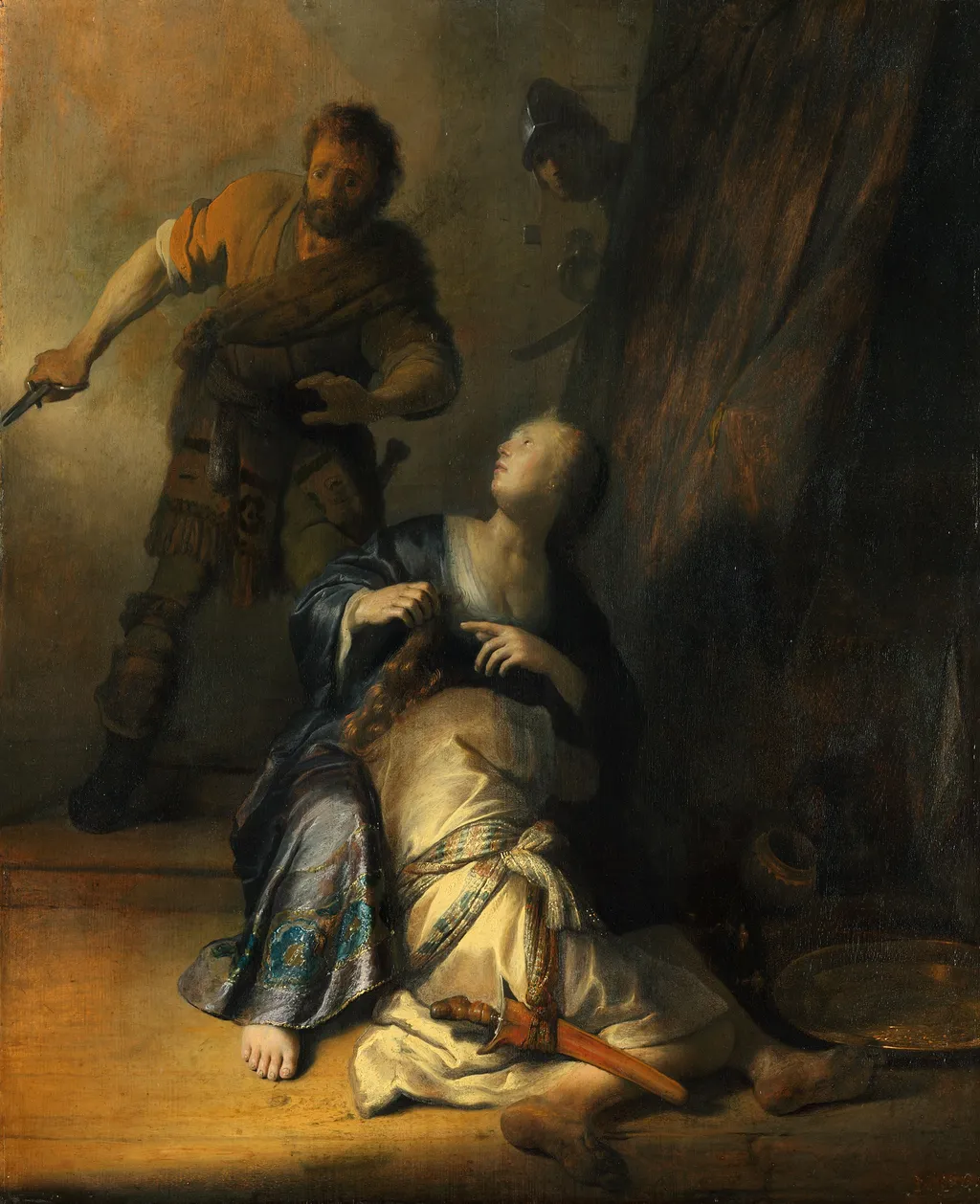
Samson betrayed by Delilah is an oil painting by the Dutch Golden Age artist Rembrandt van Rijn. It dates from 1628 and is held in the collection of the Gemäldegalerie Berlin.
About this work
Subject & Meaning
Its meaning extends to themes of trust violated and the inevitable downfall of a once‑mighty champion, reflecting Dutch Golden Age moral warnings.
The painting shows the biblical hero Samson moments before his betrayal by Delilah, a scene drawn from Judges. Rembrandt renders Samson seated, his head resting on Delilah’s lap while she signals the removal of his hair, the source of his divine strength. Two Philistine soldiers await in the shadows, emphasizing the treachery.
The work’s iconography, hair, sleep, and the hidden blade, symbolizes vulnerability and the loss of power through seduction. Its meaning extends to themes of trust violated and the inevitable downfall of a once‑mighty champion, reflecting Dutch Golden Age moral warnings.
Technique & Style
Samson betrayed by Delilah is executed in oil paint on a panel support. The work measures approximately 61.3 to 61.4 cm in height and 50.1 cm in width. Dated 1628 by the monogram 'RHL 1628' located in the lower left corner, the painting is stylistically attributed by some scholars to the period of 1629–1630.
The handling reflects the artist's early Leiden style, characterized by the depiction of a specific narrative moment where the sleeping Samson rests in Delilah's lap while a figure cuts his hair. Two Philistine accomplices appear in the background, with the foreground figure displaying a cut lock of hair to reassure Delilah. The composition focuses on the dramatic interaction between the figures and the impending betrayal.
History & Provenance
Samson betrayed by Delilah is a painting by Rembrandt, documented as early as 1628 and described as an oil work on panel. The work was first recorded in the collection of Frederick Henry of Orange‑Nassau and subsequently passed through the Orange family to Frederick I of Prussia, with Frederick the Great reportedly moving it to Berlin in 1742. It appears in an 1898 exhibition and was listed in the Berlin Stadtschloss inventory of 1793, attributed to Govert Flinck.
The painting entered the Gemäldegalerie, Berlin, in 1906. Stylistic analysis and a monogram ‘RHL 1628’ suggest a date around 1628–1630.
The painting is held by the Gemäldegalerie in Berlin, part of the Staatliche Museen zu Berlin, where it has been housed since 1906.
Its earlier provenance traces to the collection of Frederick Henry of Orange in The Hague, where it is first recorded in a 1632 inventory (entry 49, there attributed to Jan Lievens). It was later moved to Huis Honselaarsdijk, the Orange princely residence near Rijswijk, where it appears in a 1707 inventory (entry 39). Following the death of William III of Orange, the estate and its contents were bequeathed to Frederick I of Prussia. His heir Frederick the Great is thought to have transferred the painting to Berlin in 1742.
In 1793 it was listed in the inventory of the Berliner Stadtschloss, then attributed to Govert Flinck, where it remained until its 1906 transfer to the Gemäldegalerie. The painting was exhibited in 1898 in Amsterdam at "Rembrandt. Schilderijen bijeengebracht ter gelegenheid van de inhuldiging van Hare Majesteit Koningin Wilhelmina," held 8 September–31 October 1898.
Context
The painting Samson betrayed by Delilah is an oil on panel dated 1628 by Rembrandt, classified as a religious work within the Dutch Golden Age and now held in the Gemäldegalerie Berlin.
It first appears in the 1632 inventory of Frederick Henry of Orange, passed through the Orange family to Berlin, and was exhibited in the 1898 Queen Wilhelmina inauguration show; scholarly analysis questions its immediate attribution and proposes a date of 1629/1630.
The composition freezes the moment of betrayal, emphasizing psychological tension and biblical narrative, reflecting Rembrandt’s broader exploration of Old Testament subjects and his mastery of light and drama.
Legacy
The work entered the collection of Frederick Henry of Orange‑Nassau, where it was first documented in 1632, and later passed through the Orange family to Frederick I of Prussia; Frederick the Great is recorded as having transferred it to Berlin around 1742. It appeared in the 1793 inventory of the Berlin Stadtschloss, was displayed in a 1898 Rembrandt exhibition celebrating Queen Wilhelmina’s inauguration, and in 1906 was moved to the Gemäldegalerie of the Staatliche Museen zu Berlin, where it remains on public view. These provenance milestones and repeated exhibitions have contributed to its reputation as a cornerstone of Dutch Golden Age painting and a frequently cited example of Rembrandt’s biblical subjects.
Overview
Rembrandt's "Samson betrayed by Delilah," an oil painting from 1629–1630, captures a pivotal moment from the biblical narrative. It dramatically depicts Delilah cutting Samson's hair, the source of his strength, while a soldier waits in the background. The artwork is characterized by its warm palette and the artist's masterful use of light and shadow, which heighten the scene's emotional intensity and draw the viewer into the unfolding betrayal. The painting is currently housed in the Gemäldegalerie, Berlin.
Own this work as a print
Artist & collection

Artist
Rembrandt Harmenszoon van Rijn, known mononymously as Rembrandt, was a Dutch Golden Age painter, printmaker, and draughtsman.