Artwork
Joseph's Coat Brought to Jacob
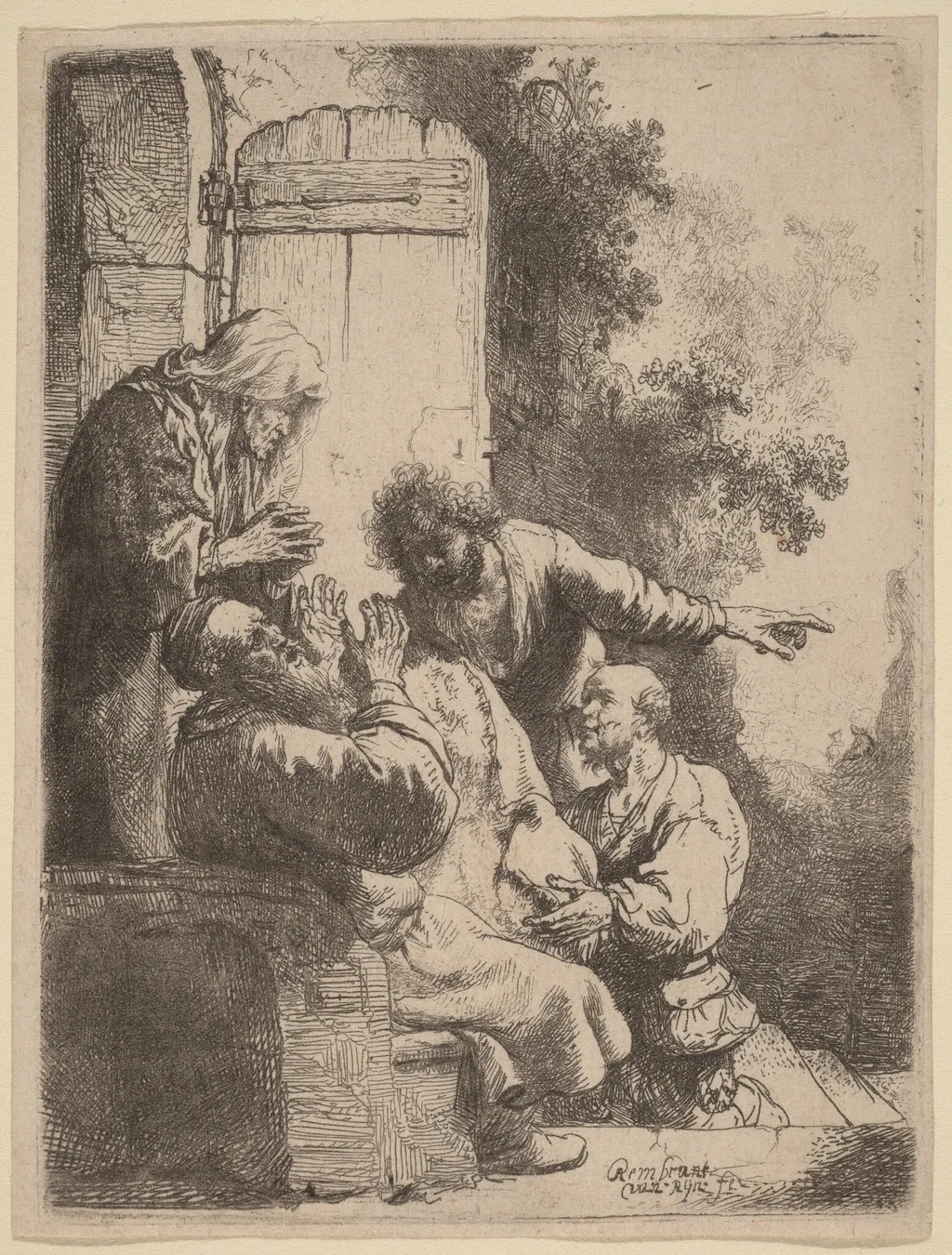
Joseph's Coat Brought to Jacob is an ink print by the Baroque artist Rembrandt van Rijn. It dates from 1633 and is held in the collection of the National Gallery of Art.
About this work
Overview
The lines are energetic and rapid, conveying a sense of immediate drama and emotional turmoil rather than static form.
Joseph's Coat Brought to Jacob is a 1633 etching by Rembrandt van Rijn, executed with touches of drypoint. The work illustrates the biblical narrative from Genesis 37, depicting the moment Jacob's sons present the bloodied tunic of their brother Joseph to their grieving father. The composition centers on the elderly Jacob, who recoils in shock as the garment is thrust toward him, while the surrounding brothers appear in varied states of agitation and concealment.
Rembrandt employs his characteristic chiaroscuro, using deep, dense cross-hatching to create a dark, atmospheric background that contrasts sharply with the illuminated folds of the coat and the expressive faces of the figures. The lines are energetic and rapid, conveying a sense of immediate drama and emotional turmoil rather than static form. Created early in the artist's career, shortly after his move to Amsterdam, this print demonstrates his mastery of the etching medium and his ability to infuse biblical scenes with profound psychological depth.
It stands as a significant example of his early exploration of light and shadow to drive narrative tension.
Subject & Meaning
The scene illustrates the biblical episode in which Joseph’s brothers present his blood‑soaked coat to their father Jacob, announcing Joseph’s presumed death. The tense expressions and the stark contrast of light suggest the shock and grief of the moment, emphasizing the narrative’s themes of loss, deception, and familial tragedy.
Technique & Style
Rembrandt employed traditional etching, incising lines into a copper plate and using acid to hold ink, then enhanced the image with dry‑point, pressing the needle directly into the metal. This combination produces both crisp, sketch‑like lines and softer, velvety edges where the dry‑point burr retains extra ink, creating a hazy atmosphere around the figures.
History & Provenance
The work dates to the early 1630s, a period when Rembrandt was establishing his reputation in Amsterdam. It is known from several impressions held in museum collections, indicating that the plate was printed in limited numbers before being withdrawn from further production, a common practice for the artist’s prints of that era.
Own this work as a print
Artist & collection

Artist
Rembrandt Harmenszoon van Rijn, known mononymously as Rembrandt, was a Dutch Golden Age painter, printmaker, and draughtsman.

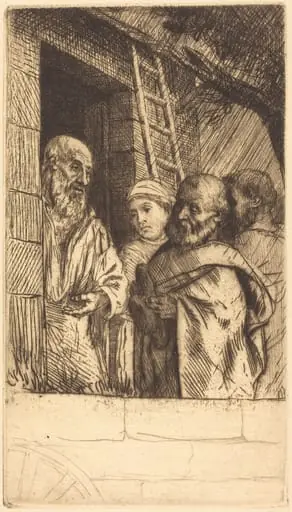 Saint Peter and Saint Paul at the Door of Bonhomme Misere (Saint Pierre et Saint Paula la port du Bonhomme Misere)
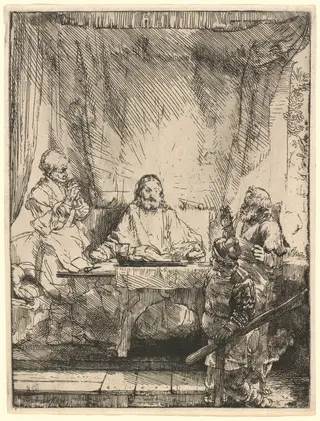 Christ at Emmaus: the Larger Plate
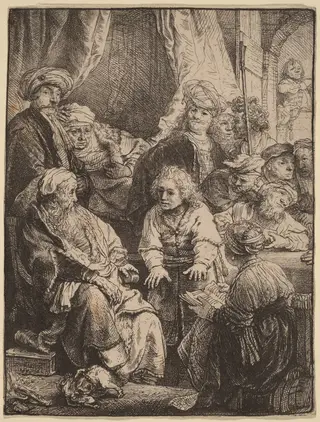 Joseph Telling His Dreams
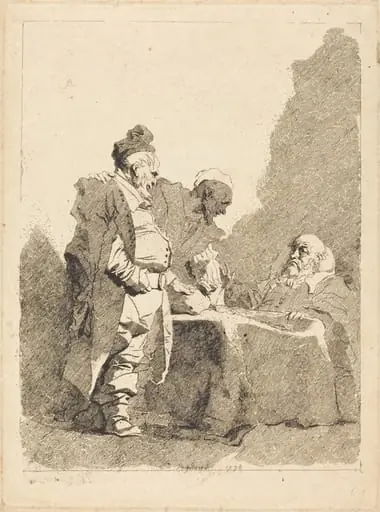 The Tax Collectors (Les traitants)
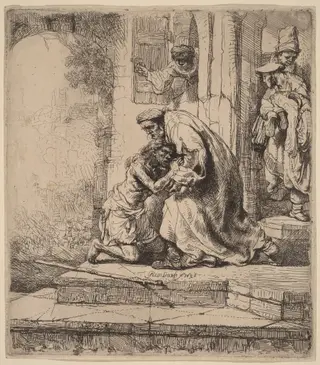 The Return of the Prodigal Son
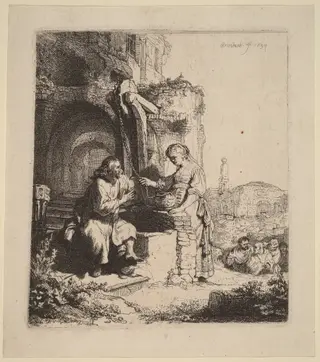 Christ and the Woman of Samaria Among Ruins
 The Angel Departing from the Family of Tobias
 Street Vendor Selling Spectacles at the Door
 Supper at Emmaus
 The Circumcision: Small Plate