Artwork
Young Woman with a Pearl Necklace
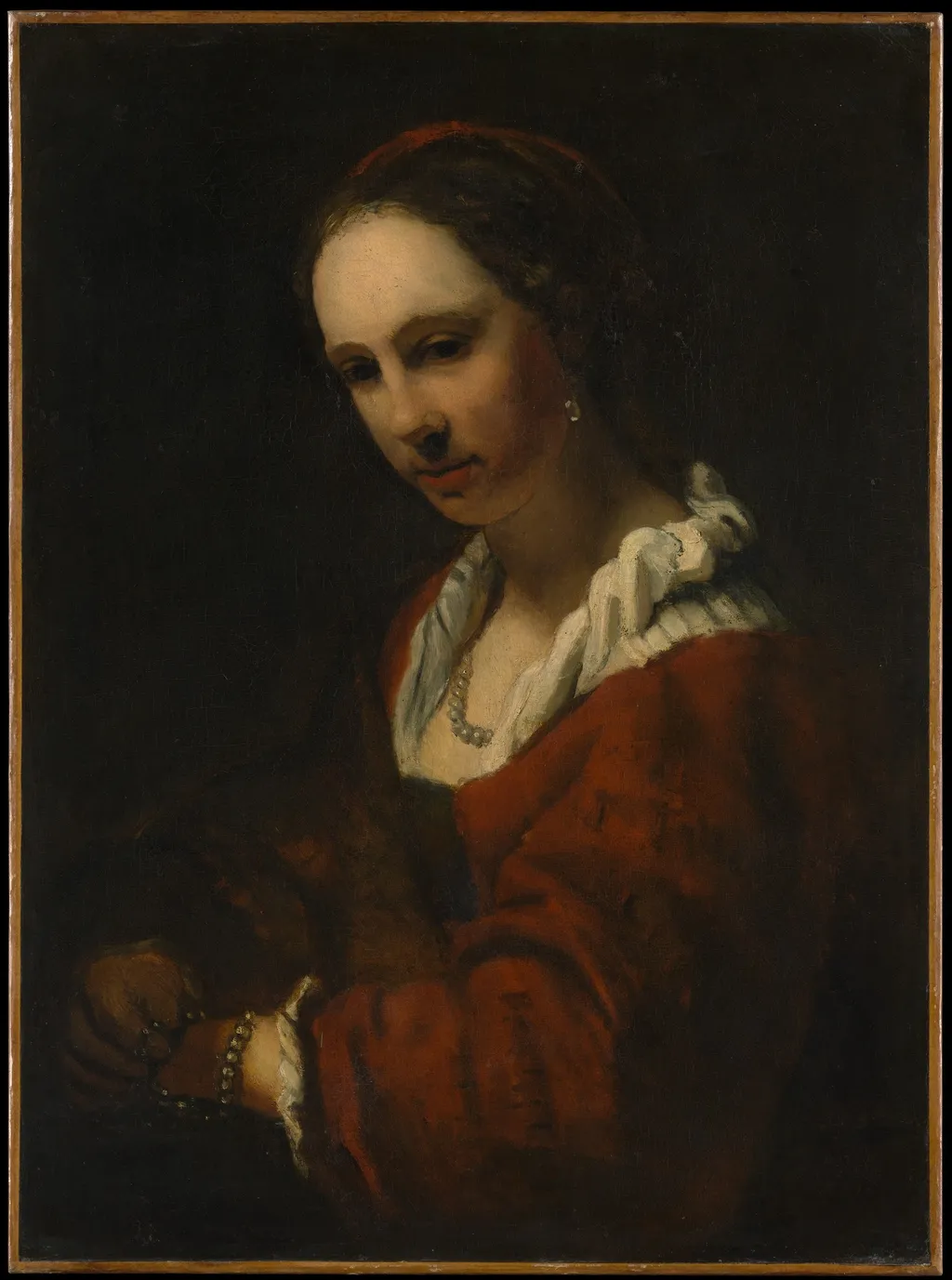
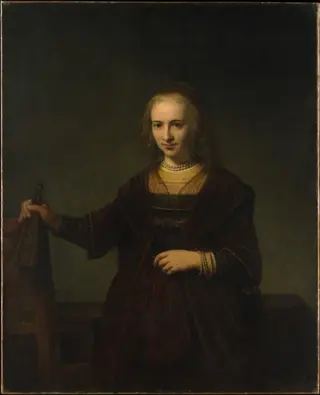
Young Woman with a Pearl Necklace is an oil painting by the Dutch Golden Age artist Rembrandt van Rijn. It dates from 1654 and is held in the collection of the Metropolitan Museum of Art.
About this work
Subject & Meaning
She wears a red bodice that opens at the chest to reveal a string of pearls around her neck and wrist, a pendant in her left ear, and a cap covering her hair.
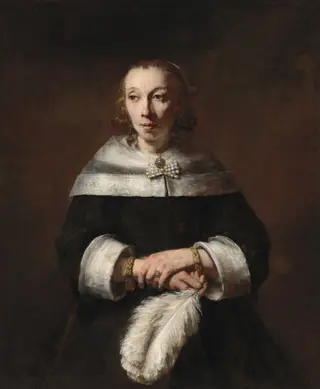
The painting shows a young woman turned toward the viewer, her head slightly inclined, set against a dark background. She wears a red bodice that opens at the chest to reveal a string of pearls around her neck and wrist, a pendant in her left ear, and a cap covering her hair. The pearls function as a conventional symbol of purity, wealth and marital virtue, while the exposed breast and direct gaze suggest both intimacy and modest confidence.
The work is identified as a portrait of a contemporary woman, possibly Hendrickje Stoffels, and its iconography reflects the Dutch Golden Age interest in representing status and moral virtue through dress and accessories.
Technique & Style
Young Woman with a Pearl Necklace is executed in oil paint on a canvas support, measuring approximately 84.1 cm in height and 62.2 cm in width. The work is classified as a portrait from the Dutch Golden Age, depicting a woman in a red bodice who gazes directly at the viewer while adjusting a pearl necklace. Stylistically, the painting presents a half-length figure with an open chemisette revealing the jewelry and a visible pearl pendant in her ear.
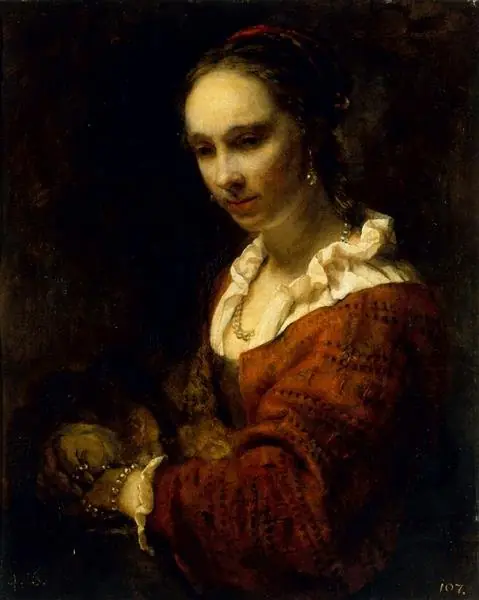
Although historically attributed to Rembrandt or Bernaert Fabritius, current scholarship identifies the piece as a copy after Willem Drost, likely created after 1655. The handling of the medium reflects the period's portraiture conventions, focusing on the texture of the fabric and the luster of the pearls against the subject's skin.
History & Provenance
Young Woman with a Pearl Necklace is dated to 1654 in the Met's records, though some scholars place it after 1655. It was painted in oil on canvas as a copy after Willem Drost's original composition rather than as an autograph work. The painting was once held by the London dealer L. Lesser, then passed through Duveen Brothers in London, where Wilhelm von Bode first championed it as a Rembrandt.
It subsequently entered the New York collection of collector Benjamin Altman, who bequeathed it to the Metropolitan Museum of Art in 1913. Documented by Hofstede de Groot in 1914 as a portrait of Hendrickje Stoffels, the work was later reattributed to Bernaert Fabritius in December 1937, before Walter Liedtke reassigned it in 1991 to its current designation as a copy after Willem Drost.
Young Woman with a Pearl Necklace is held in the collection of the Metropolitan Museum of Art in New York, where it bears the accession number 14.40.629. The work entered the museum in 1913 as part of the Benjamin Altman bequest. Its exhibition and scholarly history reflects shifting attributions: initially documented in 1914 by Hofstede de Groot as a Rembrandt, it was later re-evaluated.
In December 1937, the museum changed the attribution to Bernaert Fabritius, a designation that remained for over fifty years. In 1991, Walter Liedtke officially revised the classification to "Copy after Willem Drost." The painting has been associated with the Duveen Brothers in London prior to its acquisition by Altman.
Context
Initially documented in 1914 by Hofstede de Groot as an autograph Rembrandt depicting Hendrickje Stoffels, the work was long celebrated as a collection gem following its 1913 bequest. Early scholarship by Wilhelm von Bode supported this attribution, viewing the piece as a genuine portrait from circa 1658. However, critical consensus shifted when John Charles Van Dyke and W.R. Valentiner challenged the authenticity, arguing the New York version was a copy of a Dresden painting attributed to Bernaert Fabritius.
Valentiner eventually adopted this view, leading to a 1937 reattribution to Fabritius that persisted for over fifty years. Modern scholarship, culminating in Walter Liedtke's 1991 revision, reclassified the painting as a copy after Willem Drost. This evolution reflects broader art-historical efforts to distinguish Rembrandt's hand from his circle, situating the work within the complex workshop practices of the Dutch Golden Age rather than the master's direct oeuvre.
Legacy
Upon its 1913 bequest to the Metropolitan Museum of Art via Benjamin Altman, the painting was celebrated as a major Rembrandt, with scholar Cornelis Hofstede de Groot identifying the subject as Hendrickje Stoffels. This high reputation, initially supported by Wilhelm von Bode, faced immediate scrutiny from critics John Charles Van Dyke and W.R. Valentiner, who argued the work was a copy of a Dresden version attributed to Bernaert Fabritius. Following Hofstede de Groot's death, the museum officially reattributed the piece to Fabritius in 1937, a classification that persisted for over fifty years.
The work's scholarly legacy culminated in 1991 when curator Walter Liedtke revised the attribution to "Copy after Willem Drost," resolving decades of debate regarding its relationship to the Dutch Golden Age canon.
Overview
This oil painting, titled Young Woman with a Pearl Necklace, dates from after 1655 and is attributed to an unknown artist working after Willem Drost. It exemplifies Dutch Golden Age portraiture and is housed in the Metropolitan Museum of Art. The artwork depicts a woman adorned with pearls, presented in a manner characteristic of the period's focus on realistic portrayal and rich detail.
Own this work as a print
Artist & collection

Artist
Rembrandt Harmenszoon van Rijn, known mononymously as Rembrandt, was a Dutch Golden Age painter, printmaker, and draughtsman.