Artwork
The Skater (Portrait of William Grant)
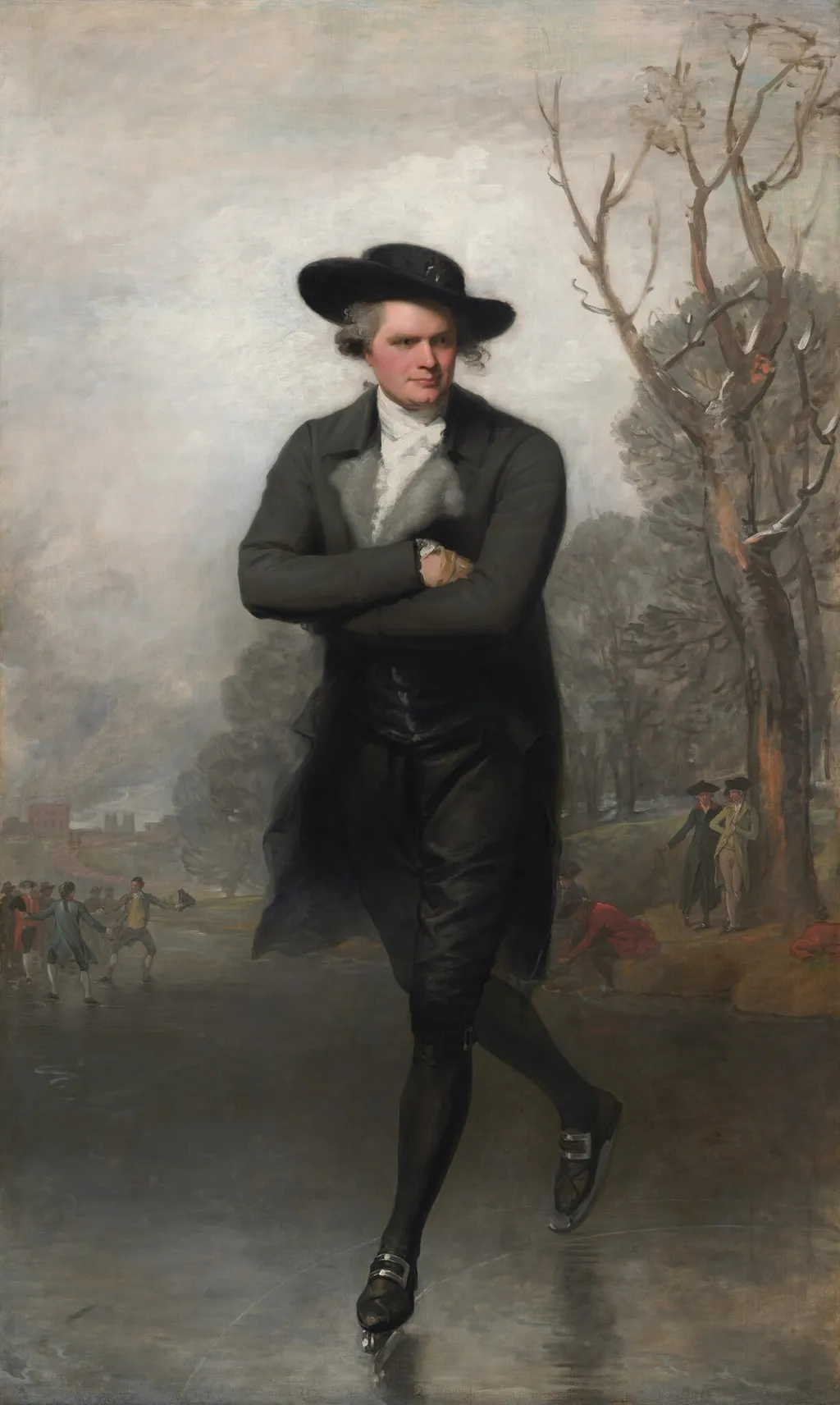
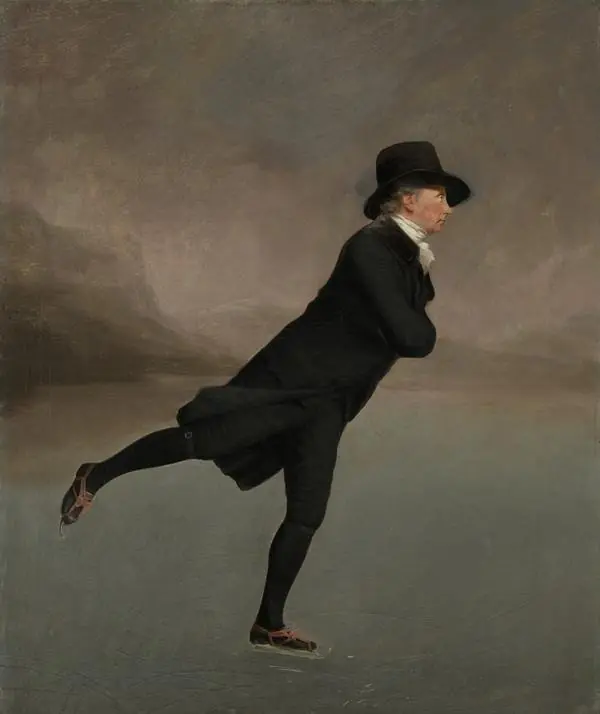
The Skater (Portrait of William Grant) is an oil painting by the American Impressionist artist Gilbert Stuart. It dates from 1782 and is held in the collection of the National Gallery of Art.
About this work
Subject & Meaning
Grant's pose, with arms crossed and head slightly lowered, derives from the Apollo Belvedere, a cast of which stood in Benjamin West's studio.
The painting depicts Sir William Grant, a young Scotsman from Congalton in East Lothian, shown full-length while skating. The composition was inspired by an actual outing to the Serpentine in Hyde Park, where Grant performed skating maneuvers before an admiring crowd before the ice cracked and Stuart led him to safety. Grant's pose, with arms crossed and head slightly lowered, derives from the Apollo Belvedere, a cast of which stood in Benjamin West's studio.
The dark coat, smallclothes, and shoes are accented by a white cravat and cuff, gray fur lapel, tan glove, and silver buckles, while the tilted hat belonged to Stuart himself. Behind Grant, a winter landscape with distant skaters, trees, and a London skyline including Westminster Abbey frames the figure. Some scholars, notably William L. Pressly, interpret the work as an essay in Romantic melancholy, while its originality was recognized at the 1782 Royal Academy Exhibition as an attitude of a single figure not previously exhausted in British portraiture.
Technique & Style
Executed in 1782, this full-length portrait is an oil painting on canvas measuring approximately 245.5 by 147.4 centimeters. Gilbert Stuart applied the paint with a characteristic lightness of touch, notably rendering the sitter's head directly without preliminary pencil drawings and subsequently painting the figure from memory. The composition employs a low viewpoint to create a dramatic, Grand Manner effect, while the pose adapts the Apollo Belvedere with crossed arms.
Stylistically, the work integrates figure and landscape through contrasting halves: the right side is anchored by a bare tree and the coat's undulating silhouette, while the left is activated by the jagged contour of the elbow and distant skaters. The palette features black tones in the coat and smallclothes relieved by white accents, gray fur, and silver buckles, set against a restrained winter background that includes Westminster Abbey.
History & Provenance
The portrait was commissioned in 1781 by Sir William Grant, a Scottish patron who met Gilbert Stuart in London and persuaded the artist to paint a full‑length image. Their sitting took place on the Serpentine, where Grant’s enthusiasm for skating inspired the composition; Stuart later painted Grant from memory after the ice incident. Executed in 1782, the oil on canvas measures 245.5 × 147.4 cm and was first shown at the Royal Academy that year.
The work remained in the Grant family, passing to his son, then to his daughter Elizabeth, and later to her son Charles Stapleton Pelham‑Clinton, who retained it until 1950 when it was sold to the National Gallery of Art.
The Skater (Portrait of William Grant) is held by the National Gallery of Art in Washington, D.C., where it is part of the Andrew W. Mellon collection (acquired 1950). Its provenance follows the sitter’s family line, from Grant and his descendants to his daughter’s branch, until its 1950 purchase by the museum. The work debuted at the Royal Academy of Arts in 1782 and was re‑exhibited there in 1878. It has remained in the NGA’s permanent collection without further public exhibitions.
Context
Critical reception of The Skater was immediate and laudatory; the 1782 Royal Academy display drew praise from connoisseur John Collum, who noted the novelty of a figure captured mid‑skate, while the Duke of Rutland urged Joshua Reynolds to view it, helping to cement Stuart’s reputation alongside Gainsborough and Reynolds. Scholarship identifies the work as a turning point that propelled Stuart’s from apprenticeship under Benjamin West to independent studio status on Newman Street, a transition highlighted in contemporary accounts and later analyses such as Pressly’s 1986 essay. Art‑historical context places the portrait within the Baroque Grand Manner, drawing on the Apollo Belvedere pose and integrating figure with a winter landscape reminiscent of Gainsborough. Its compositional innovation influenced later Scottish portraiture, notably Henry Raeburn’s The Skating Minister.
Legacy
The 1782 portrait was first shown at the Royal Academy in 1782 and re‑presented in 1878, after which it remained in the Grant family until its 1950 sale to the National Gallery of Art, Washington. Its immediate impact was to catapult Stuart into national prominence, a fact he later credited for ‘suddenly lift[ing] him into fame by a single picture.’ Scholars have noted its possible influence on Henry Raeburn’s later work ‘The Skating Minister,’ regarding the composition as a precedent for Scottish skating portraiture.
The painting’s enduring reputation rests on its innovative depiction of movement and its role in securing Stuart’s place alongside contemporary masters.
Overview
Gilbert Stuart's 1782 oil on canvas, "The Skater (Portrait of William Grant)," depicts Sir William Grant engaged in ice skating. This painting, created during Stuart's residence in London, marked a pivotal moment in the American artist's career, earning him significant public and critical attention for the first time.
Own this work as a print
Artist & collection

Artist
Gilbert Stuart (né Stewart; December 3, 1755 – July 9, 1828) was an American painter born in the Rhode Island Colony who is widely considered one of America's foremost portraitists.