Artwork
Untitled
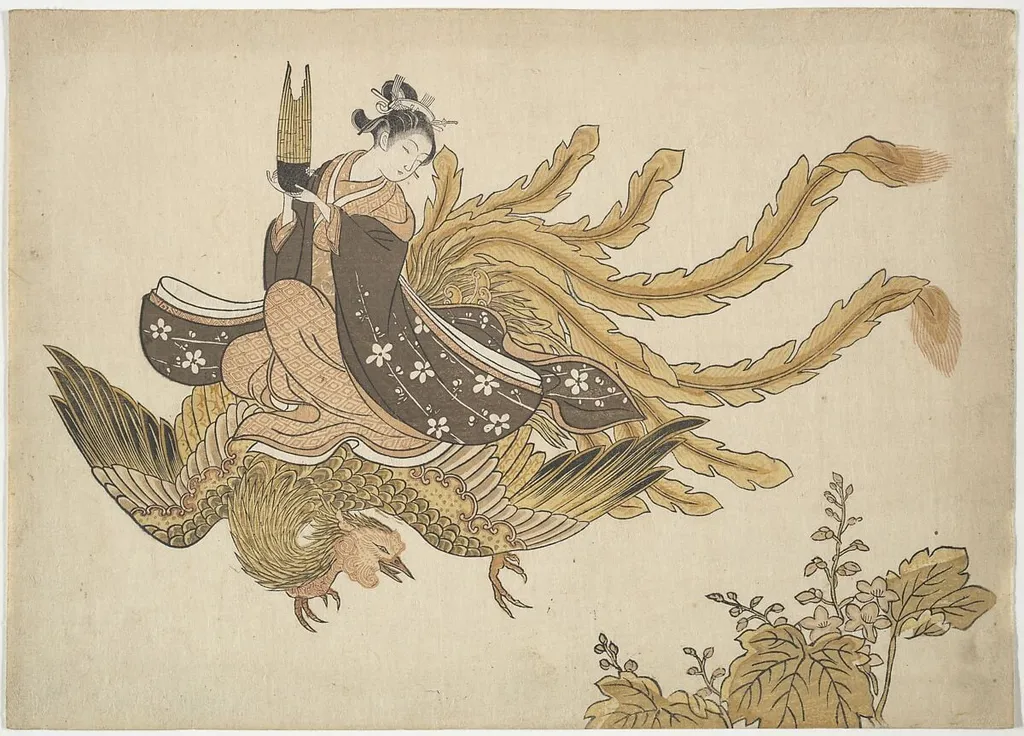
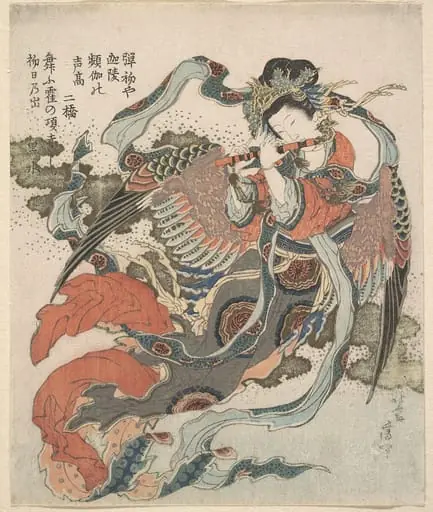
Untitled is an ink print by the Romanticist artist Suzuki Harunobu. It dates from 1766 and is held in the collection of the Metropolitan Museum of Art.
About this work
Overview
Executed in ink and color on paper, the print exemplifies the nishiki-e (brocade picture) technique that Harunobu pioneered just one year earlier.
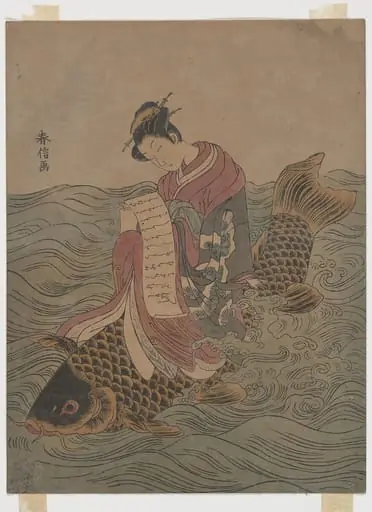
Untitled is a woodblock print by Suzuki Harunobu, dated 1766, depicting a woman riding a phoenix across an empty sky. Executed in ink and color on paper, the print exemplifies the nishiki-e (brocade picture) technique that Harunobu pioneered just one year earlier. The work is held in the collection of the Metropolitan Museum of Art. As one of the earliest full-color prints in the history of ukiyo-e, it occupies a significant position in the development of Japanese printmaking, demonstrating the technical and aesthetic possibilities that Harunobu unlocked when he first employed multiple woodblocks to achieve complex color layering in 1765.
Subject & Meaning
The print depicts a woman in flowing robes seated sidesaddle upon a large phoenix, her head bowed slightly downward as she holds a tall mouth organ in her right hand. Her hair is arranged in an elaborate updo secured with pins, and her robes are patterned with geometric designs and small white flowers on dark fabric, with long sleeves and sashes that billow behind her. The phoenix, a mythical creature of Chinese origin known in Japanese as hō-ō and in Chinese as fenghuang, displays golden plumage with individually detailed feathers, a curved beak, and clawed feet tucked beneath its body; its tail feathers stream behind in long, ribbon-like shapes. A cluster of leafy plants with small flowers grows upward in the lower right corner. The iconography suggests a celestial or dreamlike realm, combining the phoenix as a symbol of virtue and renewal with the female figure as an embodiment of refined beauty. The mouth organ she carries may allude to courtly music and poetry traditions, reinforcing the classical, romantic atmosphere that pervades Harunobu's work. The overall effect is one of ethereal movement and poetic imagination rather than narrative specificity.
Technique & Style
The print is executed as a nishiki-e, or brocade picture, using the multiple-block color printing technique that Harunobu introduced in 1765. The palette is limited to warm browns, golds, and black with touches of white, applied with precise ink outlines and flat, even color fills that show no visible brushstrokes or shading. This smooth, opaque application of color was achieved through thicker pigment application and the use of cherry wood for the blocks rather than catalpa, innovations that Harunobu developed for his wealthy patrons. The composition moves diagonally from upper left to lower right, creating dynamic movement across the undecorated beige background. The figure's slender frame and elegantly rendered features, the flowing drapery, and the decorative patterning of the robes are characteristic of Harunobu's personal style, which Richard Lane described as depicting eternal girlhood in unusual and poetic settings. The absence of shading and the emphasis on linear precision and decorative flatness reflect both the technical constraints and the aesthetic priorities of early nishiki-e production.
History & Provenance
The print is dated to 1766, placing it in the immediate aftermath of Harunobu's breakthrough with full-color printing. This was a period of extraordinary productivity for the artist; between 1765 and 1770, he created over twenty illustrated books and more than one thousand color prints. The work is now in the collection of the Metropolitan Museum of Art, having been accessioned into their holdings of Japanese prints. Its provenance prior to museum acquisition is not recorded in the available sources. The print's creation coincided with the height of Harunobu's involvement with literati samurai patrons, whose wealth enabled the expensive production methods and luxury materials that distinguish his nishiki-e from earlier, more modestly produced prints.
Context
Suzuki Harunobu (circa 1725-1770) was a pivotal figure in the ukiyo-e tradition, credited with producing the first full-color prints in 1765 and thereby rendering obsolete the earlier modes of two- and three-color printing. Though born to a samurai family with connections to Tokugawa Ieyasu, his grandfather and father were stripped of their hatamoto status and exiled from Edo to Kyoto, where Harunobu likely grew up. He studied under Nishikawa Sukenobu and possibly Nishimura Shigenaga, and his early work followed the Torii school style before his innovations with color transformed the medium. The year 1766, when this print was made, found Harunobu at the center of a flourishing artistic circle in Edo, closely associated with the scholar Hiraga Gennai and various samurai patrons who commissioned egoyomi (calendar prints) that became the vehicle for nishiki-e experimentation. The genre designation of bijin-ga (pictures of beautiful women) applies to this work, though its fantastical subject matter distinguishes it from his more numerous depictions of contemporary urban life. Government censorship was relatively lax during this period under the influence of Grand Chamberlain Tanuma Okitsugu, whose policies condoned luxurious display and pleasure, creating favorable conditions for the production of refined and sometimes erotic imagery.
Legacy
Harunobu's invention of nishiki-e fundamentally transformed Japanese printmaking, and works such as this 1766 print demonstrate the immediate application of his technical breakthroughs to imaginative subjects. During his lifetime and shortly after his death in 1770, he was widely imitated; artists such as Harushige even forged his work, while his pupil Isoda Koryusai carried forward aspects of his style before developing a more robust aesthetic in the larger oban format. Harunobu's reputation as the master of ukiyo-e during his final years was eventually eclipsed by artists including Katsukawa Shunshō and Torii Kiyonaga, but his contribution to the medium proved permanent. The full-color technique he pioneered became standard for ukiyo-e, and his emphasis on poetic atmosphere and delicate female beauty established conventions that influenced generations of printmakers. His works have consistently commanded high regard and prices, prized from their creation by wealthy collectors and later by museums worldwide. The Metropolitan Museum of Art's holding of this print reflects the enduring institutional recognition of his achievement as both artist and technical innovator who, as one scholar noted, basically helped create the genre of full-color ukiyo-e.
Artist & collection

- Untitled
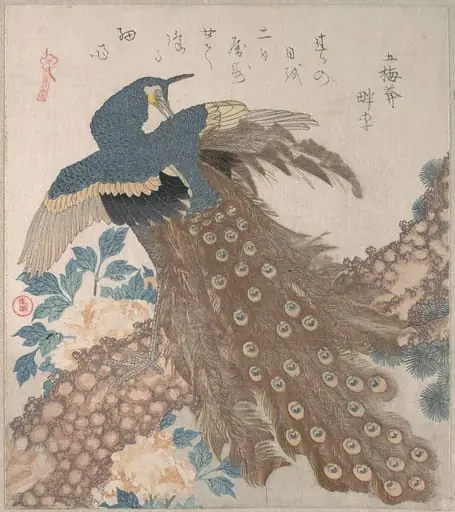 「三ひらの内」松・牡丹に孔雀|Peacock on Pine Tree and Peonies, from the series Three Sheets (Mihira no uchi)
 Untitled
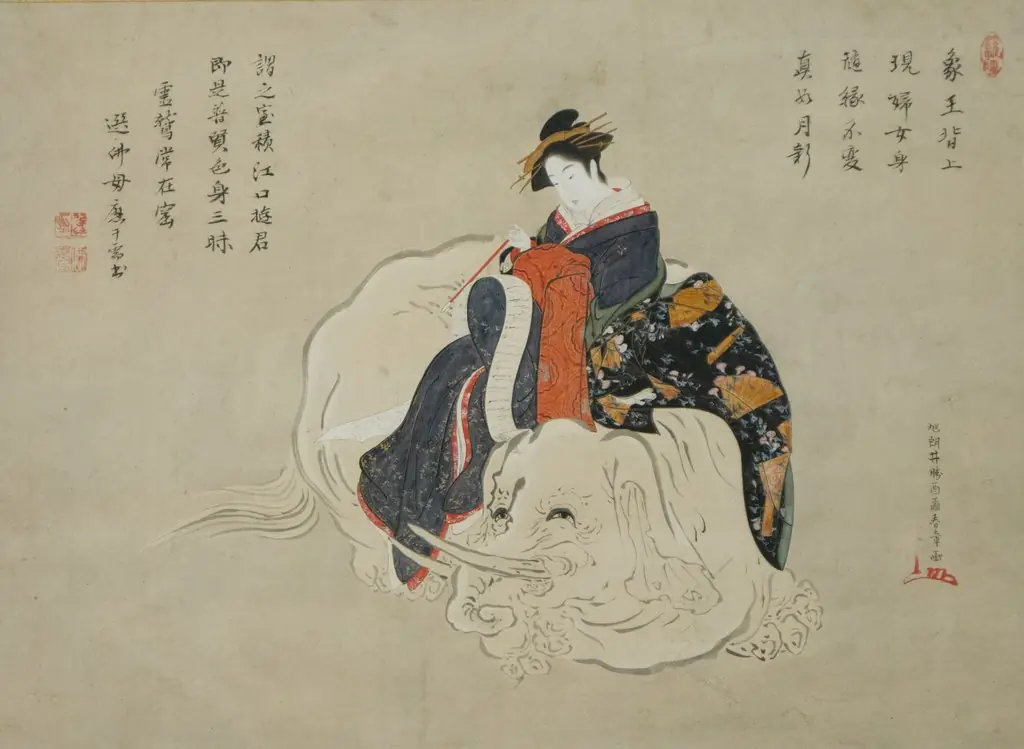 Courtesan of Eguchi (Eguchi no kimi)
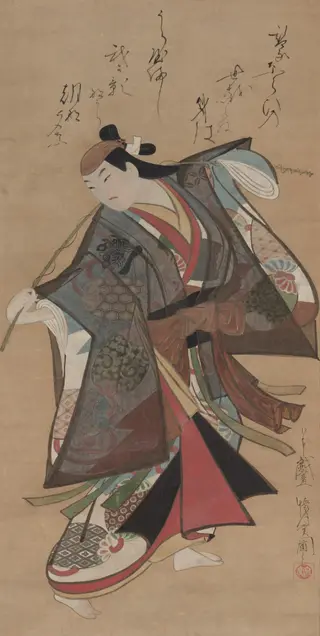 Sanjo Kantaro II in the Role of Urashima Taro
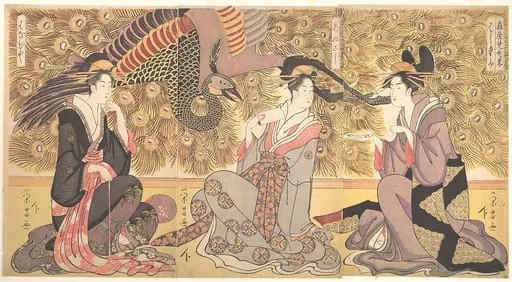 「扇屋昼見世畧」|Interior of the House called Ōgiya
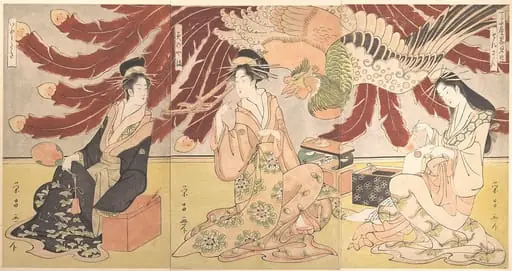 「丁子屋畧見世」|The Chōjiya Pleasure House by Day (Chōjiya hiru-mise)
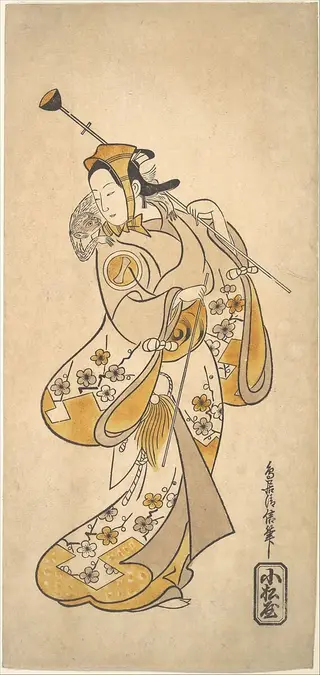 Untitled
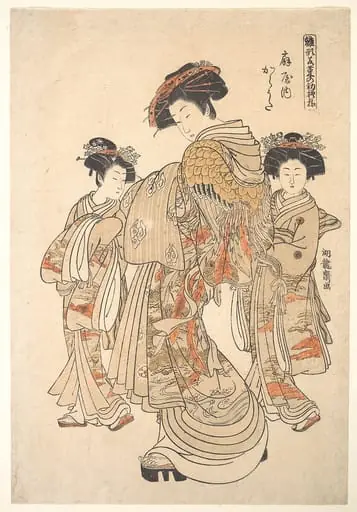 『雛形若菜の初模様 扇屋内 からうた』|The Courtesan Karauta of the Ōgiya Brothel, from the series “A Pattern Book of the Year’s First Designs, Fresh as Spring Herbs” (“Hinagata wakana no hatsu moyō”)
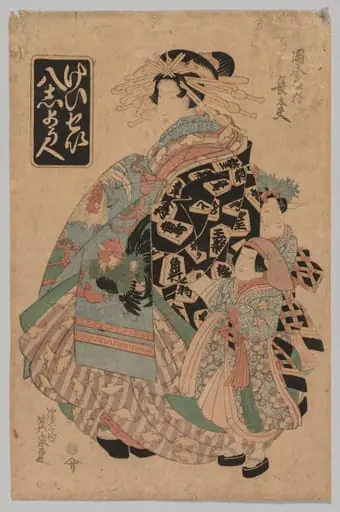 Chōdayu of the Okamotoya from the series ?
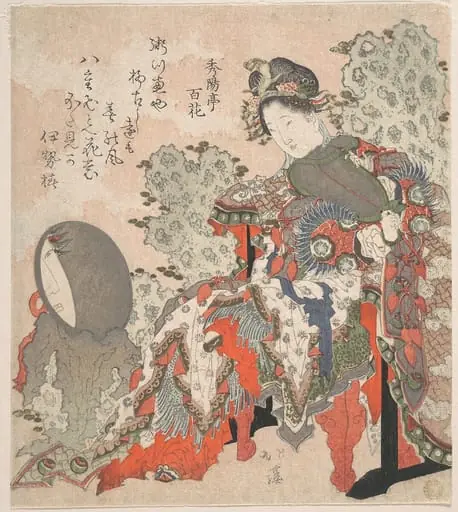 Untitled
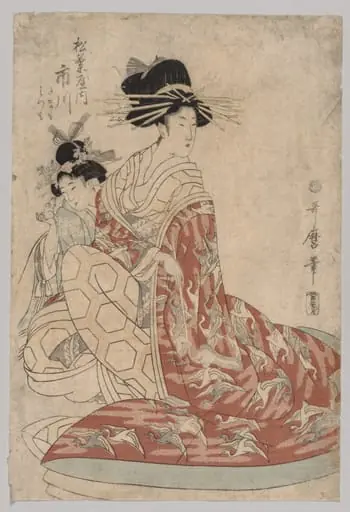 Ichikawa of Matsubaya with Minomo and Tamamo