Artwork
A River Landscape
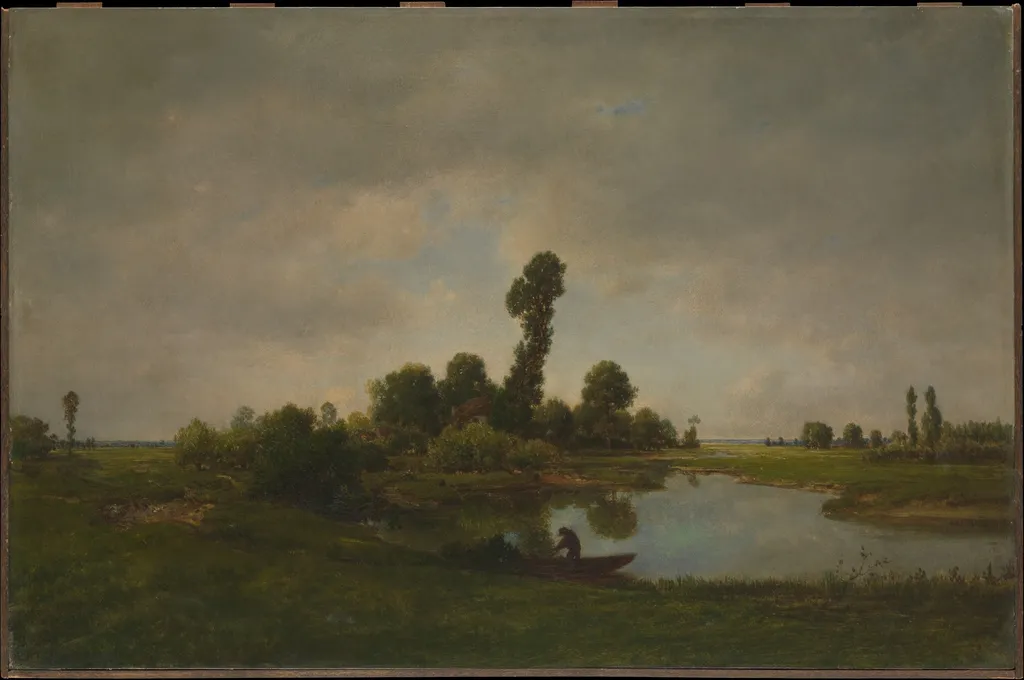
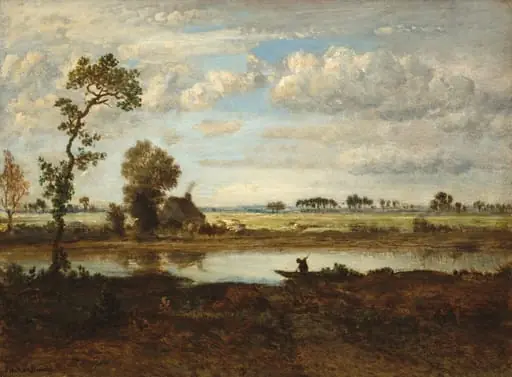
A River Landscape is an oil painting by the Barbizon school artist Théodore Rousseau. It dates from 1849 and is held in the collection of the Metropolitan Museum of Art.
About this work
Subject & Meaning
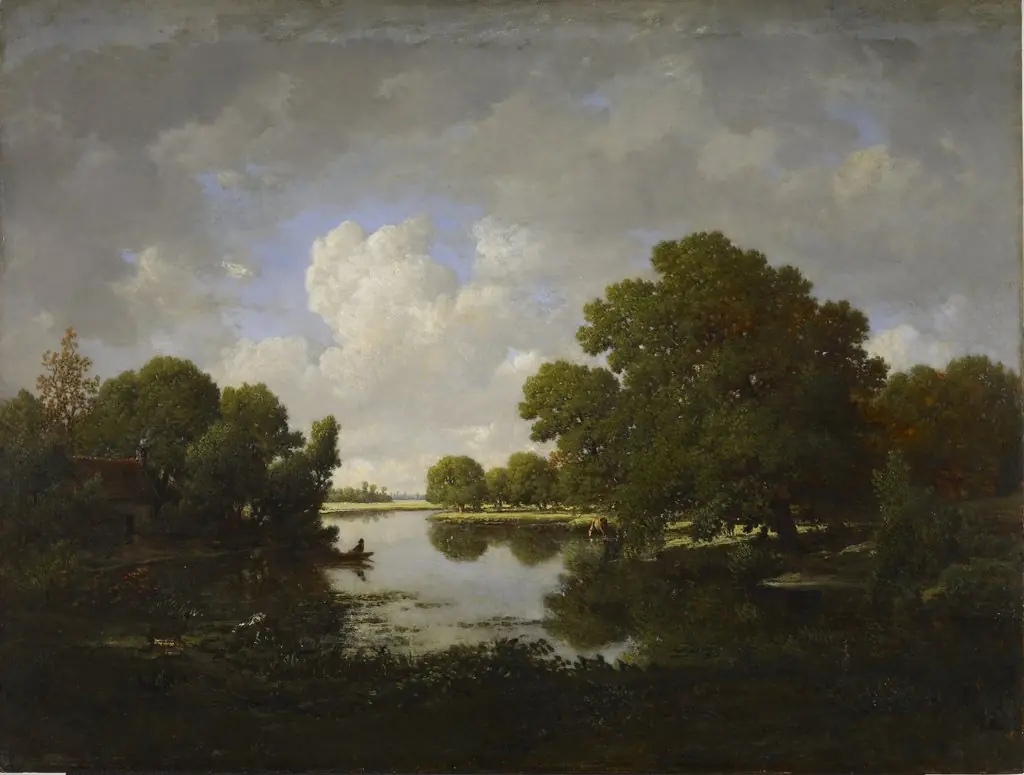
The composition explicitly depicts trees lining the banks and a small boat situated on the water, elements that define the work's genre as a landscape painting.
Théodore Rousseau's 1849 oil painting, A River Landscape, presents a naturalistic scene centered on a river winding through a wooded environment. The composition explicitly depicts trees lining the banks and a small boat situated on the water, elements that define the work's genre as a landscape painting. Executed on panel, the imagery focuses on the direct observation of these terrestrial and aquatic features without introducing complex allegorical figures or overt religious iconography.
The work represents a straightforward engagement with the rural countryside, emphasizing the physical presence of the river and the surrounding foliage as the primary subjects. By isolating these specific components of nature, the painting functions as a study of the landscape itself, capturing a moment of quietude along the waterway.
Technique & Style
The work titled A River Landscape, painted by Théodore Rousseau in 1849, is executed in oil on a wooden panel. The support is a panel measuring 41.6 cm in height by 63.2 cm in width, a format typical of mid‑nineteenth‑century French landscape practice. Rousseau renders a naturalistic riverside scene, arranging a foreground tree, a flowing river and a small boat to emphasize spatial depth and atmospheric light.
The composition reflects the genre’s focus on observed topography, while the use of oil paint allows layered tonal modelling and subtle colour transitions that define the formal qualities of the piece.
History & Provenance
Théodore Rousseau executed the oil painting A River Landscape in 1849. Created on a wooden panel, the work measures 41.6 by 63.2 centimeters and depicts a riverine scene featuring trees and a boat. The piece is currently held in the collection of the Metropolitan Museum of Art, where it is classified as a landscape painting.
While the specific circumstances of its commission and the detailed chain of ownership between its creation and current museum acquisition are not detailed in the available records, the work's inception is firmly established at the beginning of 1849.
Overview
Théodore Rousseau, a prominent French painter, completed A River Landscape in 1849. This oil painting exemplifies the artist's dedication to depicting natural environments, a characteristic central to the Barbizon school, with which he was closely associated. The work is currently part of The Metropolitan Museum of Art's collection.
Context
As a pivotal member of the Barbizon school, Théodore Rousseau championed a direct engagement with nature in his art. This movement, emerging in mid-19th century France, moved away from idealized or dramatic historical landscapes, instead focusing on capturing the unadorned beauty and specific characteristics of the French countryside through careful observation and naturalistic representation.
Own this work as a print
Artist & collection
Artist
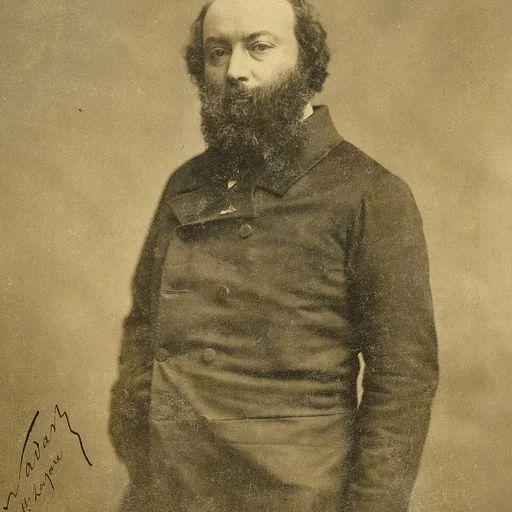
Étienne Pierre Théodore Rousseau (French pronunciation:; 15 April 1812 – 22 December 1867) was a French painter of the Barbizon school.

- The Pond (La Mare)
 The Banks of the Bouzanne River
 Ile-de-Vaux on the Oise near Auvers
 Landscape of the Oder River
 A Pond in Picardy
 Watering Place
 Opklarende vejr efter en regnbyge ved Gurre Sø
 The Seine: Morning
 Landscape With Figure Near Pond and Cottages
 Riverbank with Fowl
 Waldlandschaft
 Edgeworth Near Medford