Artwork
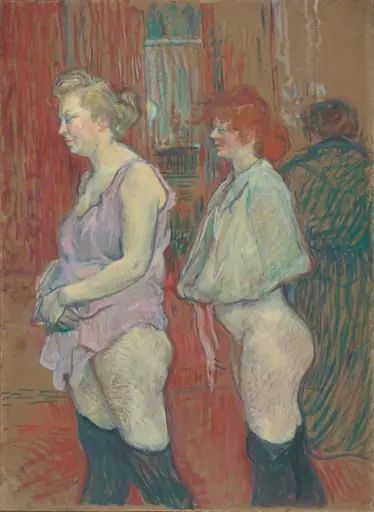
Quadrille at the Moulin Rouge
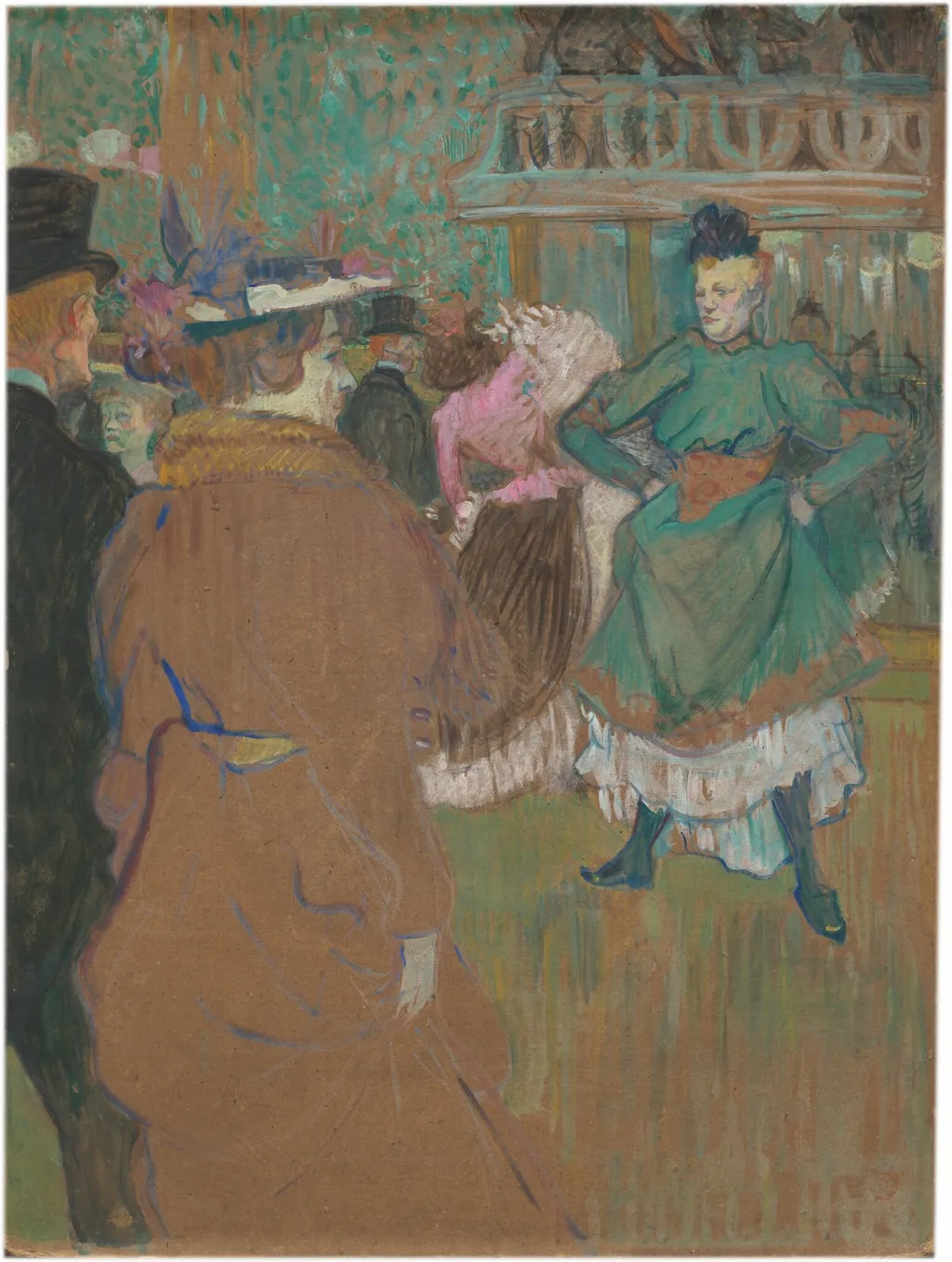
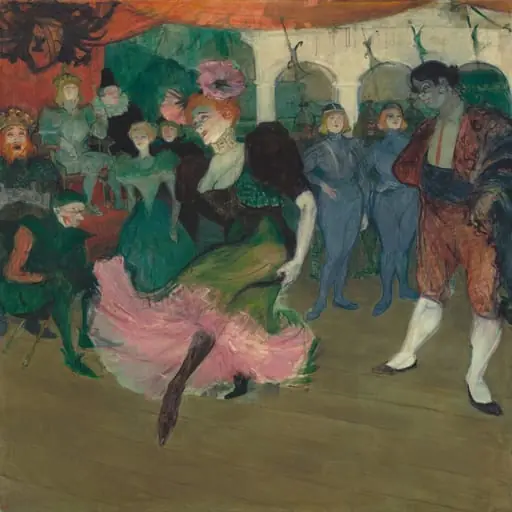
Quadrille at the Moulin Rouge is an oil painting by the Impressionist artist Henri de Toulouse-Lautrec. It dates from 1892 and is held in the collection of the National Gallery of Art.
- Inscription
- Inscribed:lower right atelier stamp in red: HTL (Lugt 1338)
About this work
Technique & Style
Oil paint forms the pictorial layer, applied with a brush to achieve the flat, decorative contours characteristic of Lautrec's poster-like style.
The work is an oil painting on a cardboard support, a material documented in the artist's records. Oil paint forms the pictorial layer, applied with a brush to achieve the flat, decorative contours characteristic of Lautrec's poster-like style. The painting measures 81 cm in height by 59.8 cm in width, placing it among Lautrec's relatively small yet impactful genre scenes. Its formal qualities include stark outlines, flattened perspective, and a focus on contemporary Parisian leisure.
History & Provenance
Quadrille at the Moulin Rouge was painted by Henri de Toulouse-Lautrec in 1892 in oil on cardboard, measuring 81 cm by 59.8 cm. Its ownership passed from the Parisian collector Louis Bouglé to the Paris dealer Bernheim-Jeune, then to the New York firm Wildenstein & Co., and on 18 October 1928 to the collector Chester Dale in New York. Dale retained it until his death, after which it entered the National Gallery of Art in Washington, D.C., through his bequest in 1963, where it remains. No exhibition history is documented in the available sources.
Context
Quadrille at the Moulin Rouge is an 1892 oil on cardboard painting measuring 81 cm by 59.8 cm. It entered the National Gallery of Art through the bequest of Chester Dale, having previously passed through the hands of Louis Bouglé, Bernheim-Jeune, and Wildenstein & Co. The work is a genre scene depicting a dance at the famed Parisian cabaret, exemplifying Lautrec's focus on contemporary urban entertainment and Parisian leisure.
Overview
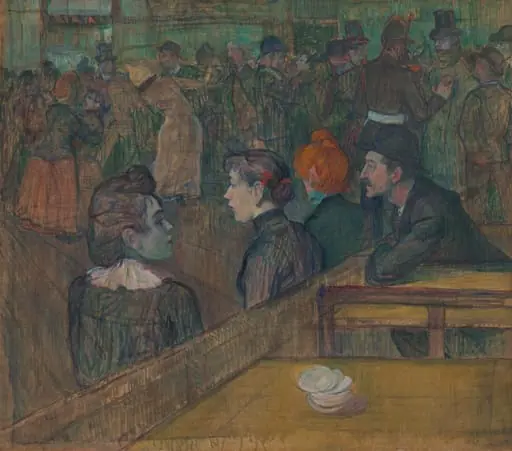
Henri de Toulouse-Lautrec's 1892 painting, Quadrille at the Moulin Rouge, captures a dynamic scene from Parisian nightlife. Rendered in oil on cardboard, the artwork depicts a bustling moment within the famous Moulin Rouge dance hall. It offers a glimpse into the energetic atmosphere of a late 19th-century quadrille performance, reflecting the artist's characteristic focus on entertainment venues and urban social life.
Subject & Meaning
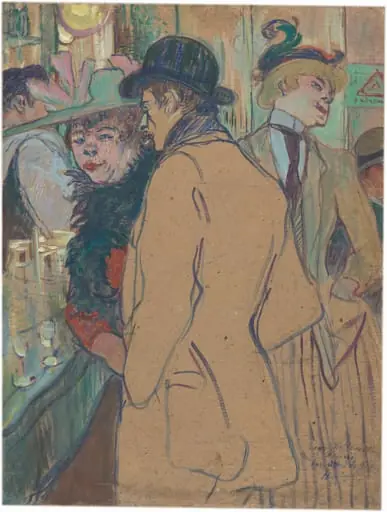
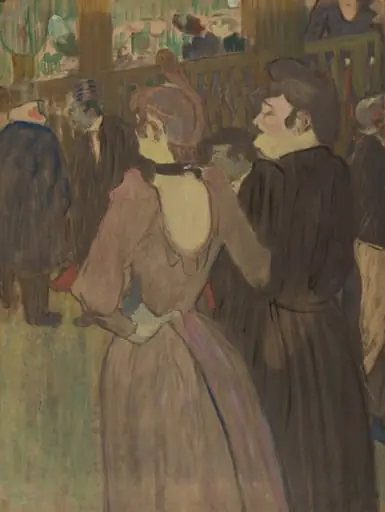
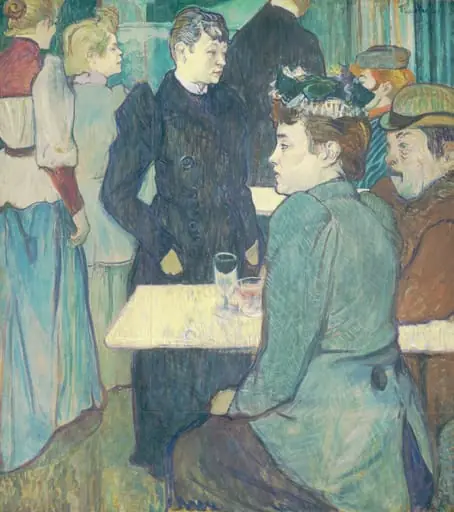
The composition places the viewer amidst a lively crowd inside the dance hall, seemingly during a brief intermission. A woman in a prominent green dress, her skirt visibly ruffled, sits at a table, drawing attention. Around her, other figures in bright hats and dark coats emerge from the background, their faces partially illuminated.
The scene conveys the animated and sometimes extravagant character of Parisian entertainment at the turn of the century.
Own this work as a print
Artist & collection
Artist
Comte Henri Marie Raymond de Toulouse-Lautrec-Montfa (24 November 1864 – 9 September 1901), known as Toulouse-Lautrec (French: ), was a French painter, printmaker, draughtsman, caricaturist, and illustrator.