Artwork
The Evening of the Deluge
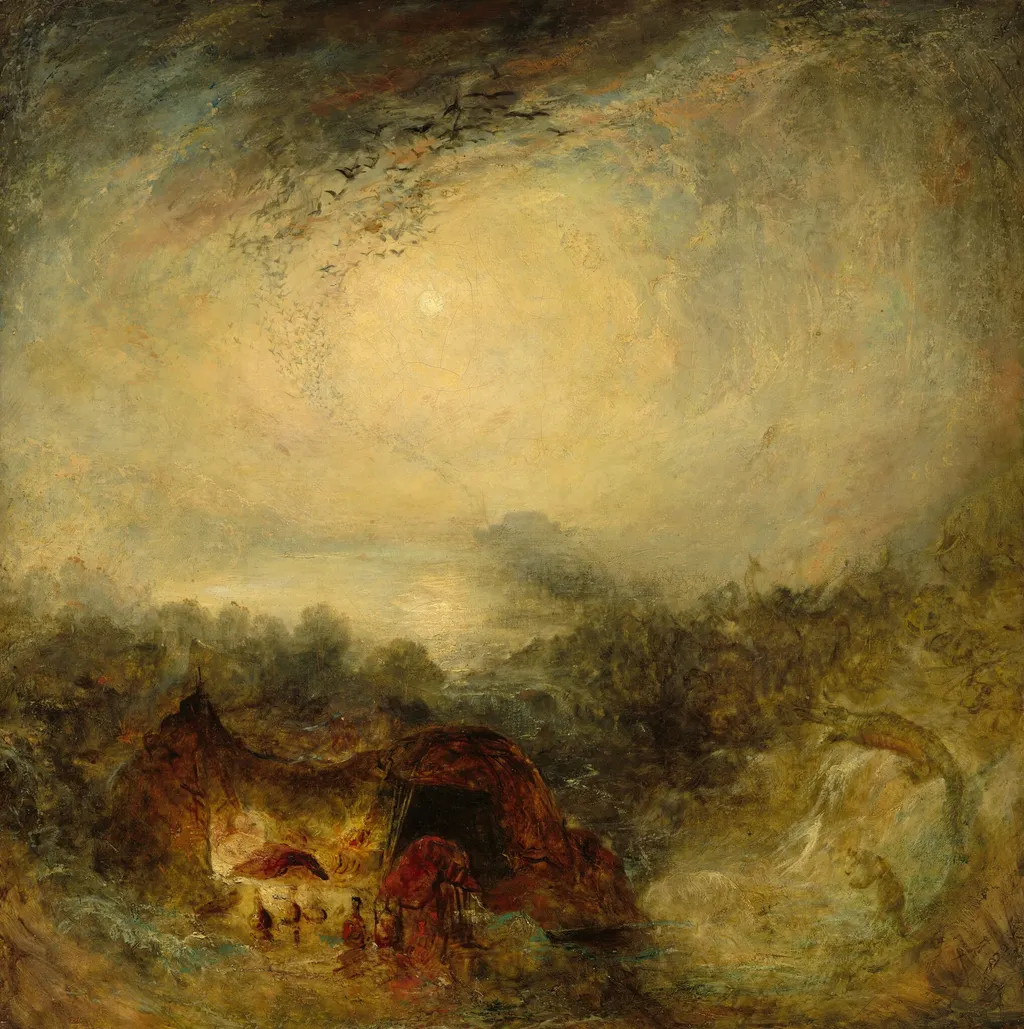
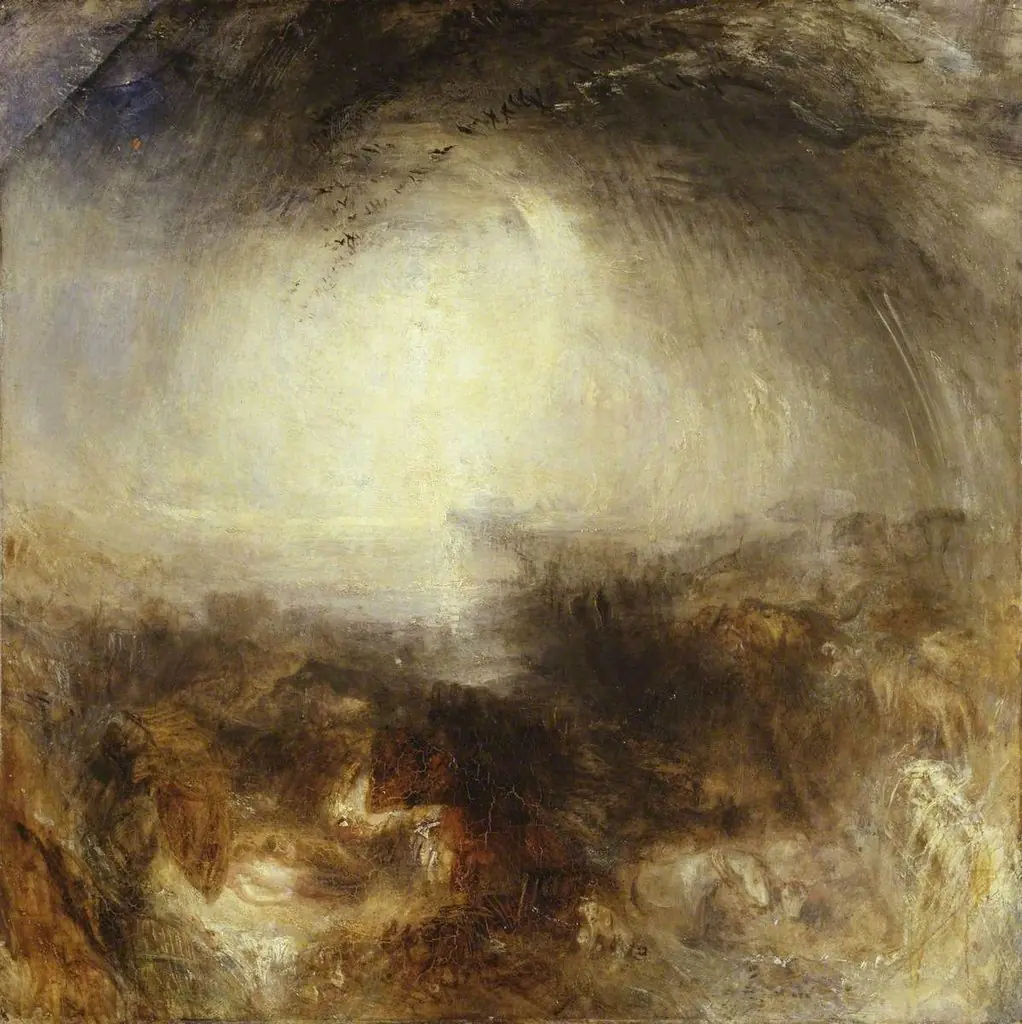
The Evening of the Deluge is an oil painting by the Romanticist artist Joseph Mallord William Turner. It dates from 1843 and is held in the collection of the National Gallery of Art.
About this work
Overview
Measuring 76 by 76 centimeters, the square-format work is held in the collection of the National Gallery of Art in Washington, D.
The Evening of the Deluge is an oil on canvas painting by Joseph Mallord William Turner, dated circa 1843. Measuring 76 by 76 centimeters, the square-format work is held in the collection of the National Gallery of Art in Washington, D.C., under accession number 1960.6.40, where it is displayed in the West Building Main Floor, Gallery M57. The painting belongs to a series of works by Turner depicting the biblical Great Flood, and it was exhibited at the Royal Academy in 1843 alongside its companion piece, Light and Colour (Goethe's Theory), The Morning After the Deluge. The work represents a pivotal moment in Turner's late career, demonstrating his radical approach to landscape painting through near-abstract atmospheric effects and his sustained engagement with biblical and apocalyptic themes.
Subject & Meaning
The painting depicts the biblical deluge described in Genesis 7:17-23, capturing the moment when darkness begins to overwhelm the world as the flood commences. At the center, a luminous pale orb, either sun or moon, radiates outward through turbulent clouds, while flocks of dark birds arc across the upper left. Below, a dark red tent occupies the lower center, with a figure in red robes bending near its opening, and another figure reclines on the ground near a small fire to the left. The middle ground shows indistinct trees and water reflecting light. The imagery draws directly from the Genesis account of the forty days and nights of flooding that destroyed all life except for Noah and those with him in the ark. Turner presents ghostly outlines of animals and people through downpouring rain and rising waters, with light being progressively blotted out by clouds. The painting carries thematic resonance with Romantic views on nature's sublime power and man's struggle to fulfill divine expectations. Scholarly interpretation has noted that even within this scene of despair, there lies an underlying suggestion of hope, while the exhausted sea serves as metaphor for human spiritual struggle. The work forms part of a broader series that captured moments before, during, and after the apocalyptic flood, with The Deluge (circa 1805) representing an earlier, more figurative treatment and the 1843 pair representing a more abstract and atmospheric approach.
Technique & Style
Turner executed The Evening of the Deluge in oil on canvas with loose, thick, and heavily worked brushstrokes that create a hazy, atmospheric effect with indistinct edges throughout. The paint application dissolves forms into vapor and glow, with light radiating outward from the central orb. The palette is warm and subdued, dominated by yellows, browns, gray-greens, muted gold, gray, and blue tones in the sky, with darker earthy browns and ochres in the foreground terrain. The surface shows visible craquelure. This technique represents the culmination of Turner's lifelong investigation of light, atmosphere, and the dissolution of solid form, pushing toward abstraction while maintaining narrative content. The square format, unusual for landscape painting, enhances the work's symbolic and compositional intensity. The handling of paint demonstrates Turner's mature method of building form through chromatic atmosphere rather than line or detailed description, creating what contemporaries found challenging but modern viewers recognize as prescient of later developments in painting.
History & Provenance
The painting's documented ownership begins with The Reverend T.J. Judkin, from whom it passed to his wife. It appeared at Christie's, London, on 13 January 1872, as lot 35 under the title The Animals going into the ark-circle, where it was bought by White. William Houldsworth of Mount Charles, Ayr, Scotland, owned it by 1878 and lent it to the Fine Art Loan Exhibition at the Corporation Art Galleries, Glasgow, that year. Houldsworth attempted to sell it at Christie's on 23 May 1891 as The Deluge, but it was bought in. On 16 May 1896, it appeared again at Christie's as lot 54 and was acquired by Messrs. Shepherd Brothers, London. Charles Sedelmeyer of the Sedelmeyer Gallery, Paris, owned it by 1896 and included it in his Third Series of 100 Paintings by Old Masters that year. Maurice Kann of Paris acquired it and sold it through Thos. Agnew & Sons, London, in 1900; H. Darell Brown purchased it in 1901. At Christie's on 23 May 1924, it appeared as The Eve of the Deluge and was bought by Carroll Galleries. Howard Young Galleries, New York, owned it by 1926. William R. Timken of New York acquired it, and upon his death in 1949 it passed to his widow, Lillian Guyer Timken, who bequeathed it to the National Gallery of Art in 1960. The painting has been exhibited extensively, including at the Detroit Institute of Arts in 1926, the Art Institute of Chicago in 1933, the Carnegie Institute in Pittsburgh in 1938, the Museo del Prado in Madrid in 1988-1989, the McMullen Museum of Art in 1996, Kunstforum Wien in 1997, and in the major Turner retrospective that traveled to Washington, Dallas, and New York in 2007-2008, among many other venues.
Context
The Evening of the Deluge occupies a significant position within Turner's late career and within Romantic art more broadly. Created in 1843, it emerged during a period when Turner was increasingly preoccupied with elemental forces, biblical narratives, and the scientific theories of light and color that fascinated contemporary intellectual culture. The pairing with Light and Colour (Goethe's Theory), The Morning After the Deluge at the Royal Academy exhibition of 1843 explicitly connected the biblical narrative with Johann Wolfgang von Goethe's color theory, a subject of deep interest to Turner. Scholar Gerald Finley has explored this connection in depth, analyzing how Turner translated pigment into light through the lens of Goethe's theories. The work's near-abstraction and atmospheric dissolution of form placed it at the challenging edge of contemporary British painting, and its reception history reflects shifting critical attitudes toward Turner's late style. John Hayes's 1992 catalogue entry for the National Gallery of Art provided important scholarly documentation. The painting has been discussed in the context of Turner's engagement with natural science, particularly in exhibitions such as Endless Forms: Charles Darwin, Natural Science, and the Visual Arts in 2009, which connected the work to contemporary scientific developments. Its place in art history is as a key example of Turner's radical late manner and his ability to merge traditional biblical subject matter with innovative formal procedures that anticipate later developments in modern art.
Legacy
The Evening of the Deluge has maintained a prominent position in Turner scholarship and public exhibition since entering the National Gallery of Art in 1960. Its inclusion in major international exhibitions has ensured continued visibility and critical attention, from the 1988-1989 exhibition at the Museo del Prado through the 2007-2008 retrospective at three major American museums and more recent appearances at the Groninger Museum in 2017-2018 and the Bundeskunsthalle in Bonn in 2019. The work's cultural afterlife extends through its reproduction in major catalogues and scholarly publications, including Martin Butlin and Evelyn Joll's authoritative catalogue raisonné of Turner's paintings. Its pairing with Light and Colour has made it a touchstone for discussions of Turner's engagement with color theory and his late synthetic vision. The painting's abstract qualities and atmospheric intensity have contributed to its reputation as a work that speaks to contemporary concerns about environmental catastrophe and the sublime power of nature, even as its specific biblical narrative has receded in emphasis for modern viewers. The sustained scholarly and curatorial attention, evidenced by its repeated inclusion in significant exhibitions across Europe and North America over more than a century, confirms its status as an essential work for understanding Turner's achievement and the broader trajectory of nineteenth-century painting.
Own this work as a print
Artist & collection
Artist
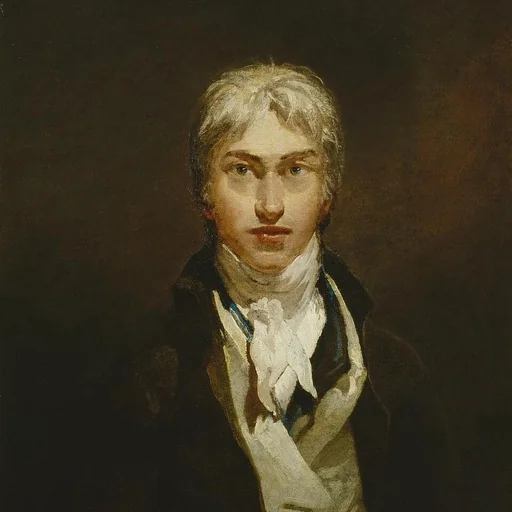
Joseph Mallord William Turner was born in 1775 at Maiden Lane, Covent Garden, where his father kept a barber and wig-making shop.

 Shade and Darkness
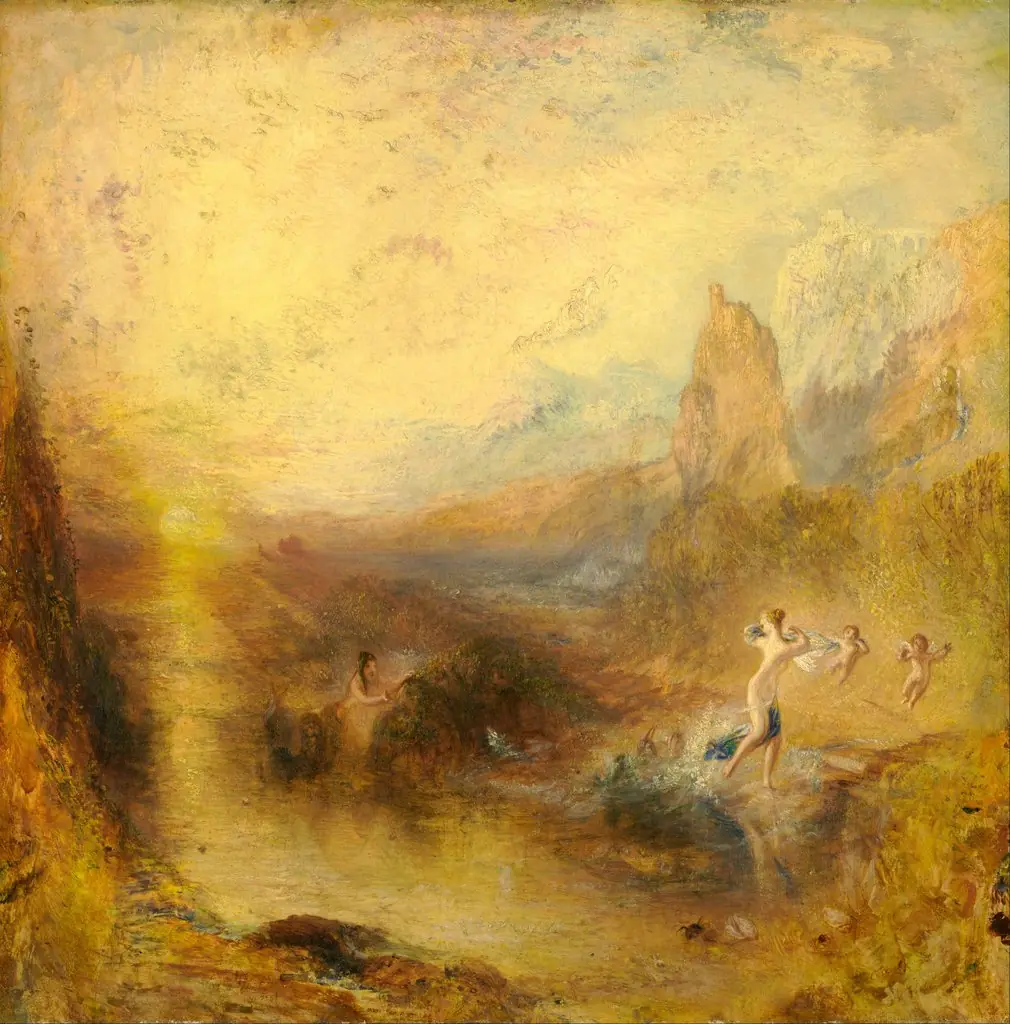 Glaucus and Scylla
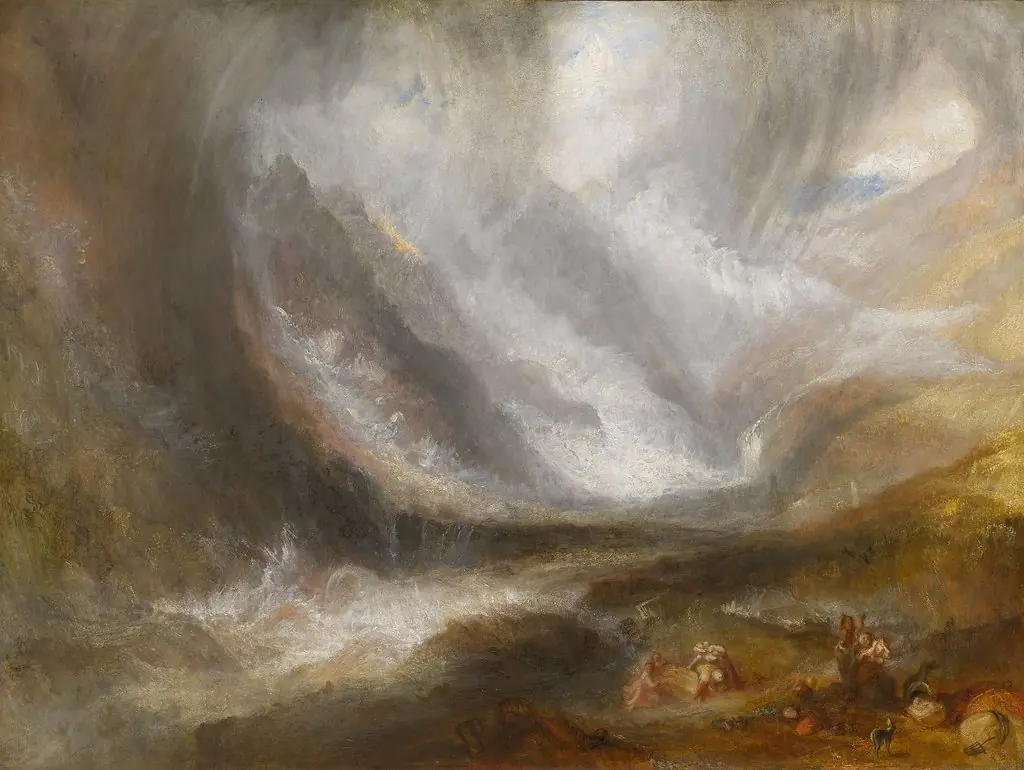 Valley of Aosta: Snowstorm, Avalanche, and Thunderstorm
 Valley of Aosta: Snowstorm, Avalanche, and Thunderstorm
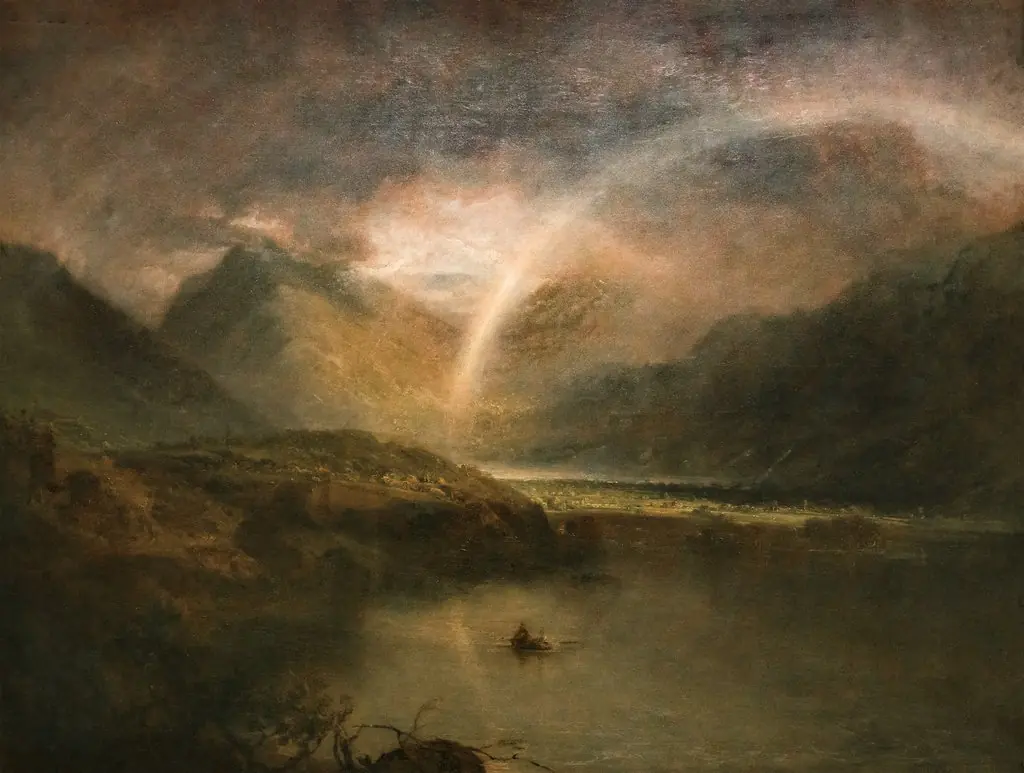 Buttermere Lake, with Park of Cromackwater, Cumberland, a Shower
 Snow Storm: Hannibal and his Army Crossing the Alps
 Queen Mab's Cave
 Queen Mab's Cave
 Slaughtered Pig in a Moonlit Landscape
 Falls of Schaffhausen (Val d’Aosta)
 Rockets and Blue Lights (Close at Hand) to Warn Steamboats of Shoal
- Noah: The Eve of the Deluge