Artwork
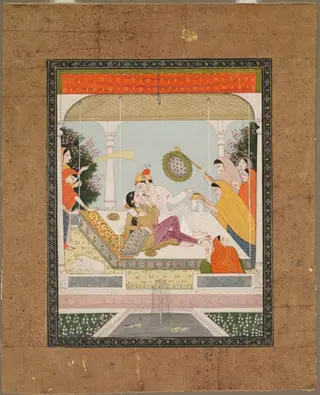
A prince celebrating Holi with palace women on a terrace at night (recto)
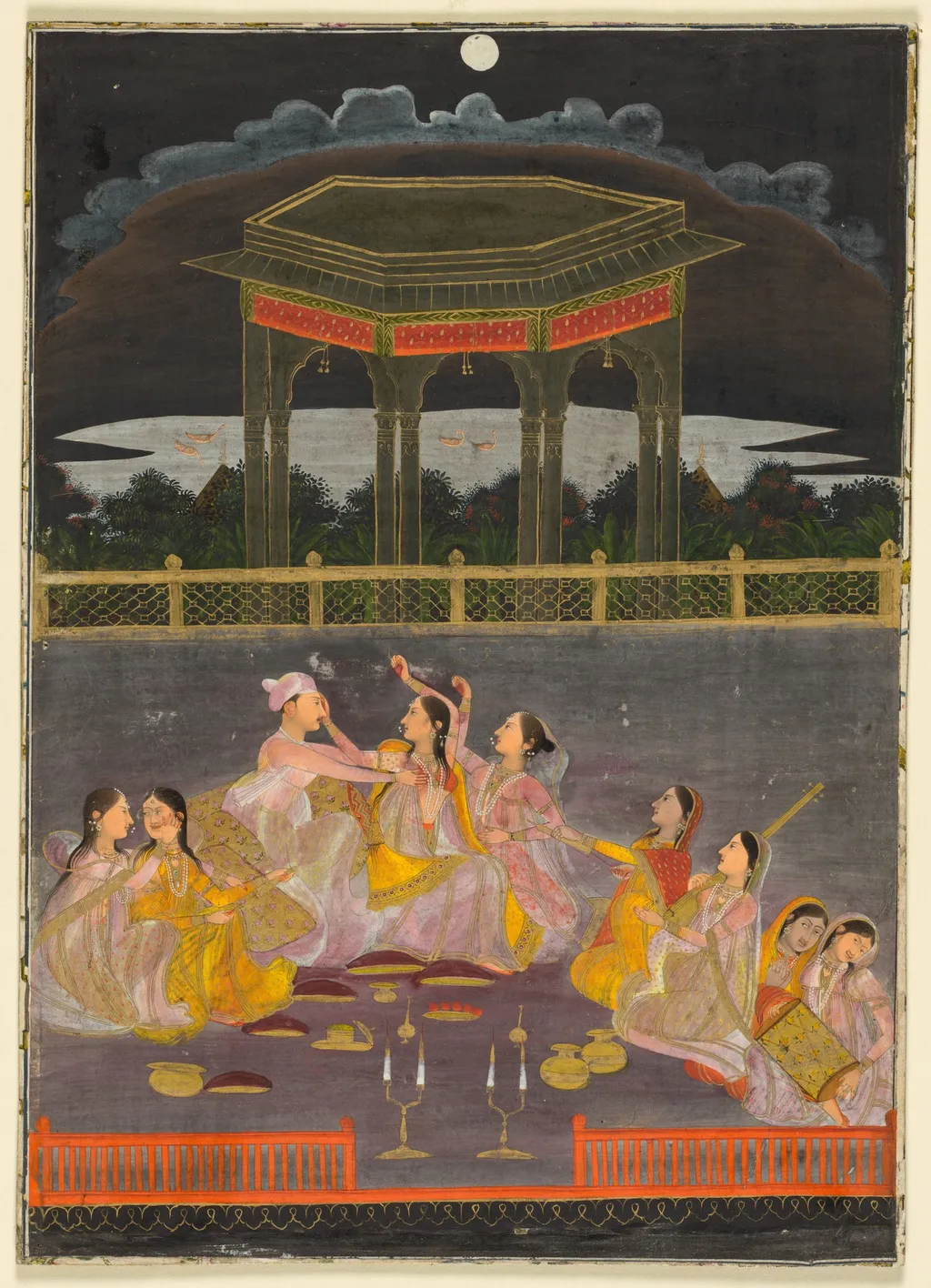
A prince celebrating Holi with palace women on a terrace at night (recto) is an unspecified painting. It dates from 1760 and is held in the collection of the Cleveland Museum of Art.
About this work
Subject & Meaning
The composition focuses on the interaction between the prince and the women, highlighting the festive atmosphere of the occasion under the cover of night.
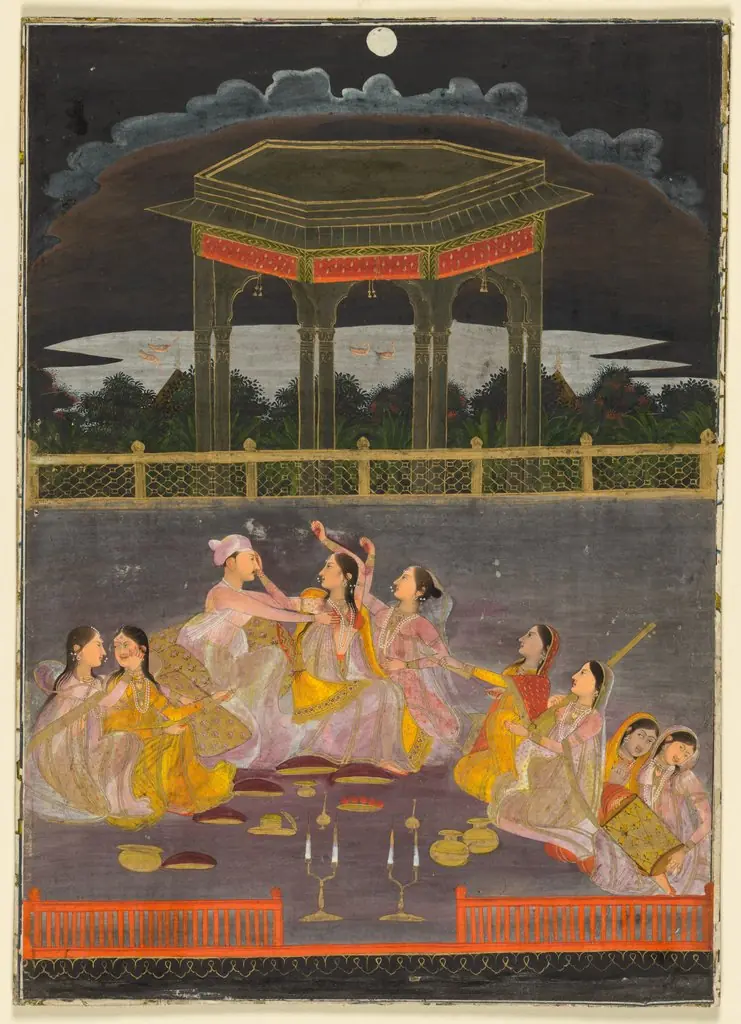
The work depicts a nocturnal scene on a palace terrace where a prince celebrates the festival of Holi alongside palace women. Created in 1760, the painting captures the specific cultural and religious observance of Holi, a spring festival often associated with color and joy, within an intimate, royal domestic setting. The composition focuses on the interaction between the prince and the women, highlighting the festive atmosphere of the occasion under the cover of night.
Technique & Style
The work is an opaque watercolor painting executed on paper, later transferred to a folio page. It depicts a prince celebrating Holi with palace women on a terrace at night, rendered in a nocturnal setting with figures in motion. The composition emphasizes courtly revelry through layered gestures and patterned drapery, reflecting a blend of Mughal and Rajasthani stylistic influences.
The surface shows delicate handling, with fine outlines and washes that suggest both spontaneity and refined draftsmanship. The work is housed at the Cleveland Museum of Art and dates to 1760.
The painting’s medium and support are consistent with Indian miniature traditions of the 18th century, where watercolor on paper was commonly used for court scenes. Its formal qualities include a limited nocturnal palette, rhythmic movement, and ornamental detailing characteristic of Rajput court painting. The handling reveals careful attention to facial expression and gesture, reinforcing narrative intimacy.
The verso is marked with a recto designation, indicating its function as a study or presentation leaf within a dispersed album.
The condition of the work is stable, with no significant damage reported, though minor handling marks are present. The stylistic approach combines naturalistic detail with decorative abstraction, particularly in the treatment of textiles and architectural elements.
History & Provenance
Created in 1760, this painting was produced by an artist whose identity remains unrecorded. The work currently resides in the collection of the Cleveland Museum of Art, where it is cataloged under the accession number 2013.342.a. No specific details regarding the original commission, the identity of the patron, or the chain of ownership prior to its acquisition by the museum are provided in the available records. The piece is classified as a painting depicting a nocturnal terrace scene.
The painting is held in the collection of the Cleveland Museum of Art, located in Cleveland. It is cataloged under the accession number 2013.342.a. The work has been part of the museum's holdings since its inception record of 1760, though specific exhibition history details are not provided in the available sources.
Context
The work is attributed to an anonymous Indian painter active in the mid-18th century, reflecting the Mughal-influenced courtly style prevalent in North Indian painting during that period. Its depiction of a princely Holi celebration aligns with thematic motifs found in Rajput and Pahari artistic traditions, where courtly revelry was a recurring subject. The composition’s nocturnal setting and intimate interaction between figures suggest a narrative emphasis on seasonal festivity within elite domestic spaces.
The attribution to an unnamed artist, documented in Cleveland Museum of Art records, situates the piece within the broader corpus of Indian miniature painting, where individual hands are rarely identifiable but stylistic affinities can be traced to regional workshops. The work’s presence in a Western collection highlights evolving patterns of global art acquisition in the 20th century.
Legacy
The work influenced later artistic representations of Indian courtly celebrations, particularly in 19th-century European travel accounts that referenced its depiction of festive nocturnal scenes. Its inclusion in the Cleveland Museum of Art collection has ensured continued scholarly attention to its cultural narrative.
Overview
The work depicts a nocturnal festivity on a palace terrace, where a male figure in a white turban raises his arms amid a circle of women dressed in vivid pink, yellow and red garments. Candles illuminate the scene, while a moon hangs above a pavilion. The composition includes a railing, a distant landscape with trees and a small boat, and the participants are adorned with heavy jewelry and patterned fabrics.
Artist & collection

- A prince celebrating Holi with palace women on a terrace at night (recto); calligraphy of a quatrain (verso)
 A prince celebrating Holi with palace women on a terrace at night (recto)
 A prince celebrating Holi with palace women on a terrace at night (recto); calligraphy of a quatrain (verso)
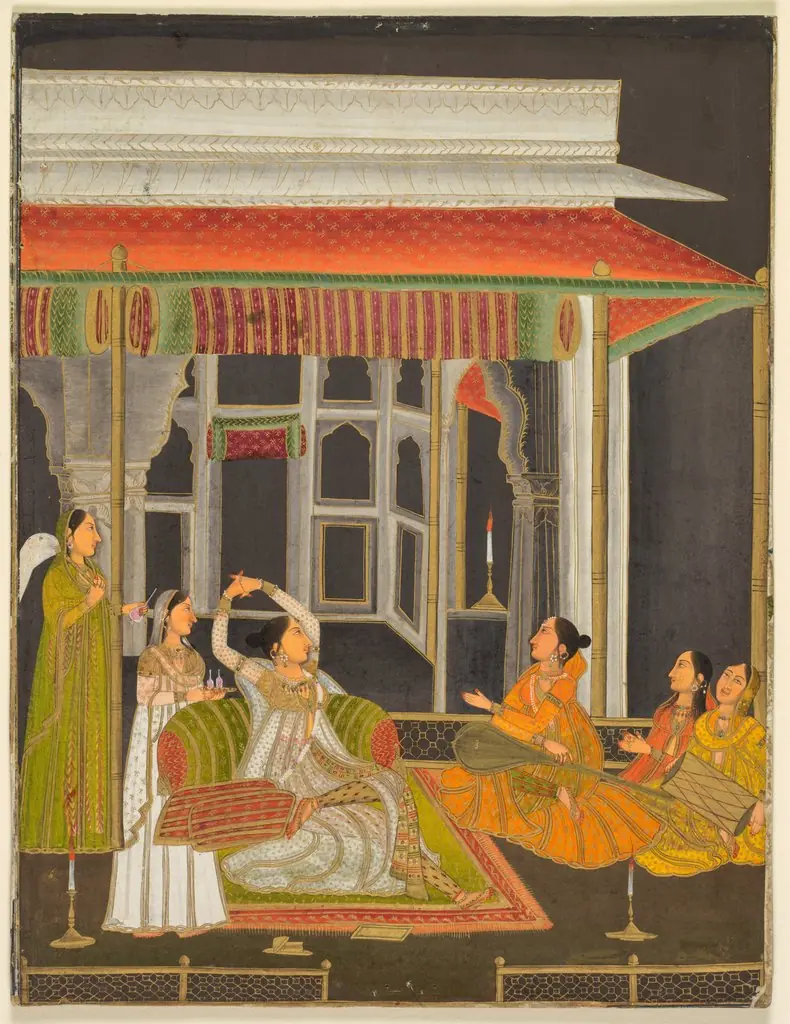 A Princess on a Terrace with Attendants at Night (recto)
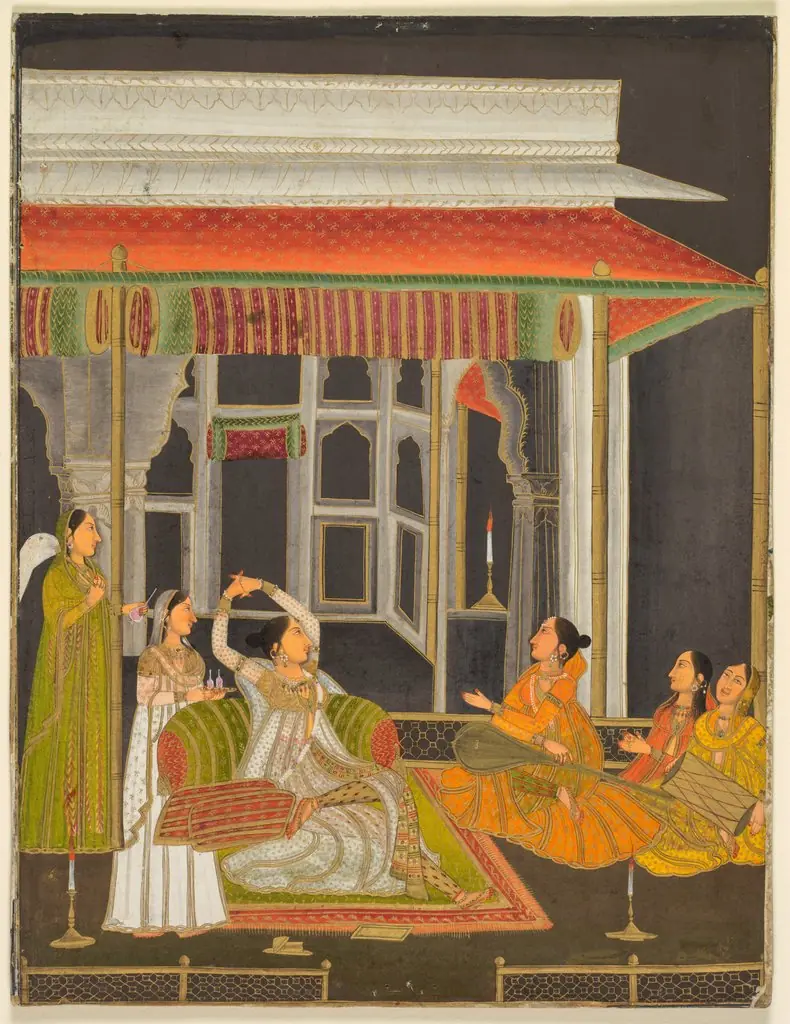 A princess on a terrace with attendants at night (recto); Calligraphy (verso)
 A Princess on a Terrace with Attendants at Night (recto)
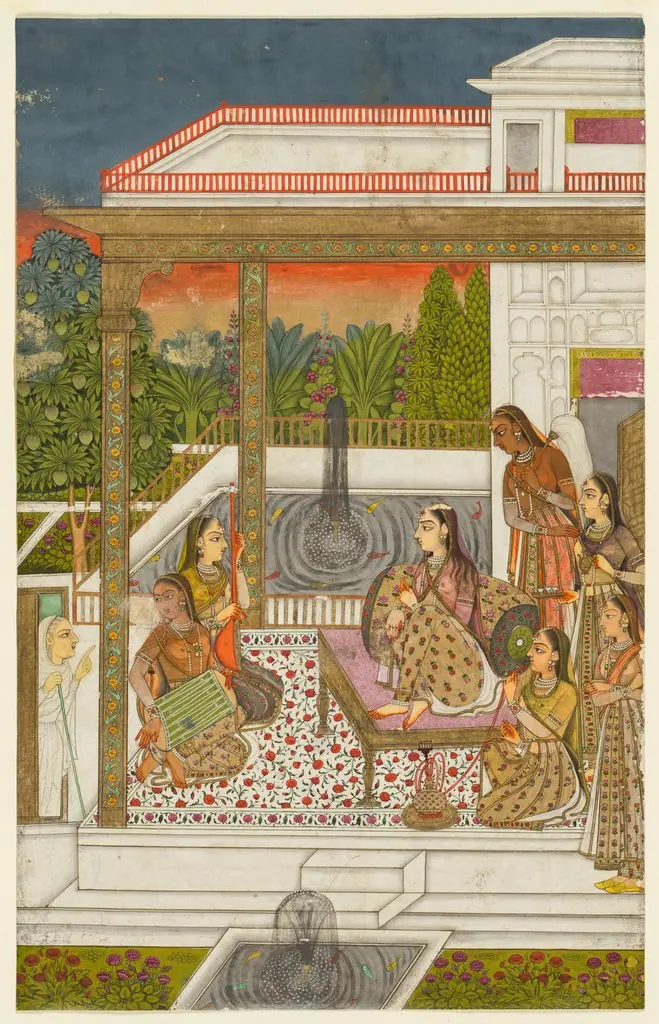 A princess with attendants on a terrace
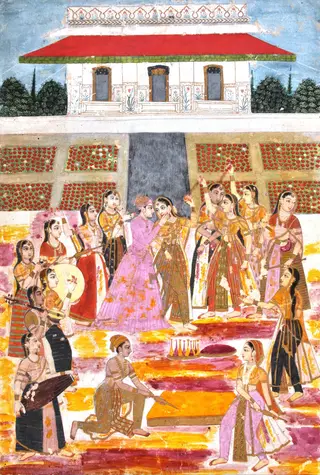 Prince playing Holi in harem
 Raja with his beloved