Artwork
A Warrior Mounting a Held Horse: Saindhava Ragaputra of Shri, from a Chamba Ragamala
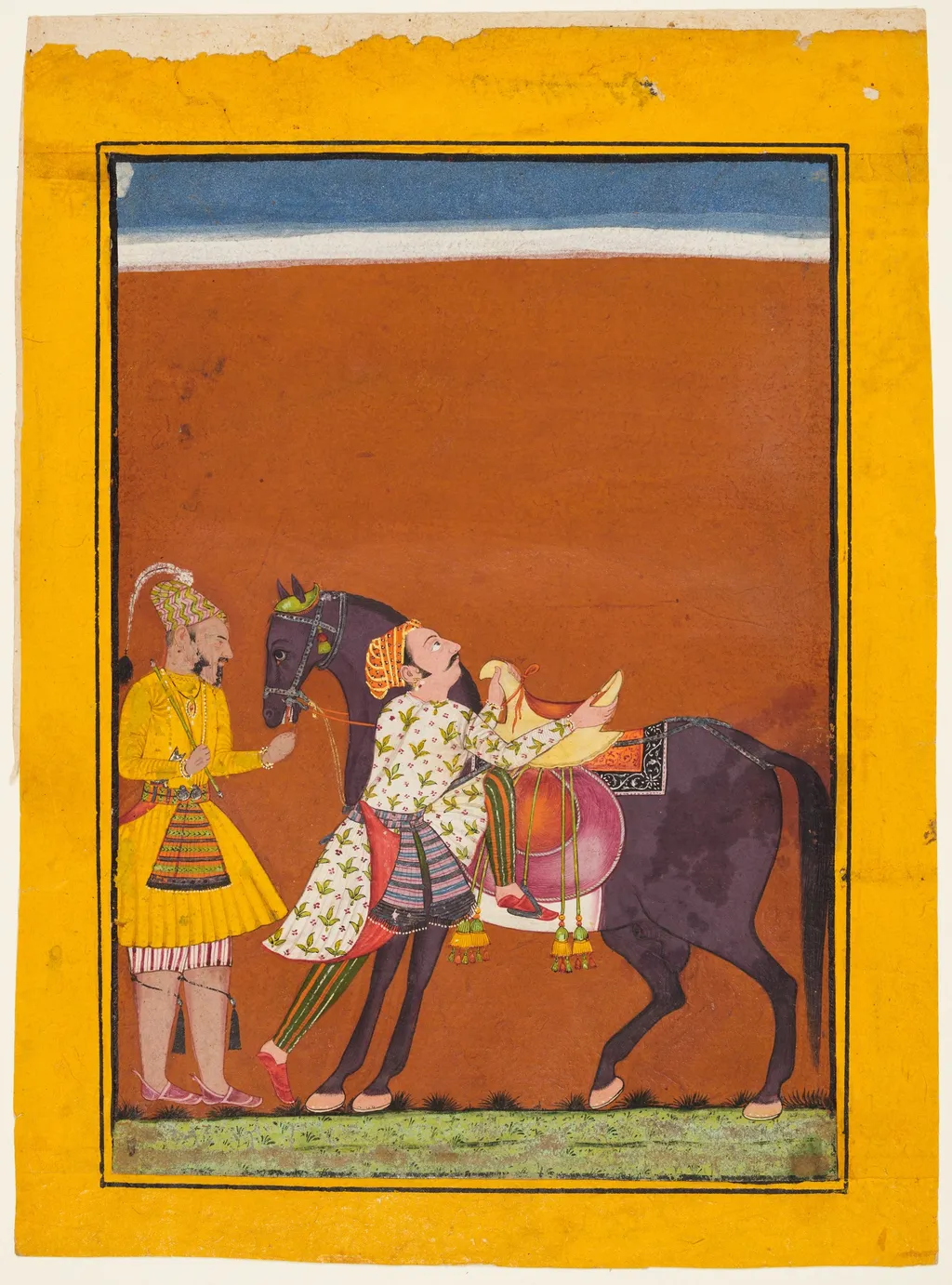
A Warrior Mounting a Held Horse: Saindhava Ragaputra of Shri, from a Chamba Ragamala is an unspecified painting. It dates from 1675 and is held in the collection of the Cleveland Museum of Art.
About this work
Technique & Style
The painting is executed in the traditional Pahari style of the Chamba school, employing opaque watercolor pigments on paper.
The painting is executed in the traditional Pahari style of the Chamba school, employing opaque watercolor pigments on paper. The artwork measures 23.5 cm in height and 31.8 cm in width, adhering to the standard dimensions recorded for this piece. Brushwork demonstrates fine linear detailing characteristic of 17th‑century Chamba artists, while the composition exhibits a restrained palette of earth tones accentuated by selective use of gold leaf for ornamental elements.
The surface shows minor craquelure along the edges, indicative of age but without evidence of structural instability. Formal analysis highlights the dynamic diagonal thrust of the warrior’s pose, balanced by the controlled rendering of the held horse, reflecting the narrative vigor typical of Ragamala illustrations.
History & Provenance
The painting A Warrior Mounting a Held Horse: Saindhava Ragaputra of Shri, from a Chamba Ragamala is held in the collection of the Cleveland Museum of Art. The institution assigns the work the accession number 2018.90. Created in 1675 within the Chamba State, the piece is classified as a painting by an unknown artist.
The provided sources confirm its location and inventory details but do not list specific exhibitions where the work has been displayed.
Overview
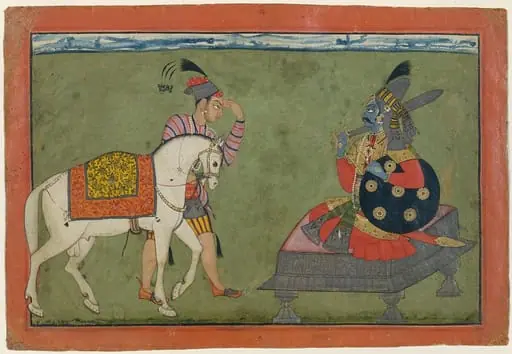
The work portrays a figure in a white, flower‑patterned tunic and striped trousers, crowned with a yellow turban, as he prepares to mount a dark brown horse. A second individual, dressed in a yellow tunic and turban, steadies the animal. The composition rests on a brown ground, topped by a thin blue‑white band, and includes a richly decorated saddle and tassels on the horse.
Subject & Meaning
The central figure is identified as a warrior, suggested by his martial attire and the act of mounting a horse, a common motif of readiness for battle. The assisting figure may represent a stablehand or attendant, emphasizing the ritualized preparation for combat or ceremonial procession within the narrative of the Ragamala series.
Context
The scene is taken from a Chamba Ragamala, a collection of illustrations that visually interpret musical modes (ragas) through allegorical figures and stories. Such manuscripts were produced in the Himalayan kingdom of Chamba during the early modern era, blending local artistic conventions with broader Indian iconographic traditions.
Legacy
Works from the Chamba Ragamala tradition contribute to the understanding of regional variations in Indian miniature painting, illustrating how musical theory was translated into visual narrative. The painting’s depiction of a warrior mounting a held horse exemplifies the fusion of courtly elegance and martial symbolism prevalent in the genre.
Artist & collection

 Sindhu (Saindhava) Ragaputra of Shri Raga, from a Ragamala
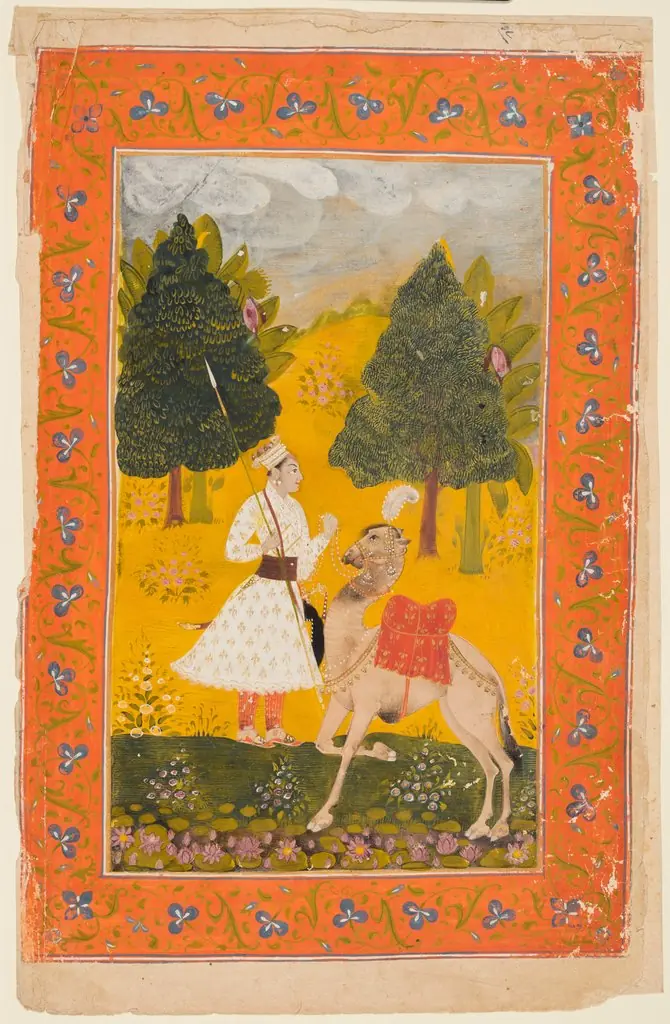 Maru Ragini, from a Ragamala (Garland of Melodies)
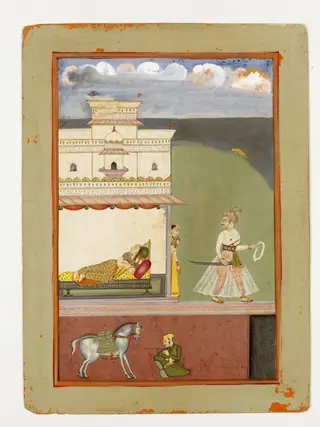 Lalita Ragini
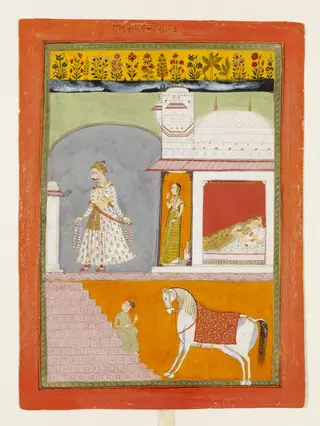 Lalita ragini
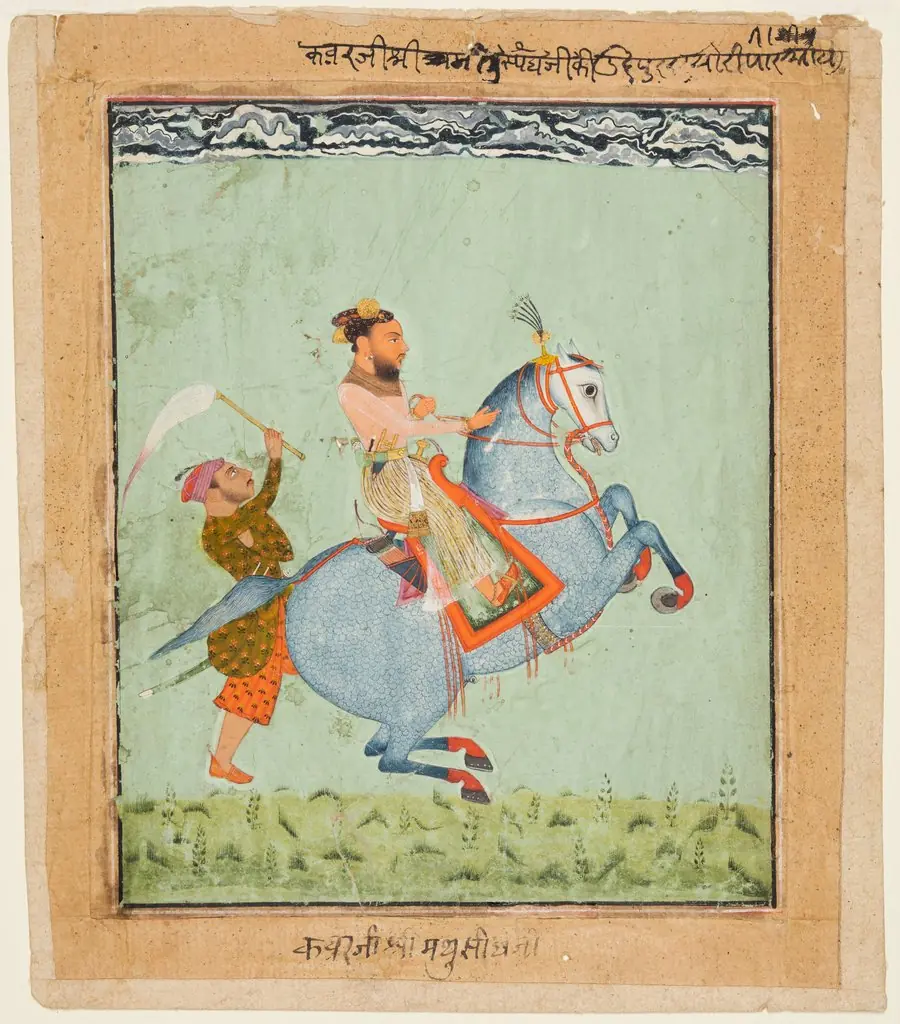 Prince Mathu Singh of Jatoli on a Blue Horse Riding to Udaipur
 Prince Mathu Singh of Jatoli on a Blue Horse Riding to Udaipur
 Untitled
 Vishnu as Kalki
 Dhanasri Ragini
 Kalki
Kalki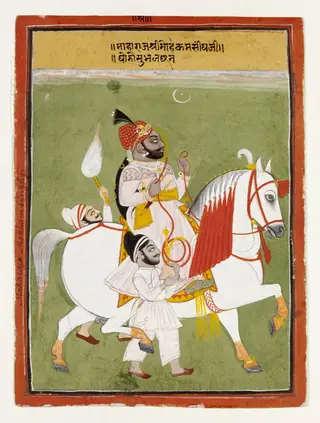 Mokham Singhji
- Maru Ragini, from a Ragamala (Garland of Melodies)