Artwork
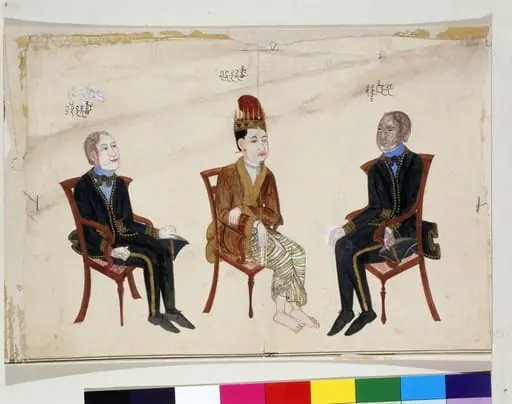
Ambassador of the King of Burma seated with Major Phayre
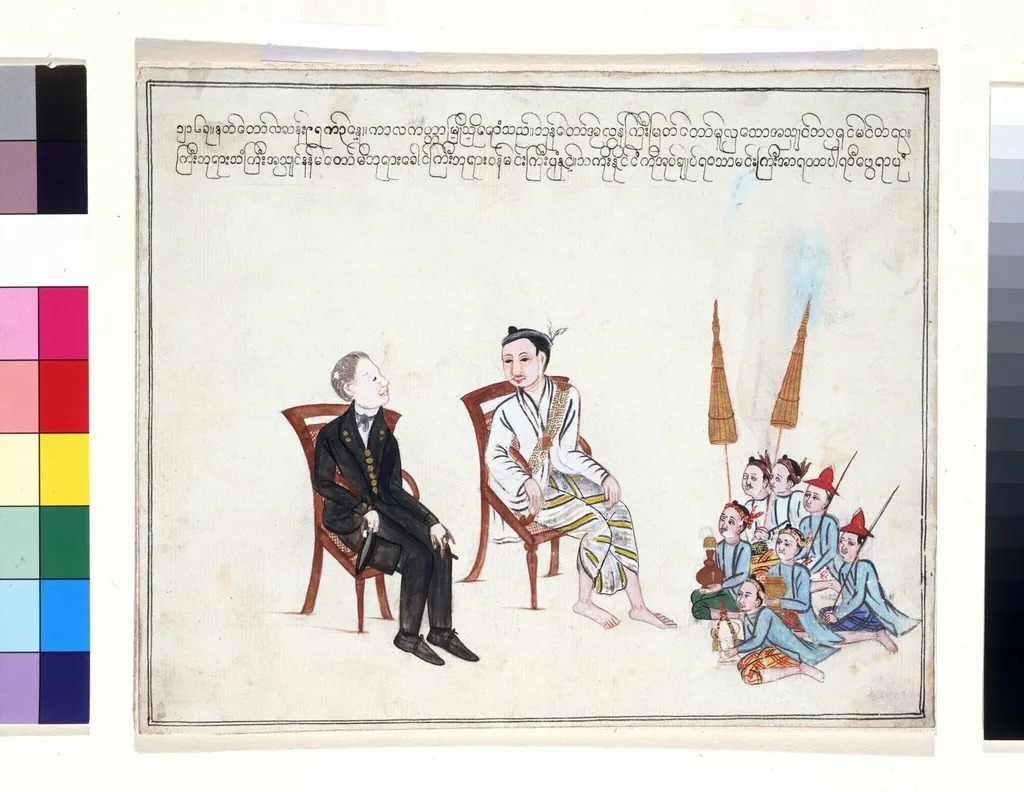
Ambassador of the King of Burma seated with Major Phayre is a paint painting by the Impressionist artist Unknown. It dates from 1854 and is held in the collection of the Victoria and Albert Museum.
About this work
This painting shows two men in suits sitting across from each other. One wears a long jacket with a sash. The other has a red hat and a sword.
It records a real diplomatic visit in 1854. The British ruled southern Burma then. The Burmese king wanted peace.
Mingyi’s embassy was meant to smooth tensions. Look up Victoria and Albert Museum to see more of its Asian art.
Overview
The work is one of a trio of watercolour paintings that document the 1854 diplomatic mission of Burmese envoy Ashin Nanmadaw Payawun Mingyi to Calcutta. It captures a meeting between the Burmese ambassador and Sir Arthur Phayre, the British Commissioner for Burma, illustrating the formal yet relaxed atmosphere of the encounter.
Subject & Meaning
The scene portrays the ambassador seated opposite Phayre, each dressed in contemporary attire: the Burmese official in a silk pahsoe and white muslin jacket, the British figure in a Western suit with a sash. The composition emphasizes the exchange of cultures and the diplomatic overture following the Second Anglo‑Burmese War.
Technique & Style
Executed in watercolour, the painting combines precise linear drawing with delicate washes to render fabrics, insignia and facial features. The artist, likely attached to the Burmese court, balances detailed representation of ceremonial objects, swords, umbrellas, headcloths, with a softer, more informal rendering of the seated figures.
History & Provenance
Created shortly after the 1854 embassy, the three related watercolours entered the Victoria and Albert Museum through the donation of Sir Arthur Phayre’s great‑niece. Their provenance links directly to the participants of the mission, offering a contemporaneous visual record of the event.
Context
The embassy occurred after the British annexation of lower Burma in 1852, when King Mindon Min sought to ease tensions with the colonial administration. The visit to Governor‑General Lord Dalhousie in Calcutta was intended as a gesture of goodwill, with Phayre serving as interpreter and liaison.
Legacy
These paintings provide rare insight into mid‑nineteenth‑century Burmese diplomatic protocol and attire, complementing textual accounts of the period. As visual sources, they aid scholars in understanding the interplay of Burmese and British ceremonial practices during a pivotal moment in colonial history.
Artist & collection