Artwork
An East African King Receives Three Emissaries, from a Khamsa of Amir Khusrau Dihlavi
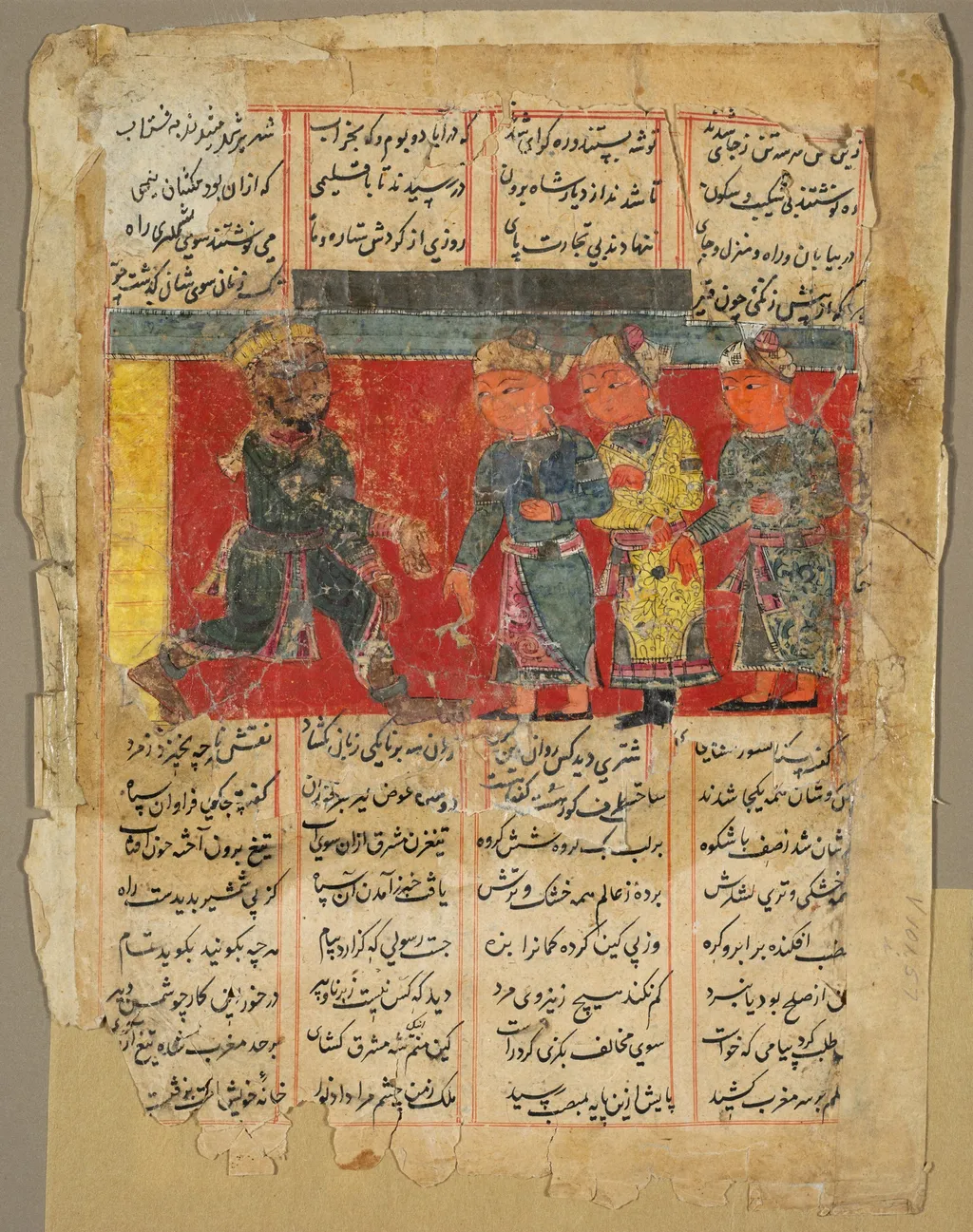
An East African King Receives Three Emissaries, from a Khamsa of Amir Khusrau Dihlavi is an unspecified painting. It dates from 1450 and is held in the collection of the Cleveland Museum of Art. The work depicts a formal encounter in which an East African ruler receives three emissaries.
About this work
History & Provenance
The painting An East African King Receives Three Emissaries, created in 1450, is held in the collection of the Cleveland Museum of Art.
The painting is dated to 1450, a dating carried by the work itself and consistent with its attribution to a Khamsa of Amir Khusrau Dihlavi produced in that period. It is now held in the collection of the Cleveland Museum of Art, where it is recorded under the accession number 1963.261, indicating that it entered the museum in 1963. No further details of its earlier ownership chain, commission, or creation circumstances are documented in the available sources.
The painting An East African King Receives Three Emissaries, created in 1450, is held in the collection of the Cleveland Museum of Art. The institution assigns the work the accession number 1963.261. No specific exhibition history for this manuscript folio is provided in the available records.
Context
The painting An East African King Receives Three Emissaries, from a Khamsa of Amir Khusrau Dihlavi, created circa 1450, depicts a moment of diplomatic exchange that scholars interpret as reflecting East African courtly hierarchies and transregional connections within Indian Ocean trade networks. Its attribution to an anonymous artist associated with the Cleveland Museum of Art collection underscores the work's significance in early East African visual culture and manuscript illumination. The piece is studied within the broader corpus of 15th-century East African art, where royal iconography and diplomatic narratives were rendered in manuscript form, contributing to scholarly discussions on cross-cultural exchange in medieval Indian Ocean societies.
Overview
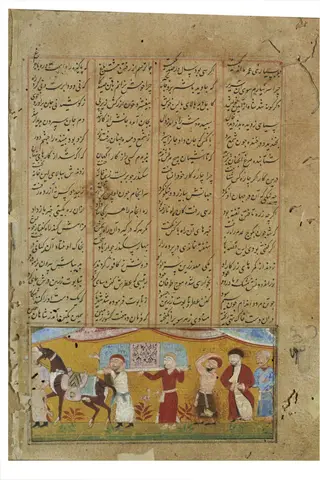
The work depicts a formal encounter in which an East African ruler receives three emissaries. Four male figures dominate the composition: a dark‑skinned king seated on a raised red platform, dressed in a green garment and a yellow hat, and three lighter‑skinned visitors standing beside him in vivid attire and headgear. The background is rendered in bold red and yellow fields, and despite considerable age and damage, the original palette remains strikingly bright.
Subject & Meaning
The scene illustrates a diplomatic exchange, likely drawn from the Khamsa of Amir Khusrau Dihlavi, a medieval Persian literary collection that includes tales of courtly etiquette and political intrigue. The presence of an African monarch and foreign envoys suggests themes of cross‑cultural interaction, authority, and the ceremonial protocols governing such meetings.
Technique & Style
Executed in a traditional miniature painting technique, the piece employs flat areas of saturated color and fine linear detailing characteristic of Persian court art. The figures are outlined with delicate brushwork, while the use of contrasting reds, yellows, and greens creates visual hierarchy, emphasizing the seated ruler against the surrounding platform.
Artist & collection

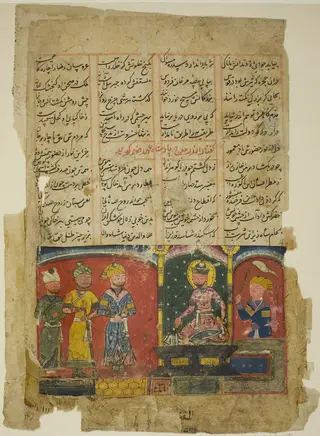 Amir Khusraw Dedicates His Poem to Sultan Ala al-Din Khalji, page from a copy of the Khamsa of Amir Khusraw Dihlavi
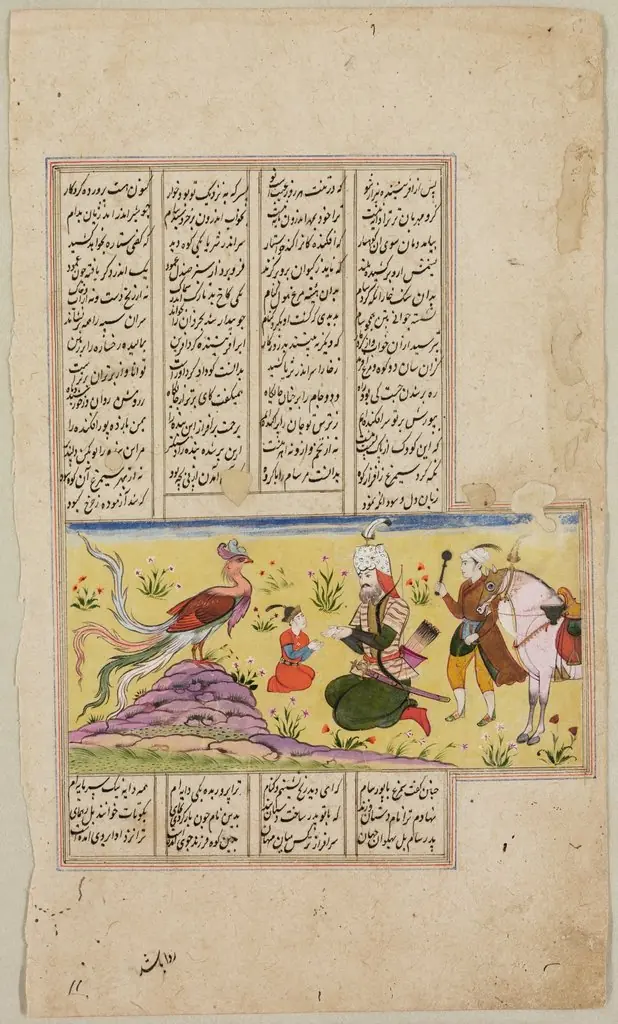 Rustam and the Simurgh
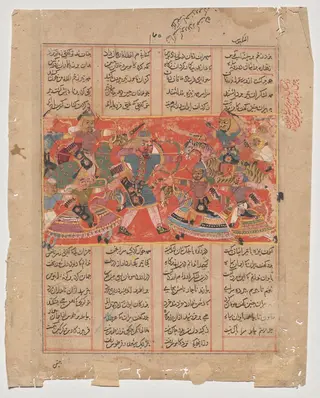 Rustam Takes Aim at Ashkabus, from a Shah-nama (Book of Kings)
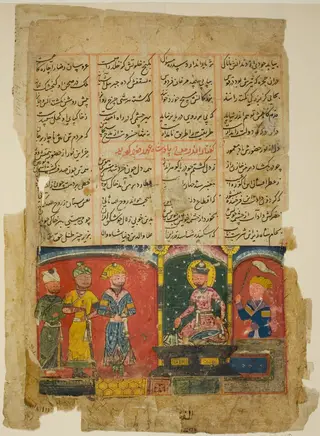 Amir Khusrau Dedicates His Poem to Sultan Ala al-Din Khalji, page from the Quintet (Khamsa) of Amir Khusraw Dehlavi
 Untitled
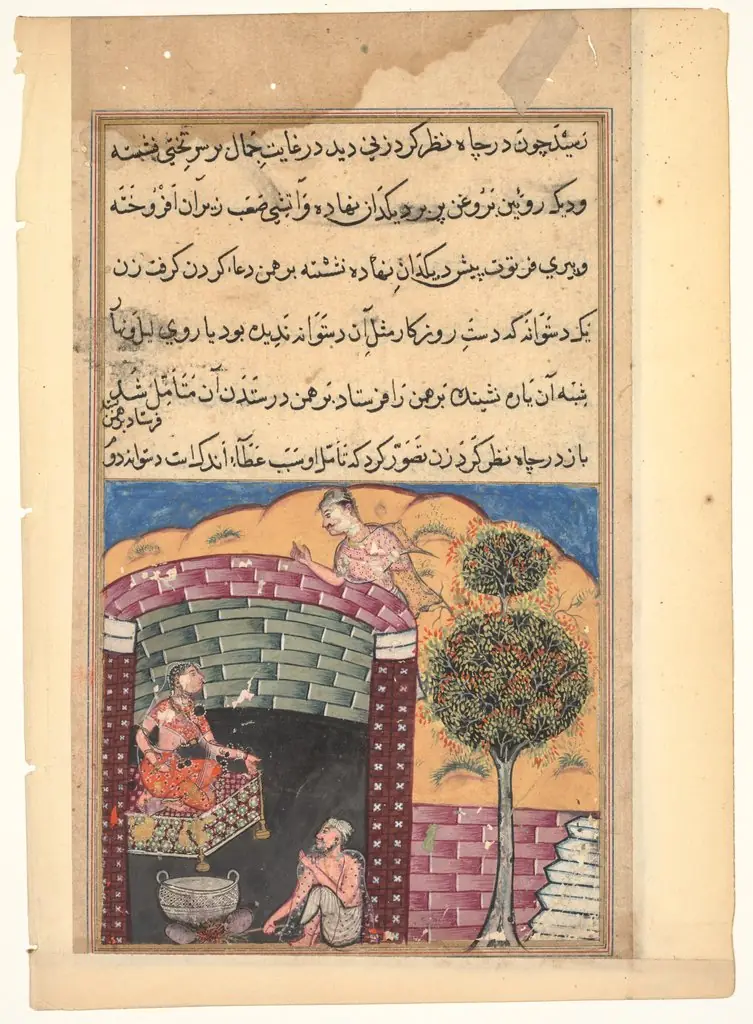 The Brahman gambler sees the daughter of the king of the jinns in a pit together with an old man and a cauldron of boiling oil, from a Tuti-nama (Tales of a Parrot: Seventh Night)
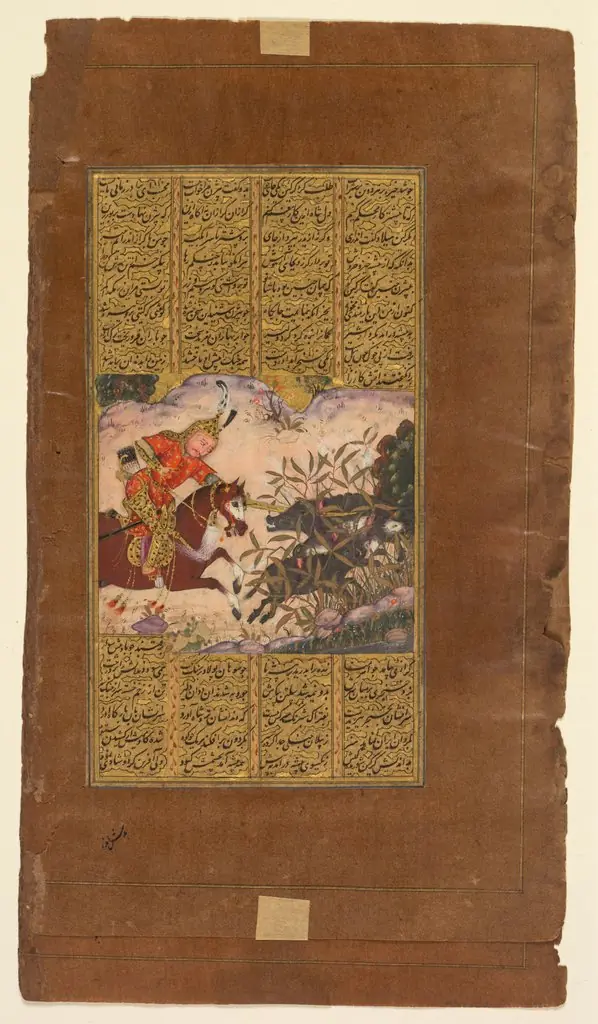 Bijan killing the wild boars of Irman, from a Shah-nama (Book of Kings) of Firdausi (Persian, about 934–1020) (verso)
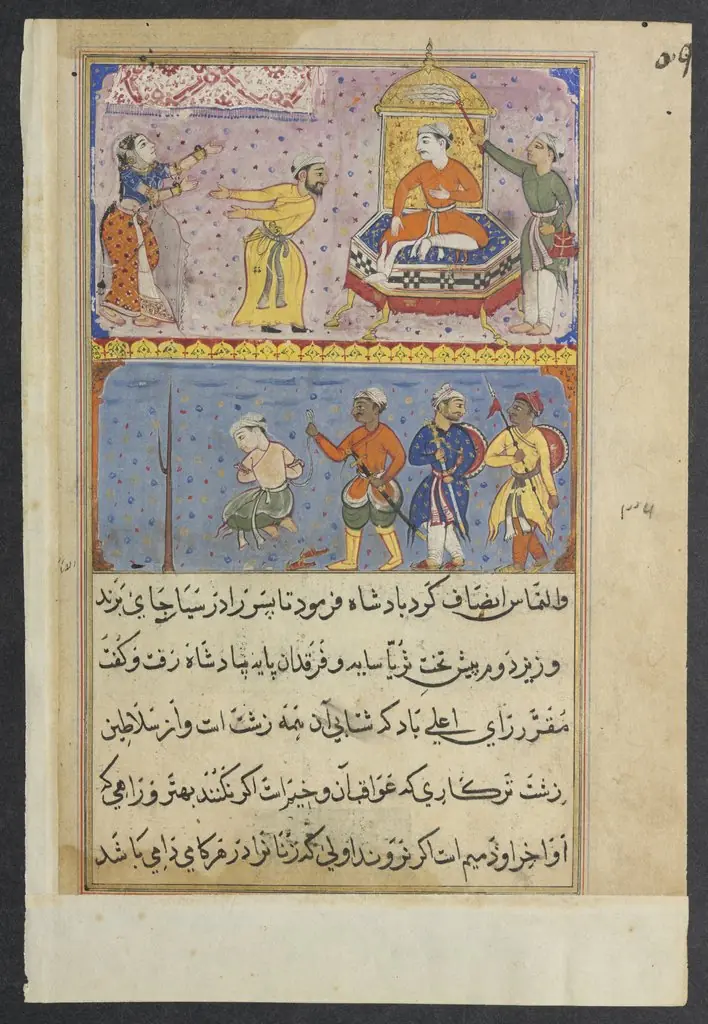 The prince, once reprieved, is returned to the palace of execution a second time on the plea of the king’s handmaiden, from a Tuti-nama (Tales of a Parrot): Eighth Night
 The prince, once reprieved, is returned to the palace of execution a second time on the plea of the king’s handmaiden, from a Tuti-nama (Tales of a Parrot): Eighth Night
- An East African King Receives Three Emissaries, from a Khamsa of Amir Khusrau Dihlavi