Artwork
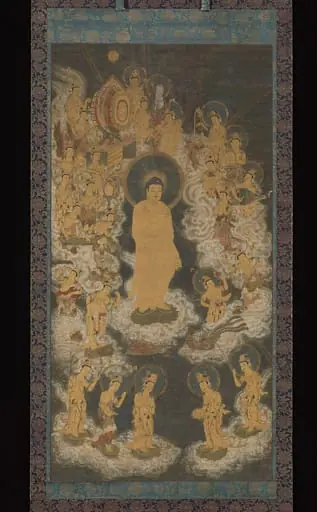
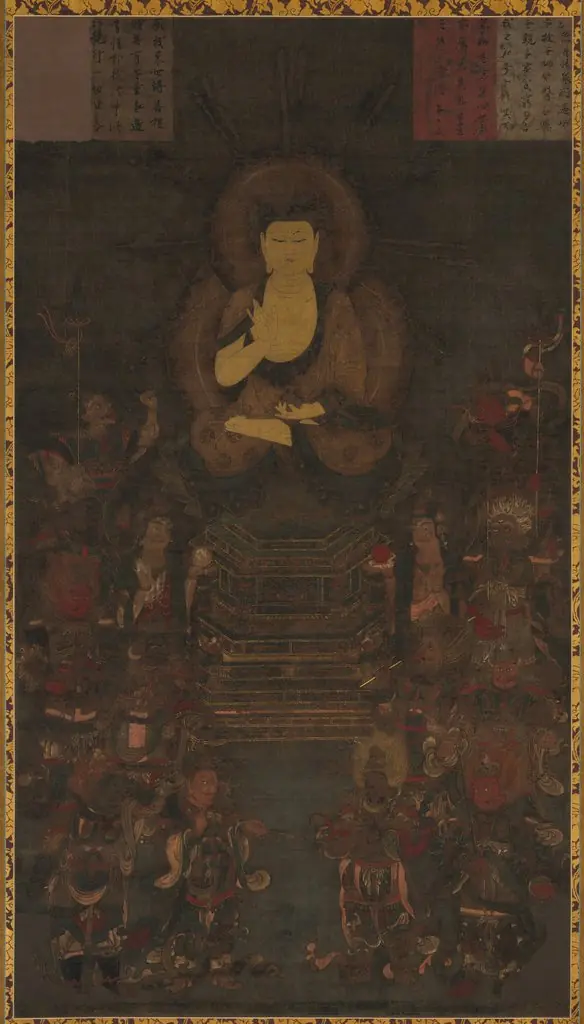
阿弥陀二十五菩薩来迎図|Buddha and Attendants
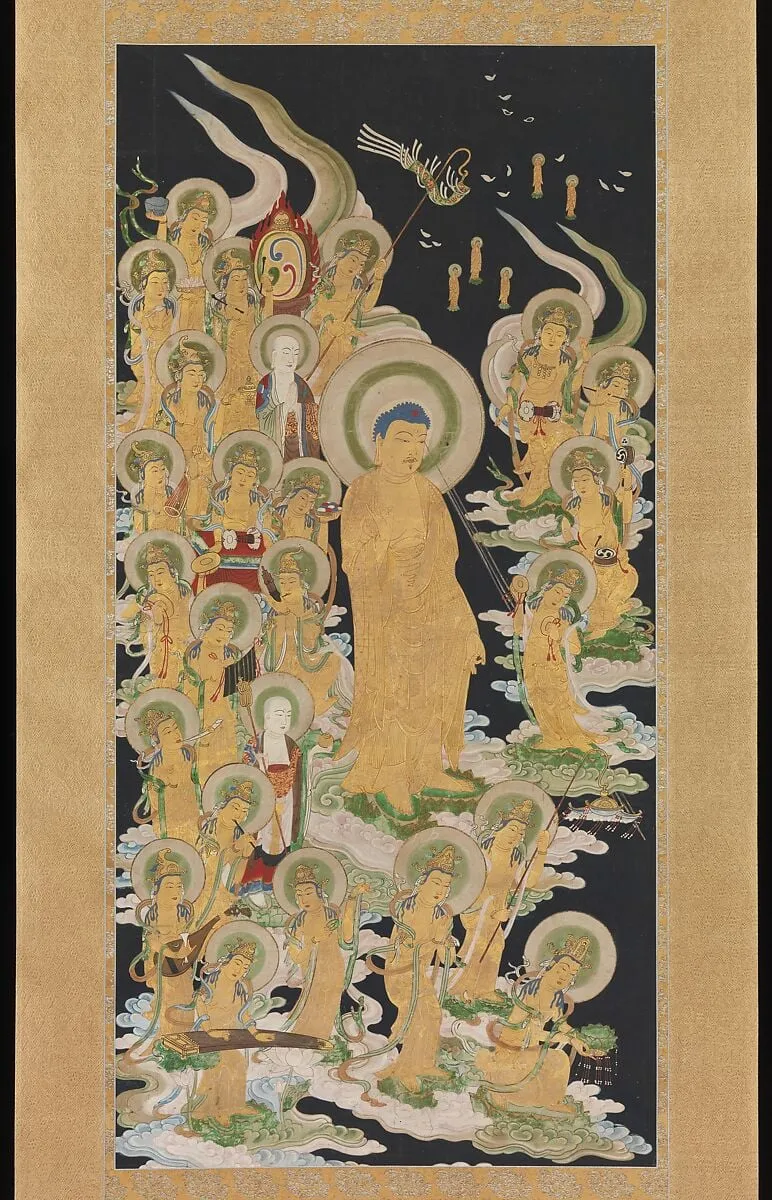
阿弥陀二十五菩薩来迎図|Buddha and Attendants is an ink painting. It dates from 1707 and is held in the collection of the Metropolitan Museum of Art. This hanging scroll, titled Buddha and Attendants (阿弥陀二十五菩薩来迎図), is a painting rendered in ink and color on paper.
About this work
Subject & Meaning
This iconography illustrates the Pure Land belief in the compassionate arrival of Amida and his retinue to escort a devotee's soul to the Western Paradise.
The work depicts the Buddhist subject of Amida Buddha accompanied by twenty-five bodhisattas, a scene representing the divine welcome awaiting the faithful at the moment of death. This iconography illustrates the Pure Land belief in the compassionate arrival of Amida and his retinue to escort a devotee's soul to the Western Paradise. The painting serves as a visual representation of this soteriological promise, emphasizing the central role of Amida in Japanese Buddhist practice.
As a religious hanging scroll, the image functions as an object of devotion and a reminder of the path to salvation within the Pure Land tradition.
Technique & Style
The work is executed as a hanging scroll on paper, using ink outlines filled with pigment color, a technique typical of Edo‑period Buddhist paintings. The support is a single sheet of paper, handled by mounting it on a silk roller for display. The composition depicts Amitābha surrounded by twenty‑five bodhisattvas, arranged in a hierarchical vertical format that emphasizes spiritual ascent.
Stylistically, the figures are rendered with delicate line work and subtle gradations of color, reflecting a refined decorative aesthetic rather than naturalistic representation. Documentation does not specify the current condition of the scroll.
History & Provenance
The work titled Buddha and Attendants, also known as 阿弥陀二十五菩薩来迎図, is a hanging scroll painted in ink and color on paper during 1707 in Japan. The piece, classified as a religious painting, depicts Buddha and his attendant bodhisattvas and was produced by an anonymous artist. It measures 96.4 cm in height and 46.2 cm in width.
The scroll entered the collection of the Metropolitan Museum of Art, where it remains on display. Its creation is attributed to an anonymous Japanese painter working in the early 18th century.
The painting is held in the collection of the Metropolitan Museum of Art, where it is identified as part of the museum's paintings holdings. Its 1707 date and Japanese origin are documented within the museum's cataloguing record.
No specific accession number, credit line, or prior exhibition history is recorded in the available sources.
Overview
This hanging scroll, titled Buddha and Attendants (阿弥陀二十五菩薩来迎図), is a painting rendered in ink and color on paper. It depicts a divine procession led by a golden Buddha, surrounded by numerous smaller figures, all descending upon soft, pink clouds. This artwork was specifically created for display in a temple setting, intended to be used during funeral rites.
Context
This type of painting played a significant role in Buddhist funerary practices, particularly within Pure Land Buddhism. Hung in temples during memorial services, the scroll served as a visual aid for the bereaved, illustrating the promise of Amida Buddha's compassion and his direct intervention to receive the departed. It reinforced the belief in a peaceful journey to the Pure Land, offering spiritual comfort during a time of loss.
Artist & collection

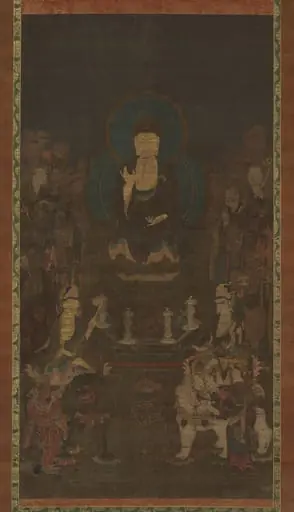 釈迦三尊十大弟子像|Shaka (Shakyamuni), the Historical Buddha, with Two Attendant Bodhisattvas and the Ten Great Disciples
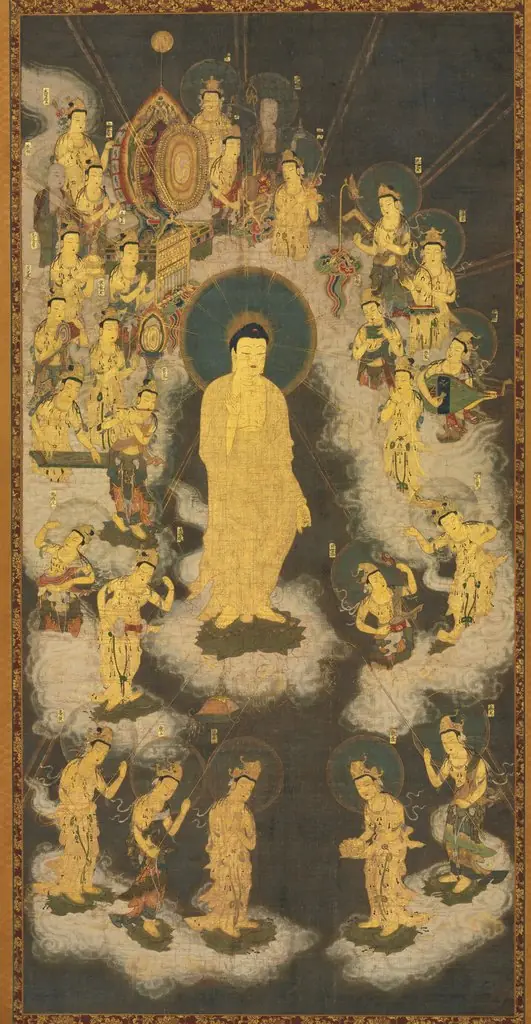 Welcoming Descent of Amida (Amida Raigō)
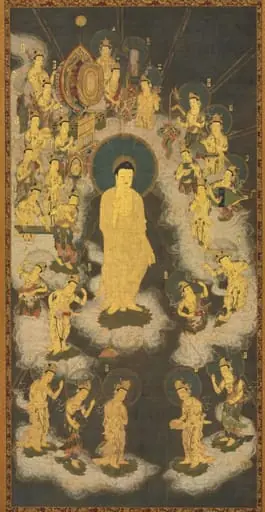 Welcoming Descent of Amida (Amida Raigō)
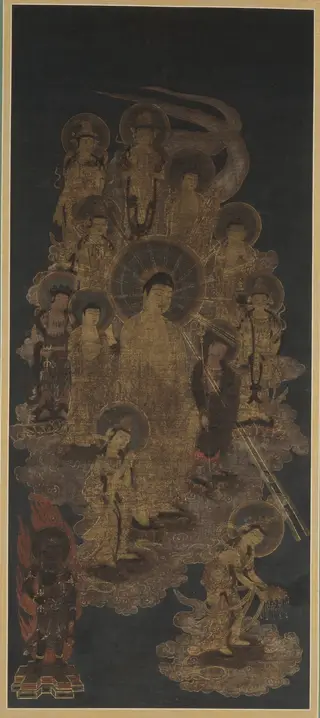 Thirteen Buddhas Welcoming the Dying Believer to the Western Pure Land
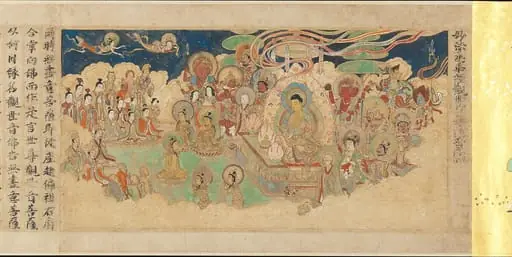 『妙法蓮華経』 「観世音菩薩普門品」|“Universal Gateway,” Chapter 25 of the Lotus Sutra
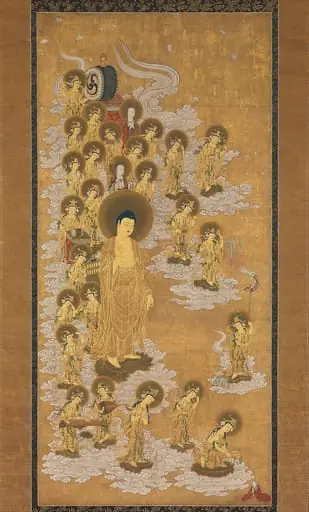
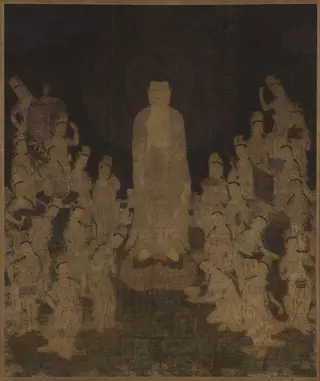 Welcoming Descent of Amida with Twenty-Five Bodhisattvas
 Medicine Master Buddha and the Twelve Divine Generals