Artwork
De vastgelopen wagen
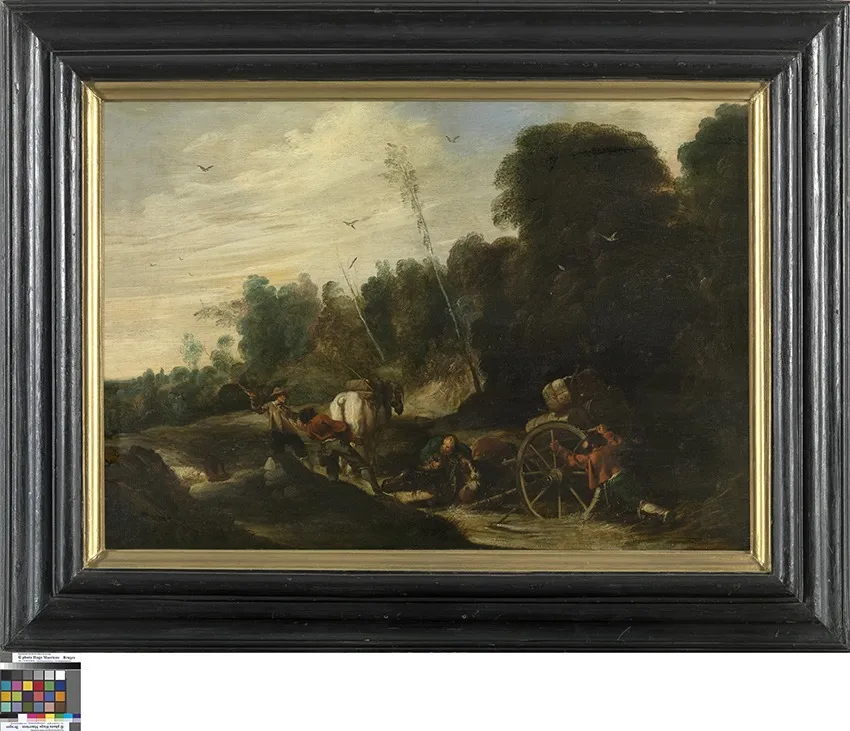
De vastgelopen wagen is an oil painting by the Dutch Golden Age artist Unknown. It dates from 1620 and is held in the collection of the Groeningemuseum. This oil painting depicts a rural scene in which a group of individuals attend to a stalled wagon on a dirt path.
About this work
Overview
6 cm in width, the painting belongs to the collection of Musea Brugge and is held at the Groeningemuseum in Bruges, bearing the accession number 0000.
De vastgelopen wagen is an oil painting on panel created circa 1620. The work is attributed to a follower of Peter Paul Rubens, rather than the master himself, and likely dates between circa 1620 and circa 1700. Measuring 55.6 cm in height and 80.6 cm in width, the painting belongs to the collection of Musea Brugge and is held at the Groeningemuseum in Bruges, bearing the accession number 0000.GRO0244.I. The composition captures a heavily laden cart stuck in the mud, a theme executed multiple times by Rubens, and this version is considered a probable copy of a lost original from around 1615.
Subject & Meaning
The painting depicts a heavily packed wagon bogged down in a muddy track at the edge of a forest. Five men struggle to free the cart and its draft animal from the sludge. One figure in red leans near the white horse harnessed to the cart, another crouches beside the vehicle, and a third pushes or pulls at the large wooden wheel. A small dog stands nearby. The background contrasts the dense, dark green forest on the right with a lighter sky featuring scattered birds and soft clouds on the left. The scene captures human and animal exertion against the resistance of the natural world, a motif Rubens explored repeatedly in his early landscapes.
Technique & Style
Executed in oil paint on a wooden panel, the work demonstrates a stylistic alignment with the early landscape compositions of Peter Paul Rubens. The composition relies on a strong diagonal axis, analogous to a known Rubens version from 1617. The figures are plastically modeled and depicted in highly animated, twisted poses, which are characteristic of Rubens' approach to landscape painting. The palette is dominated by earthy browns, dark greens, and muted yellows, accented by touches of red in the figures' clothing. Light enters from the left, illuminating the sky and parts of the scene while casting deep shadows in the wooded area. The brushwork appears smooth in the sky and more textured in the foliage and earth.
History & Provenance
The painting is believed to be a copy of a lost original by Peter Paul Rubens, likely dating to around 1615. While the exact provenance chain prior to its museum entry is not documented in the available sources, the work is currently part of the Musea Brugge collection. It is housed in the Groeningemuseum under the inventory number 0000.GRO0244.I. The painting is presented in a dark wooden frame with a gold inner border, measuring 79.5 cm by 104 cm with the frame included.
Context
The painting occupies a specific place in the study of Rubens' workshop and influence. While the composition and the vigorously twisted figures reflect Rubens' early landscape innovations, scholars have determined that the work was most likely not painted by Rubens himself. Instead, it is classified as being by a follower of the master. Some institutional records initially attributed the work directly to Peter Paul Rubens, but current museum scholarship firmly categorizes it as a work by an unknown follower, highlighting the dissemination and replication of Rubens' compositional ideas in the seventeenth century.
Legacy
As a probable copy of a lost Rubens original, De vastgelopen wagen serves as a vital visual record of a composition that would otherwise be unknown to modern scholars. The painting preserves the diagonal compositional structure and the dynamic, muscular figural style that characterized Rubens' landscape output around 1615 to 1617. Its survival in the Groeningemuseum allows for continued comparative study of Rubens' thematic repetitions, specifically his multiple variations on the stuck cart, and provides insight into how the master's designs were reproduced and circulated by his workshop and followers.
Artist & collection