Artwork
Hercules and the Nemean lion
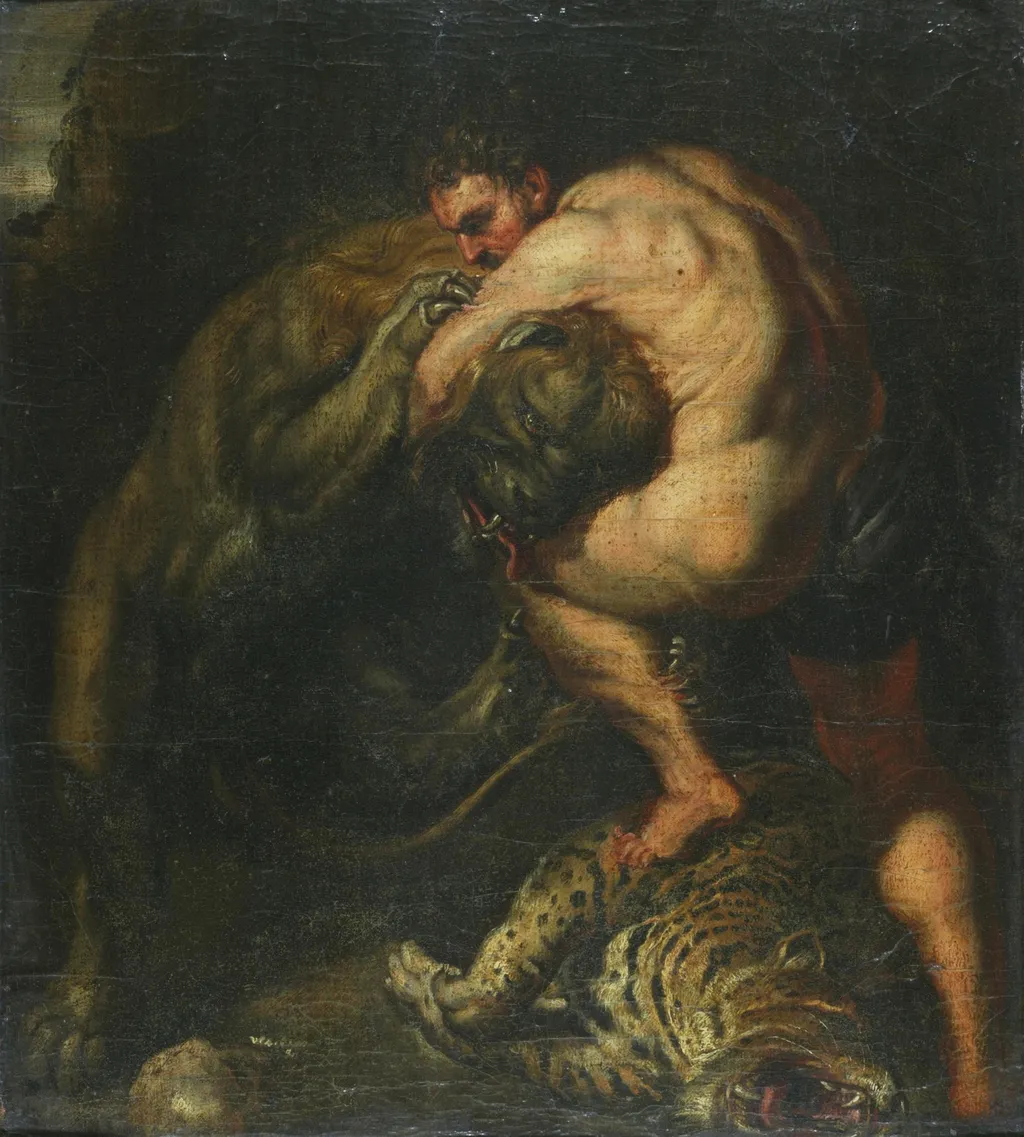
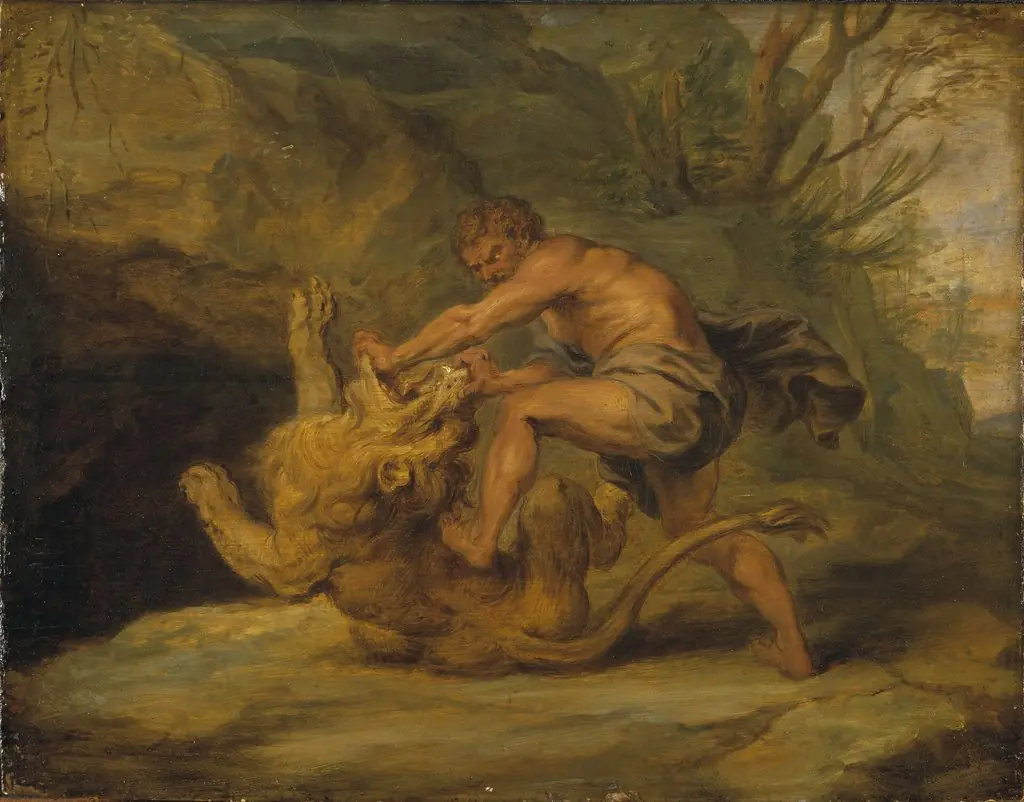
Hercules and the Nemean lion is an oil painting by the French Romanticist artist Unknown. It dates from 1800 and is held in the collection of the Victoria and Albert Museum. The oil painting portrays a muscular, shirtless figure locked in combat with a lion.
About this work
Overview
Hercules and the Nemean Lion is an oil painting attributed to an anonymous artist working after Peter Paul Rubens, dated to approximately 1800.
Hercules and the Nemean Lion is an oil painting attributed to an anonymous artist working after Peter Paul Rubens, dated to approximately 1800. The work measures 44.5 by 39 centimeters and is executed in oil on canvas laid on panel. It depicts the mythological hero Hercules wrestling the Nemean Lion, the first of his twelve labors. The painting is held in the collection of the Victoria and Albert Museum, currently located at the V&A East Storehouse, and was acquired by the museum in 1864 through the bequest of Mrs. Duroure. As a later adaptation of Rubens's celebrated treatment of this subject, the painting exemplifies the enduring appeal of Herculean iconography in European art and the widespread practice of copying and adapting compositions by major masters during the late eighteenth and early nineteenth centuries.
Subject & Meaning
The painting illustrates the climactic moment of Hercules's first labor: the strangling of the Nemean Lion. In Greek mythology, this beast possessed impenetrable golden fur that repelled all mortal weapons, rendering it invulnerable to arrows, swords, and clubs. Hercules's solution, wrestling the lion to death with his bare hands, demonstrated not only superhuman strength but also the ingenuity required when conventional force failed. The composition centers on this physical struggle, with Hercules's muscular form bent over the lion, his arms locked around its neck. The lion's gaping mouth and visible tongue convey the violence of the encounter. The spotted animal skin draped across the lower foreground likely alludes to the lion's pelt, which Hercules subsequently fashioned into his iconic armor, wearing the head as a helmet and the body as a cloak. A club rests against the right edge, referencing the hero's futile initial attempts with conventional weapons. The faint architectural element in the upper left may suggest the cave where the confrontation occurred, which Hercules blocked to trap the beast. The subject carried layered meanings for contemporary viewers: it spoke to themes of divine punishment and redemption, since the labors were penance for Hercules's murder of his family; it celebrated the triumph of civilization over chaos; and it served as a reminder that the demigod's entire narrative of twelve labors began with this seemingly impossible feat.
Technique & Style
The painting is executed in oil on canvas laid on panel, a support choice that suggests both durability and the influence of earlier Northern European painting practices. The palette is dominated by deep browns, ochres, and muted flesh tones set against a nearly black background, creating a compressed, dramatically lit composition. Strong chiaroscuro models the figures, with light falling across Hercules's back and the lion's mane to emphasize the physical tension of their struggle. The brushwork is vigorous and textured, particularly evident in the rendering of the lion's fur and the animal skin in the foreground. This painterly handling recalls the dynamic, energetic technique associated with Rubens's workshop and followers. The surface shows visible craquelure throughout, consistent with the work's age and medium. The dark, indistinct setting focuses attention entirely on the central struggle, eliminating distracting detail and heightening the dramatic intensity. The composition's tight cropping and the figures' intertwined forms create a sense of claustrophobic combat that mirrors the myth's account of the fight within the confined space of the cave.
History & Provenance
The painting was bequeathed to the Victoria and Albert Museum by Mrs. Duroure in 1864, entering the collection under accession number 308-1864. Its creation around 1800 places it within a period of renewed interest in classical and mythological subjects, as well as in the works of Peter Paul Rubens, whose compositions were widely copied and adapted across Europe. The attribution to an anonymous artist working after Rubens indicates that the painting derives from Rubens's own treatment of Hercules and the Nemean Lion, a subject the Flemish master addressed in multiple versions. The work's relatively modest dimensions, 44.5 by 39 centimeters, suggest it may have been intended for private display rather than as a large-scale commission. The painting is currently housed at the V&A East Storehouse, the museum's storage and research facility, rather than on permanent public display. No extensive exhibition history has been recorded for this specific work, though its presence in the V&A collection ensures its accessibility for scholarly research.
Context
The painting emerges from a long tradition of depicting Hercules's labors that stretches back to ancient Greek art, where the Nemean Lion appeared on black-figure and red-figure pottery from at least the sixth century BC. By the late eighteenth and early nineteenth centuries, Rubens's interpretations of mythological subjects had achieved canonical status, and copies after his works circulated widely, serving as models for artists and collectors alike. The anonymous status of this painter reflects the common practice of the period, where reproduction and adaptation of masterworks was a respected artistic activity rather than mere imitation. The subject held particular resonance in an era fascinated by heroism, physical prowess, and classical revival. For British collectors and institutions in the mid-nineteenth century, acquiring works with classical subjects aligned with educational and cultural aspirations. Mrs. Duroure's bequest in 1864 came at a moment when the Victoria and Albert Museum, founded in 1852, was actively building its collections through gifts and bequests. The painting's placement in a museum primarily devoted to decorative arts and design, rather than a fine art gallery, reflects the Victorian tendency to treat historical paintings as illustrative of craft techniques and cultural history as much as autonomous works of art.
Legacy
While the anonymous painting itself has not independently shaped art historical narratives, its value lies in exemplifying the widespread diffusion of Rubens's visual language and the persistent cultural fascination with Herculean mythology. The Nemean Lion episode remained one of the most commonly depicted subjects from classical mythology across millennia, appearing in ancient pottery, Renaissance and Baroque painting, and continuing into modern sculpture and popular culture. The constellation Leo, placed in the heavens by Zeus according to myth, preserves this story in the night sky. For modern viewers, the painting offers insight into how canonical images were transmitted, adapted, and consumed in the period before photographic reproduction. Its presence in the V&A collection, though not currently on public display, contributes to understanding the museum's formation and the tastes of nineteenth-century British collectors. The work stands as a material witness to the afterlife of Rubens's compositions and the enduring capacity of Hercules's story, with its themes of strength, penance, and redemption, to compel artistic attention across centuries.
Artist & collection