Artwork
Khuman Singh and Bijai Singh
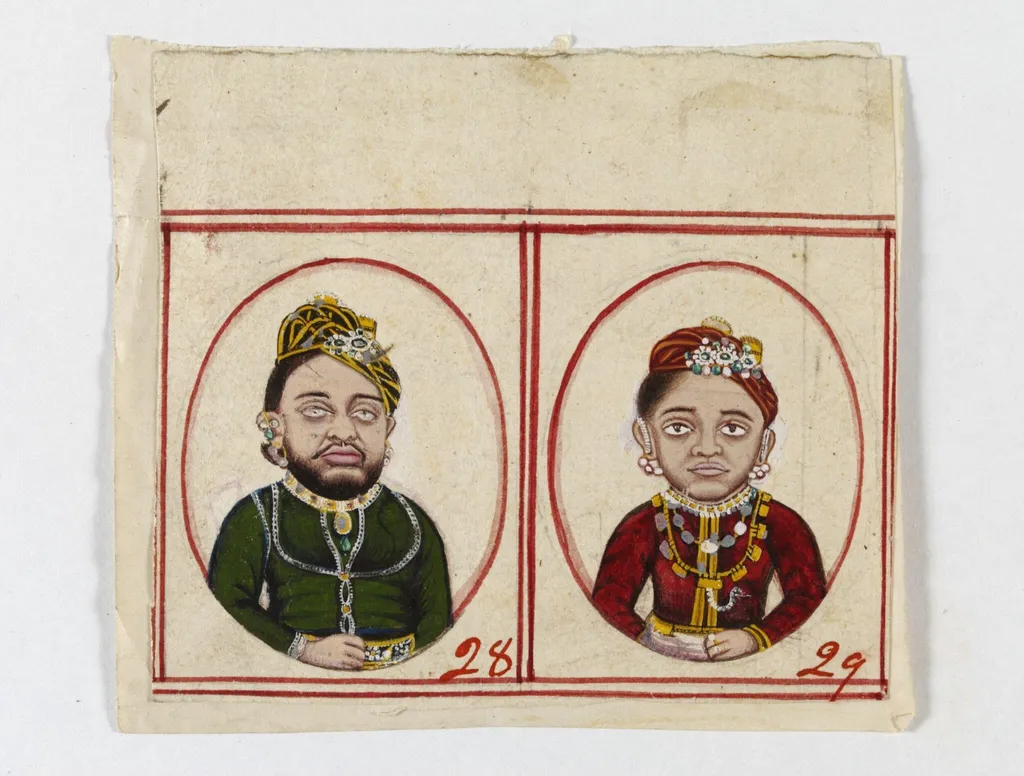
Khuman Singh and Bijai Singh is a paint painting by the Impressionist artist Unknown. It dates from 1890 and is held in the collection of the Victoria and Albert Museum.
About this work
Overview
The composition is formal and symmetrical, emphasizing their status through precise rendering and restrained ornamentation.
Created in 1890, this opaque watercolour on paper portrays two ruling brothers of Dungarpur, Khuman Singh and Bijai Singh. Each figure is enclosed within a separate oval frame against a pale beige background, outlined by thin red lines. The composition is formal and symmetrical, emphasizing their status through precise rendering and restrained ornamentation. Numerical markings at the base suggest cataloging, likely for archival or collection purposes.
Subject & Meaning
The painting depicts Khuman Singh and Bijai Singh, co-rulers of the princely state of Dungarpur, presented side by side to signify shared authority and familial unity. Their clasped hands convey solidarity, while their matching postures reinforce equality in rank. The inclusion of both figures, rather than one alone, reflects a political or dynastic statement, possibly commemorating a joint rule or succession arrangement within the lineage.
Technique & Style
Executed in opaque watercolour on paper, the work employs fine brushwork to render textures of fabric, jewelry, and skin with quiet precision. The palette is muted yet deliberate, greens, reds, and golds highlight regal attire without excess. Backgrounds are flat and unadorned, directing focus to the figures. The style leans toward naturalism, avoiding idealization, and prioritizes observable detail over symbolic embellishment.
History & Provenance
The painting originates from the royal court of Dungarpur in Rajasthan, likely commissioned to document the rulers’ joint tenure. The red numerals '28' and '29' at the base indicate it was part of a numbered series, possibly from a royal album or inventory. Its survival suggests preservation within the family or later acquisition by a collector, though its exact path to institutional custody remains undocumented.
Context
In late 19th-century Rajput courts, portraiture served administrative and commemorative functions amid British colonial influence. While European realism began to affect local styles, artists retained indigenous techniques and symbolic conventions. This work reflects that transition, its naturalism aligns with broader trends, yet its format and intent remain rooted in regional traditions of courtly documentation.
Legacy
As a rare double portrait from a smaller Rajput state, the painting offers insight into dynastic representation beyond major centers like Jaipur or Udaipur. Its restrained aesthetic and factual presentation distinguish it from more ornate courtly works. Today, it contributes to scholarly understanding of how regional rulers navigated identity, authority, and visual culture during a period of political change.
Artist & collection