Artwork
Leaf from a Qur'an (verso)
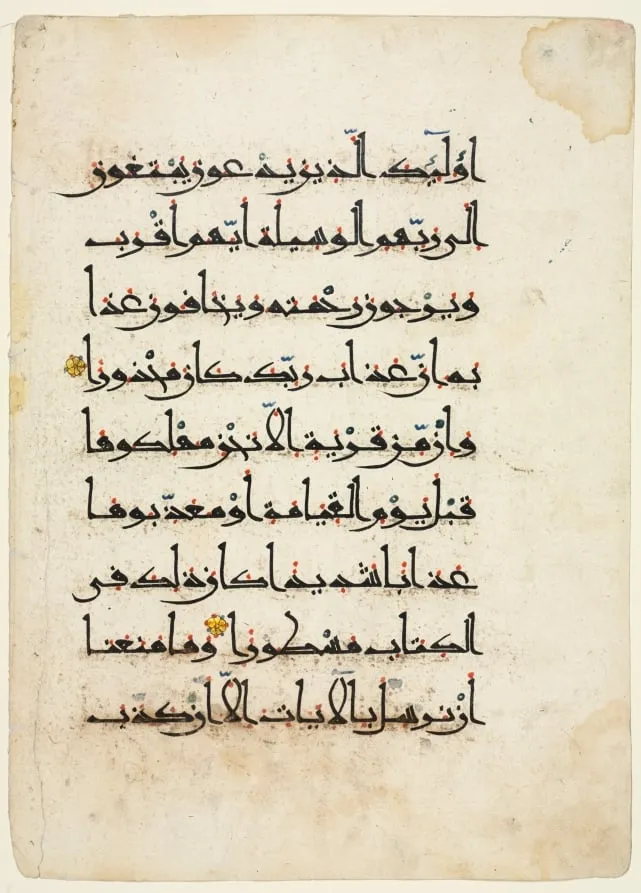
Leaf from a Qur'an (verso) is a drawing by Unknown. It dates from 1100 and is held in the collection of the Cleveland Museum of Art. This fragment originates from a handwritten Qur'an, its verso side preserving a section of sacred text in Arabic script.
- Accession no.
- 1933.481.b
- Credit line
- Edward L. Whittemore Fund
About this work
Overview
Small red and blue markings, placed between words, function as vocalization aids, guiding proper recitation according to Islamic tradition.
This fragment originates from a handwritten Qur'an, its verso side preserving a section of sacred text in Arabic script. The ink is black, applied with precision, forming continuous, elegantly curved letterforms. Light brown paper, aged and thin, supports the script.
Small red and blue markings, placed between words, function as vocalization aids, guiding proper recitation according to Islamic tradition.
Subject & Meaning
The text contains verses from the Qur'an, the holy book of Islam, intended for liturgical use. Its purpose was devotional, not decorative; the script served as a vessel for divine revelation. The diacritical marks, red dots for consonants and blue for vowels, ensure accurate oral transmission, reflecting the centrality of recitation in Islamic worship and scholarship.
Technique & Style
The script is executed in a cursive style typical of early Qur'anic manuscripts, with letters linked fluidly to enhance legibility and rhythm. Ink was applied with a reed pen, producing consistent line weight. The minimal use of color in diacritics suggests restraint, prioritizing textual clarity over ornamentation, consistent with early Islamic scribal practices.
History & Provenance
This leaf likely dates to the 8th or 9th century, produced in a scriptorium within the Islamic world, possibly in Iraq or Iran. It was once part of a larger codex, now dispersed. The Cleveland Museum of Art holds other fragments from the same manuscript tradition, suggesting a shared origin and workshop practice among early Qur'anic scribes.
Context
During this period, Qur'ans were copied by hand with great care, often commissioned by patrons or religious institutions. The use of colored dots for pronunciation was a developing standard, replacing earlier methods. Such manuscripts were not merely books but objects of reverence, preserved in mosques and libraries for communal recitation and study.
Legacy
This fragment exemplifies the early codification of Qur'anic script and orthographic conventions that shaped Islamic book culture. Its survival offers insight into the material practices of medieval scribes and the transmission of sacred text. Similar fragments remain in museum collections worldwide, testifying to the widespread production and veneration of handwritten Qur'ans.
Artist & collection









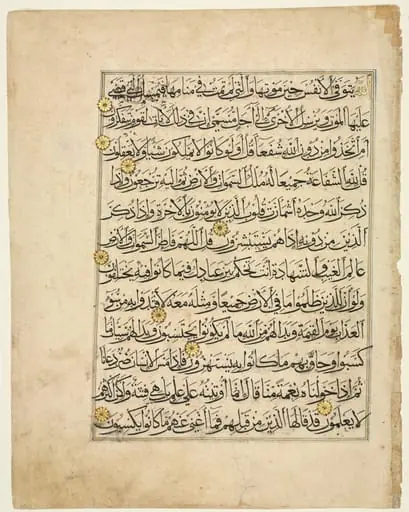 Qur'an Manuscript Folio (recto)
![Qur'an Manuscript Folio (recto; verso) [Left side of Bifolio], by Unknown](https://artifactworldgallery.com/img/unknown--qur-an-manuscript-folio-recto-verso-left-side-of-bifolio--7b560e06b8af0905-w320.webp) Qur'an Manuscript Folio (recto; verso) [Left side of Bifolio]
Qur'an Manuscript Folio (recto; verso) [Left side of Bifolio]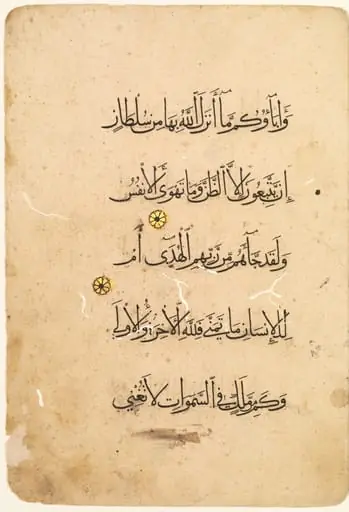 Qur'an Manuscript Folio (recto) (left side of bifolio)
![Qur'an Manuscript Folio (recto) [Right side of Bifolio], by Unknown](https://artifactworldgallery.com/img/unknown--qur-an-manuscript-folio-recto-right-side-of-bifolio--c1fa5781f1fa5bcd-w320.webp) Qur'an Manuscript Folio (recto) [Right side of Bifolio]
Qur'an Manuscript Folio (recto) [Right side of Bifolio]![Qur'an Manuscript Folio (recto; verso) [Right side of Bifolio], by Unknown](https://artifactworldgallery.com/img/unknown--qur-an-manuscript-folio-recto-verso-right-side-of-bifolio--0873974e1864806f-w320.webp) Qur'an Manuscript Folio (recto; verso) [Right side of Bifolio]
Qur'an Manuscript Folio (recto; verso) [Right side of Bifolio]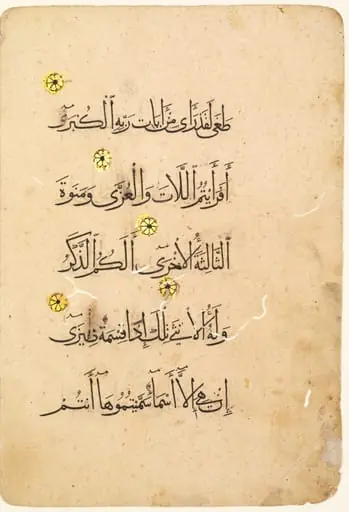 Qur'an Manuscript Folio (verso) (right side of bifolio)
- Leaf from a Qur'an (recto)