Artwork
Qur'an Manuscript Folio (recto)
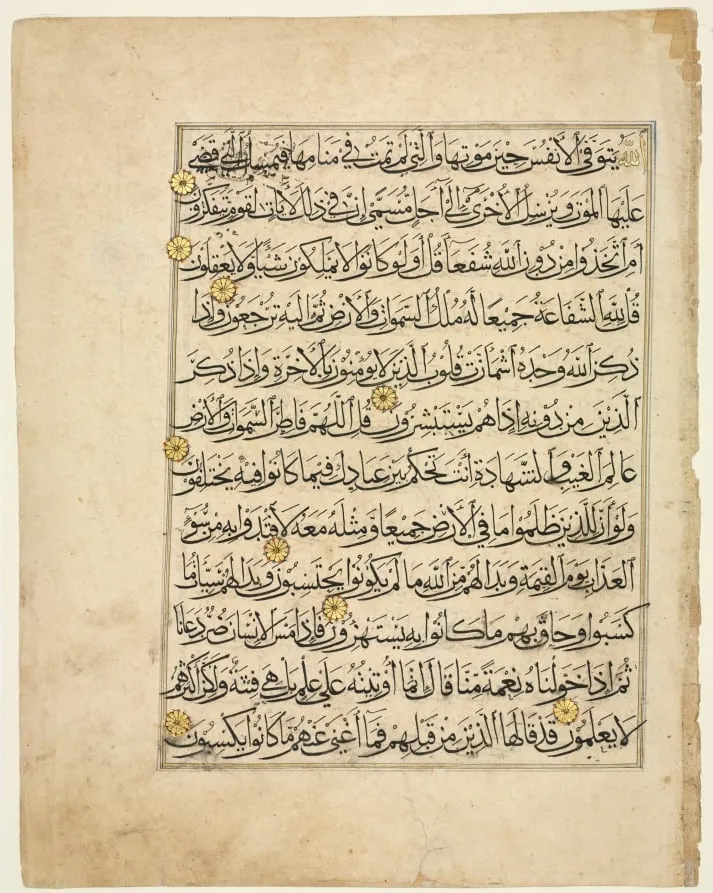
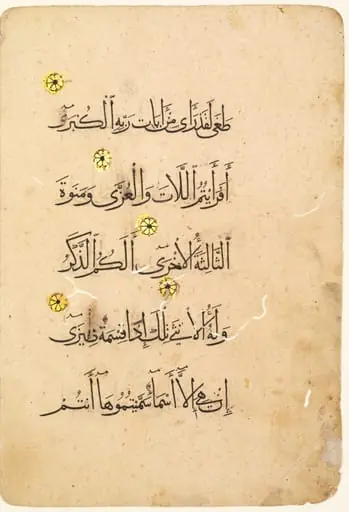
Qur'an Manuscript Folio (recto) is a drawing by Unknown. It dates from 1304 and is held in the collection of the Cleveland Museum of Art. This folio is a single page from a Qur’an manuscript produced in 14th-century Egypt under the Mamluk Sultanate.
- Accession no.
- 1933.480.a
- Credit line
- Edward L. Whittemore Fund
About this work
You see a single page from a Qur’an, written in elegant black ink with red, blue, and gold flowers between the lines.
You see a single page from a Qur’an, written in elegant black ink with red, blue, and gold flowers between the lines. The letters curve and stretch like vines, filling the space with careful rhythm.
This page comes from 1300s Egypt, when Mamluk rulers commissioned beautiful books. The script here, Rayhani, was one of six official styles, prized for its balance and grace. Tiny rosettes mark pauses in the text, guiding readers through the verses.
To see more pages like this, look up mamluk sultanate (1250–1517).
Overview
This folio is a single page from a Qur’an manuscript produced in 14th-century Egypt under the Mamluk Sultanate. It features part of Surah al-Zumar, the 39th chapter of the Qur’an, rendered in Rayhani script, a refined calligraphic style recognized for its rhythmic proportions and elegance. The page is adorned with small floral motifs in red, blue, and gold, placed between lines to indicate pauses in recitation.
Subject & Meaning
The text contains sacred verses from the Qur’an, specifically from Surah al-Zumar, which addresses themes of divine unity, human accountability, and the nature of worship. The careful arrangement of script and ornamentation reflects reverence for the word of God, transforming the page into a meditative object. The decorative elements serve not as embellishment alone but as visual cues to aid in liturgical recitation.
Technique & Style
The script is executed in black ink with precise, flowing strokes characteristic of Rayhani, a script developed for its clarity and harmonic balance. Rosettes in red, blue, and gold punctuate the text at syntactic breaks, guiding the reader’s rhythm. The letters elongate and curve with controlled grace, creating a visual cadence that mirrors the oral tradition of Qur’anic recitation, blending function with aesthetic discipline.
History & Provenance
This folio originates from Egypt during the Mamluk period (1250–1517), a time when royal and elite patrons commissioned luxurious Qur’an manuscripts as acts of piety and political expression. The use of Rayhani script and costly pigments suggests it was produced in a royal scriptorium, likely for a high-ranking official or religious institution. Its survival offers insight into the material culture of Islamic bookmaking in medieval Egypt.
Context
In 14th-century Mamluk Egypt, the production of Qur’anic manuscripts was a highly organized craft, supported by state patronage and centered in Cairo’s scholarly circles. Calligraphers trained in one of six official scripts, with Rayhani favored for its legibility and beauty. The integration of color and ornamentation reflected broader artistic trends that elevated religious texts into objects of both spiritual and cultural significance.
Legacy
This folio exemplifies the enduring influence of Mamluk calligraphic traditions, which shaped later Islamic book arts across the eastern Mediterranean and beyond. Its disciplined script and restrained decoration became a model for subsequent generations of scribes. Surviving fragments like this one help scholars reconstruct the production methods and devotional practices of medieval Islamic societies.
Artist & collection









- Qur'an Manuscript Folio
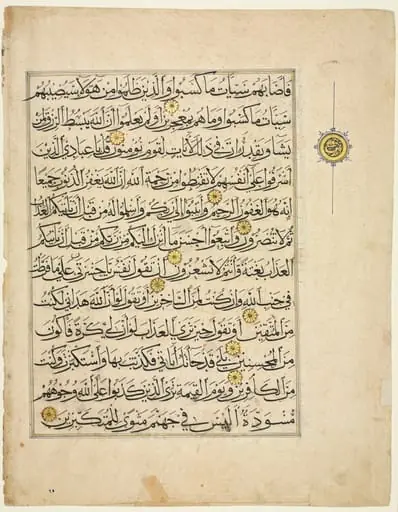 Qur'an Manuscript Folio (verso)
![Qur'an Manuscript Folio (recto; verso) [Right side of Bifolio], by Unknown](https://artifactworldgallery.com/img/unknown--qur-an-manuscript-folio-recto-verso-right-side-of-bifolio--0873974e1864806f-w320.webp) Qur'an Manuscript Folio (recto; verso) [Right side of Bifolio]
Qur'an Manuscript Folio (recto; verso) [Right side of Bifolio]![Qur'an Manuscript Folio (recto; verso) [Left side of Bifolio], by Unknown](https://artifactworldgallery.com/img/unknown--qur-an-manuscript-folio-recto-verso-left-side-of-bifolio--7b560e06b8af0905-w320.webp) Qur'an Manuscript Folio (recto; verso) [Left side of Bifolio]
Qur'an Manuscript Folio (recto; verso) [Left side of Bifolio]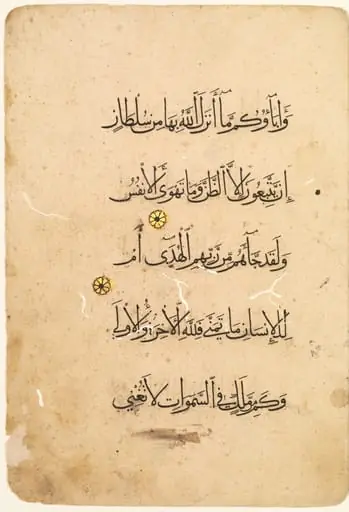 Qur'an Manuscript Folio (recto) (left side of bifolio)
![Qur'an Manuscript Folio (recto) [Right side of Bifolio], by Unknown](https://artifactworldgallery.com/img/unknown--qur-an-manuscript-folio-recto-right-side-of-bifolio--c1fa5781f1fa5bcd-w320.webp) Qur'an Manuscript Folio (recto) [Right side of Bifolio]
Qur'an Manuscript Folio (recto) [Right side of Bifolio]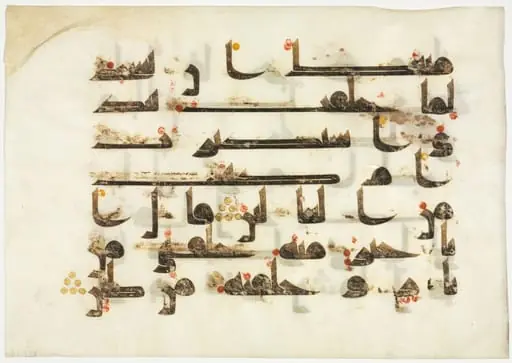 Folio from a Qur'an
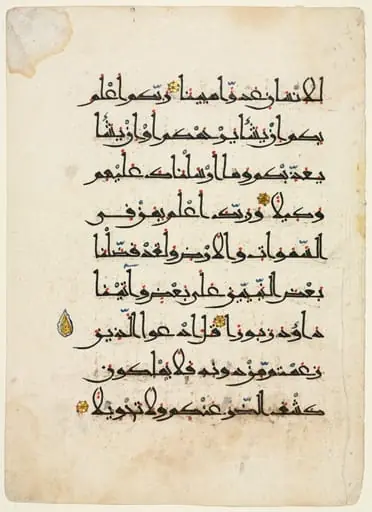 Leaf from a Qur'an
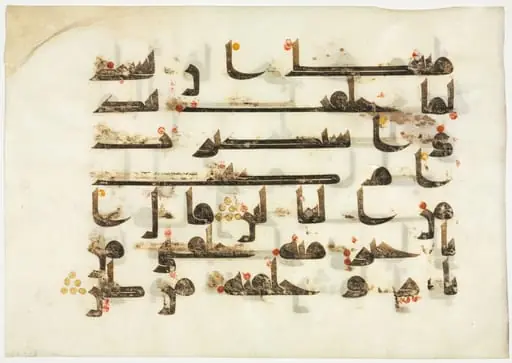 Folio from a Qur'an (recto)
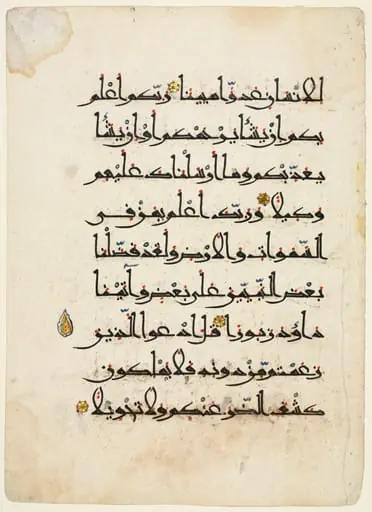 Leaf from a Qur'an (recto)
 Qur'an Manuscript Folio (verso) (right side of bifolio)
 Folio from a Qur'an (verso)