Artwork
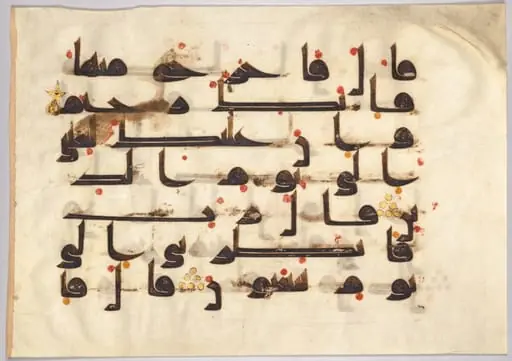
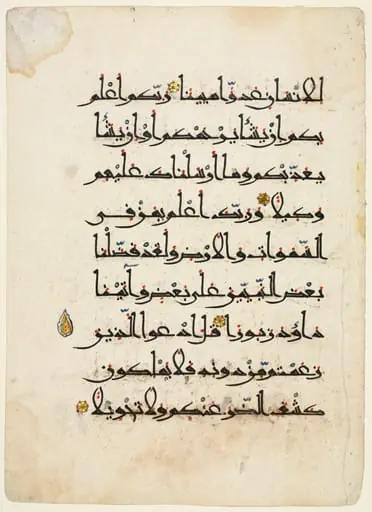
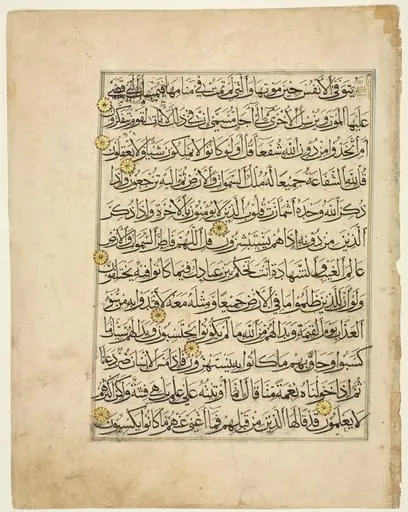
Qur'an Manuscript Folio (recto; verso) [Right side of Bifolio]
![Qur'an Manuscript Folio (recto; verso) [Right side of Bifolio], by Unknown, 1400](https://artifactworldgallery.com/img/unknown--qur-an-manuscript-folio-recto-verso-right-side-of-bifolio--0873974e1864806f-w1024.webp)
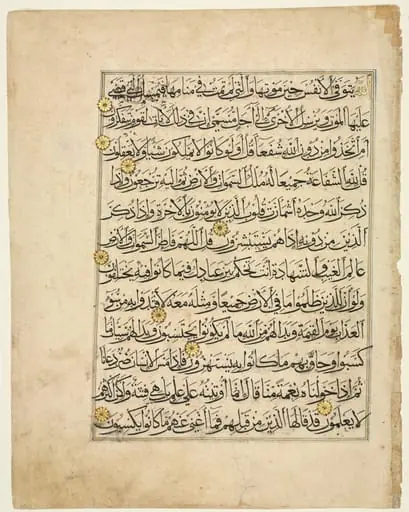
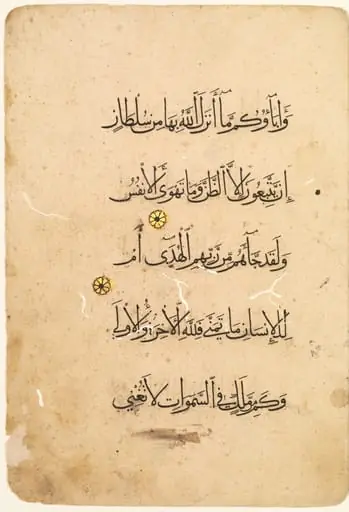
Qur'an Manuscript Folio (recto; verso) [Right side of Bifolio] is a drawing by Unknown. It dates from 1400 and is held in the collection of the Cleveland Museum of Art. This folio is a double‑page leaf from a Qur’an manuscript produced in Egypt during the Mamluk era (1250–1517).
- Accession no.
- 1933.473.1
- Credit line
- Edward L. Whittemore Fund
About this work
You see black ink on cream paper: flowing Arabic letters, red dots for vowels, and a gold border that looks like lace.
You see black ink on cream paper: flowing Arabic letters, red dots for vowels, and a gold border that looks like lace.
This page is part of a Qur’an made in Egypt when the Mamluk sultans ruled. The tiny red dots help readers pronounce every word correctly. Calligraphy wasn’t just for holy books, it decorated bowls, coins, and buildings too.
To see how calligraphy turned everyday objects into art, look up “mamluk sultanate (1250–1517).”
Overview
This folio is a double‑page leaf from a Qur’an manuscript produced in Egypt during the Mamluk era (1250–1517). The recto side displays a passage from Surah An‑Najm, the fifty‑third chapter of the Qur’an, rendered in flowing Arabic script with black ink on a cream‑colored paper. A delicate gold border frames the text, while small red dots indicate vowel sounds.
Subject & Meaning
The selected verses belong to Surah An‑Najm, traditionally interpreted as a contemplation of divine guidance symbolised by the star. In Islamic tradition the Qur’an’s words are considered the literal revelation to the Prophet Muhammad, giving the written text a sacred status that elevates its calligraphic presentation beyond mere transcription.
Technique & Style
The calligrapher employed a cursive Arabic script typical of Mamluk manuscripts, using dense black ink for the main letters and red diacritical marks to guide pronunciation. The gold border, executed in a fine, lace‑like pattern, demonstrates the period’s penchant for ornamental framing that both protects and enhances the visual impact of the sacred text.
History & Provenance
Created under the patronage of the Mamluk sultans, the manuscript reflects the dynasty’s investment in religious art and scholarship. While the exact workshop remains unidentified, the use of high‑quality paper, gold leaf, and precise vowel notation indicates a commission for an elite or institutional collector within the Egyptian Islamic world.
Context
Calligraphy held the highest esteem in Islamic visual culture, serving both devotional and secular functions. Beyond Qur’anic manuscripts, the same scriptural elegance adorned objects such as ceramics, metalwork, and architectural inscriptions, illustrating the fluid boundary between sacred and everyday artistic expression in the Mamluk period.
![Qur'an Manuscript Folio (recto) [Right side of Bifolio]](https://artifactworldgallery.com/img/unknown--qur-an-manuscript-folio-recto-right-side-of-bifolio--c1fa5781f1fa5bcd-w320.webp)
Artist & collection









![Qur'an Manuscript Folio (recto; verso) [Left side of Bifolio], by Unknown](https://artifactworldgallery.com/img/unknown--qur-an-manuscript-folio-recto-verso-left-side-of-bifolio--7b560e06b8af0905-w320.webp)