Artwork
Maharao Kishor Singh II of Kota (r. 1819–28) Worshiping Krishna as Brij Rajji
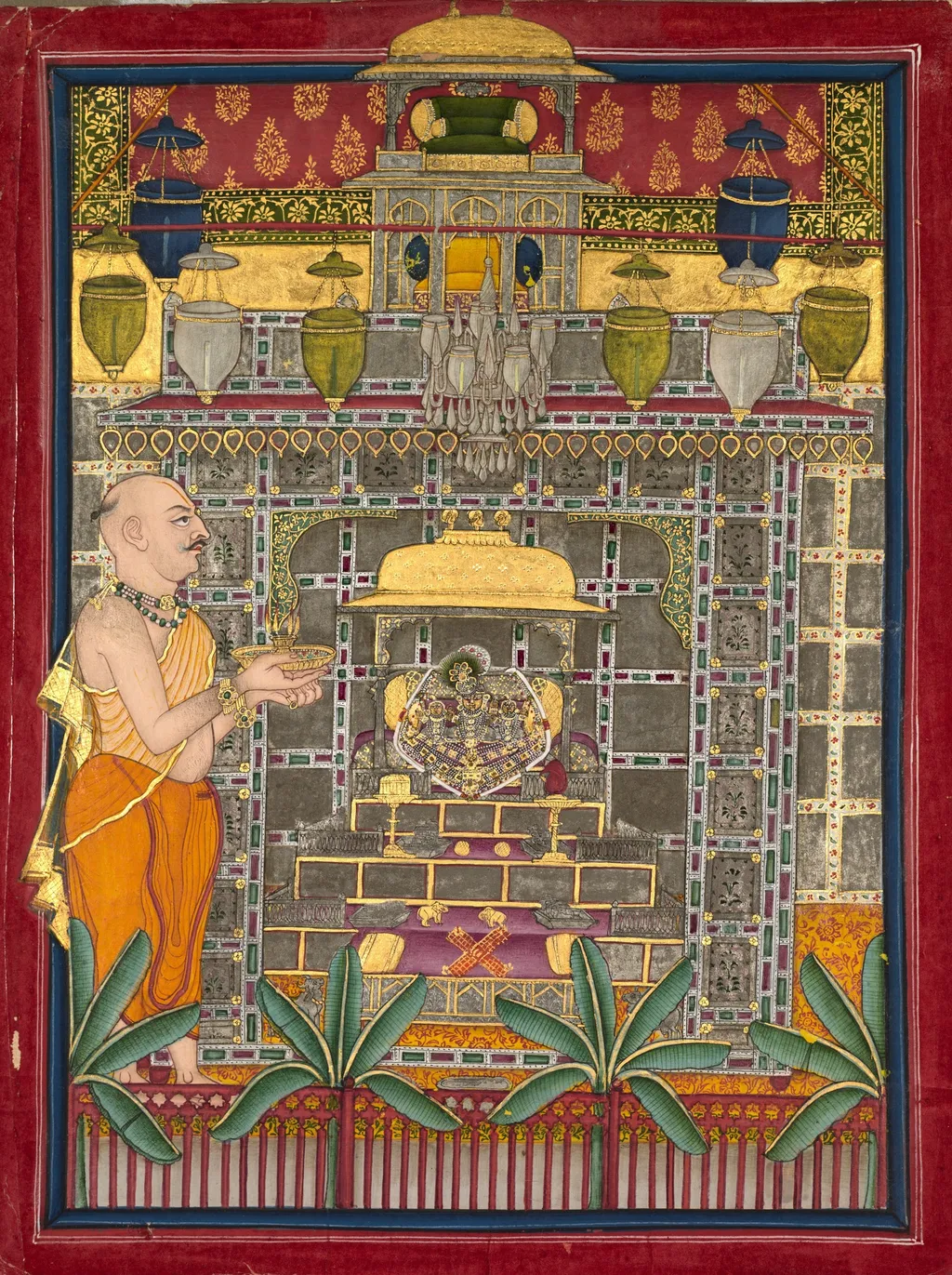
Maharao Kishor Singh II of Kota (r. 1819–28) Worshiping Krishna as Brij Rajji is an unspecified painting. It dates from 1825 and is held in the collection of the Cleveland Museum of Art.
About this work
Subject & Meaning
The painting portrays Maharao Kishor Singh II of Kota engaged in worship of Krishna as Brij Rajji, a form of the deity associated with the pastoral legends of Braj. By depicting the ruler in a devotional posture before the god, the work emphasizes his personal piety and positions his temporal authority under divine sanction. The act of worship serves as a visual affirmation of loyalty to Krishna, reinforcing the king's role as a righteous patron and linking Kota's courtly identity with the broader Vaishnava tradition of the early nineteenth century.
History & Provenance
The piece depicts Maharao Kishor Singh II of Kota worshipping Krishna as Brij Rajji and is classified as a painting within the museum's holdings.
The work is a painting dated to 1825 and attributed to an unknown artist. It is held in the Cleveland Museum of Art, where it is registered under accession number 1978.71, reflecting its acquisition by the museum in 1978. The piece depicts Maharao Kishor Singh II of Kota worshipping Krishna as Brij Rajji and is classified as a painting within the museum's holdings. No specific exhibition history is recorded in the available sources.
Overview
The work depicts Maharao Kishor Singh II of Kota, who ruled from 1819 to 1828, in the act of worshiping Krishna, identified here as Brij Rajji. He is shown in vivid orange robes, bearing a gilded tray, before an elaborate interior that includes a throne, golden vessels, and a procession of elephants. The composition balances a sense of ceremonial grandeur with a tightly organized visual rhythm.
Technique & Style
Executed in a richly colored palette of reds, golds, and greens, the piece employs fine brushwork to delineate intricate architectural details and the ornamental attire of the figures. The use of flat, decorative surfaces combined with a hierarchical scaling of elements reflects the courtly painting traditions of Rajasthan, where narrative clarity often superseded naturalistic modeling.
Context
The work belongs to a broader corpus of Rajput court paintings that celebrate the intertwining of political authority and Hindu devotion. Elephants, opulent furnishings, and the depiction of a ruler in worship echo the visual language used by neighboring princely states to convey both wealth and religious fidelity during the period of British colonial expansion.
Artist & collection

 Worship of Dvaraka Nathji at Kankroli
 Krishna and Kansa
 Untitled
 Sri Raga
 Rama, Sita, and Lakshmana visit the hermitage of the sage Bharadvaja at Prayaga, from Chapter 48 of the Ayodhya Kanda (Book of Ayodhya) of a Ramayana (Rama’s Journey)
 Bhairava Raga
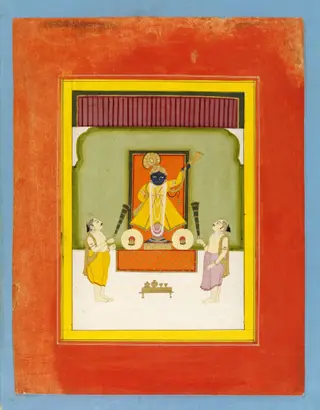 Sri Nathji
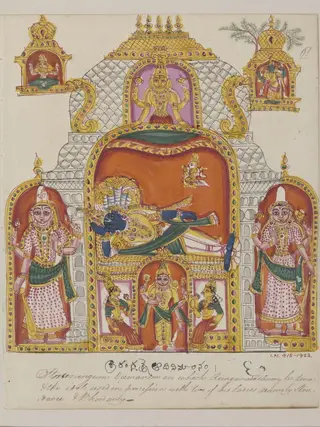 The temple of Shri Ranganatha
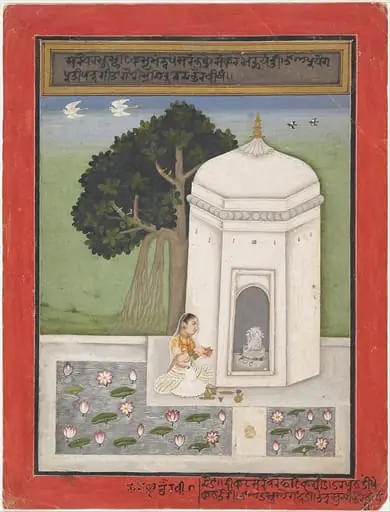 Untitled
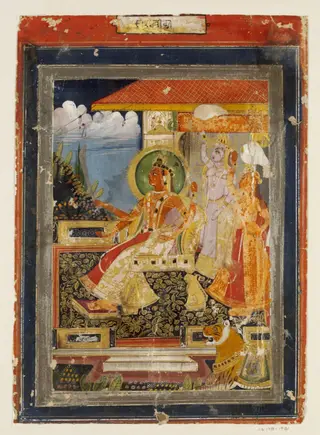 Durga
Durga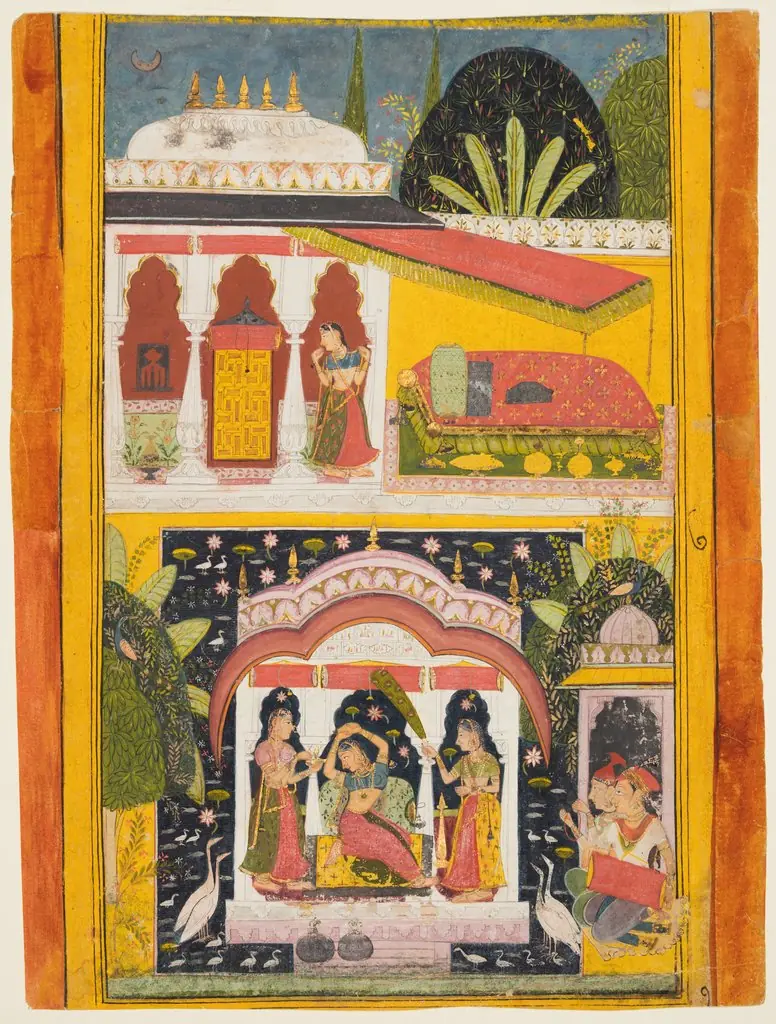 A Royal Woman in a Pavilion: Desavarari Ragini of Dipak, from a Ragamala
- Maharao Kishor Singh II of Kota (r. 1819–28) Worshiping Krishna as Brij Rajji