Artwork
Rama, Sita, and Lakshmana visit the hermitage of the sage Bharadvaja at Prayaga, from Chapter 48 of the Ayodhya Kanda (Book of Ayodhya) of a Ramayana (Rama’s Journey)
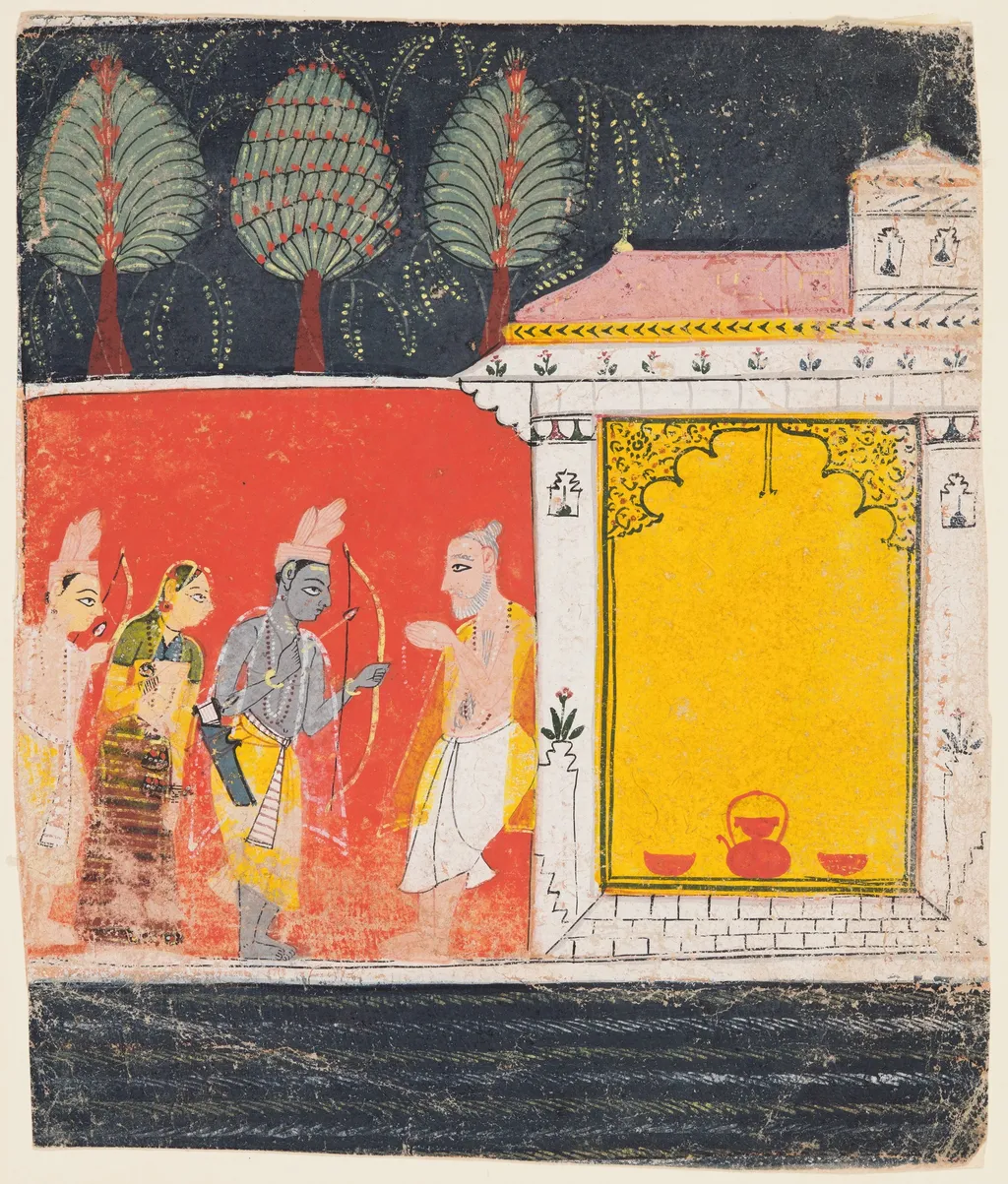
Rama, Sita, and Lakshmana visit the hermitage of the sage Bharadvaja at Prayaga, from Chapter 48 of the Ayodhya Kanda (Book of Ayodhya) of a Ramayana (Rama’s Journey) is an unspecified painting. It dates from 1650 and is held in the collection of the Cleveland Museum of Art. The work depicts three figures, Rama, Sita, and Lakshmana, standing within a vivid red doorway.
About this work
Technique & Style
The work belongs to the broader tradition of Indian miniature painting, reflecting the stylistic conventions of courtly narrative illustration from that period.
The painting depicts the scene of Rama, Sita, and Lakshmana arriving at the hermitage of the sage Bharadvaja at Prayaga, drawn from Chapter 48 of the Ayodhya Kanda in the Ramayana. Executed in the mid-17th century, it was created in the Malwa region and is attributed to an unknown artist. The work belongs to the broader tradition of Indian miniature painting, reflecting the stylistic conventions of courtly narrative illustration from that period.
It is executed in tempera and ink on paper, a common support and medium for Rajput-style works of the time. The composition emphasizes hierarchical scale and symbolic color to convey narrative clarity, with figures rendered in flat planes of color and delicate outlines. The condition is stable, with only minor aging of the paper support noted in the Cleveland Museum of Art's conservation records.
History & Provenance
The painting is held in the collection of the Cleveland Museum of Art, where it is catalogued under accession number 2018.129. It has been part of the museum’s exhibitions focusing on Indian miniature painting and South Asian religious art, including a 2019 display of the Ramayana series and a 2022 showcase of early modern Indian works.
Legacy
The painting depicting Rama, Sita, and Lakshmana visiting the sage Bharadvaja’s hermitage at Prayaga was created in 1650 in Malwa, establishing an early example of narrative illustration from the Ayodhya Kanda within the broader Ramayana tradition. Its inclusion in the Cleveland Museum of Art’s collection since 2018 highlights its recognition as a significant work of Indian miniature painting, reflecting sustained scholarly and curatorial interest in its artistic and cultural resonance. The piece contributes to ongoing interpretations of this episode, underscoring its enduring presence in visual storytelling traditions.
Overview
The work depicts three figures, Rama, Sita, and Lakshmana, standing within a vivid red doorway. Rama holds a staff, Sita is identified by a green sash, and Lakshmana by a yellow cloth draped over his shoulder. A small seated figure is visible behind them on a yellow wall, while three stylized trees bearing red fruit appear outside against a dark sky.
Subject & Meaning
The scene illustrates a episode from the Ayodhya Kanda of the Ramayana, in which the royal siblings visit the hermitage of the sage Bharadvaja at Prayaga. The composition emphasizes the sanctity of the sage’s abode and the devotion of the protagonists, underscoring themes of hospitality, piety, and the intertwining of royal duty with spiritual guidance.
Artist & collection

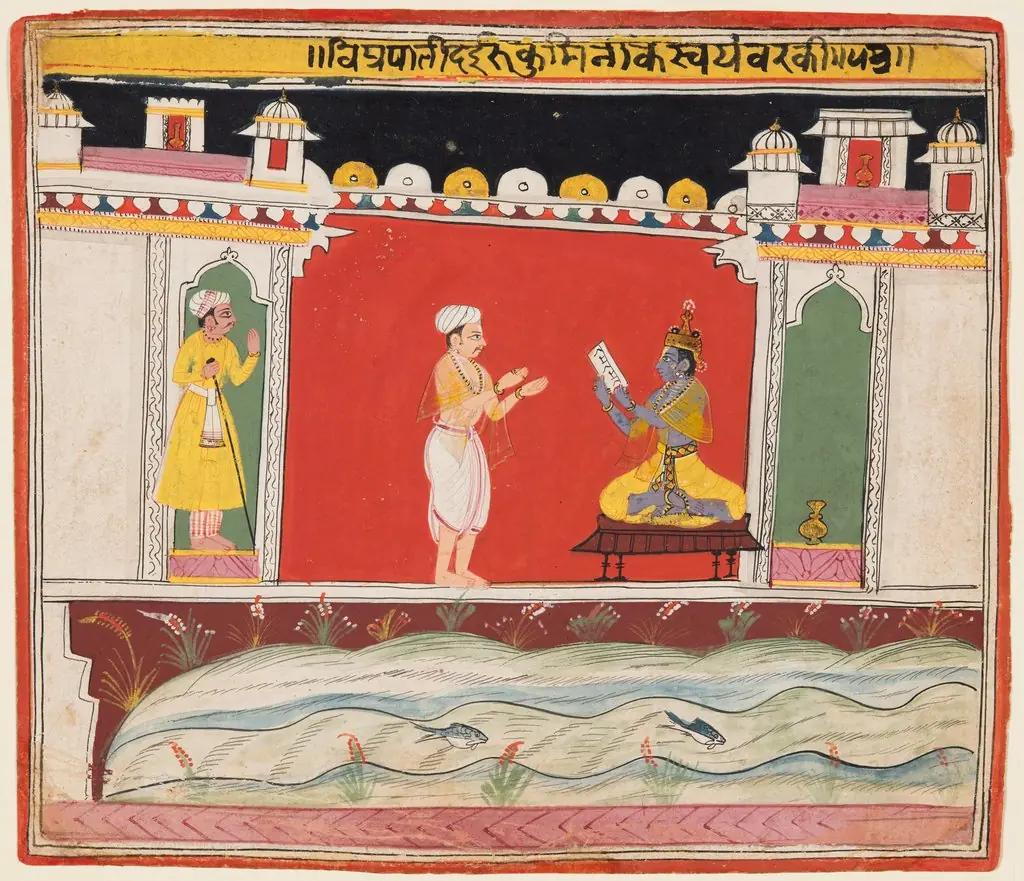 A Brahmin gives Krishna the Message or Invitation for the Competition to Rukmini’s Svayamvara, from a Bhagavata Purana
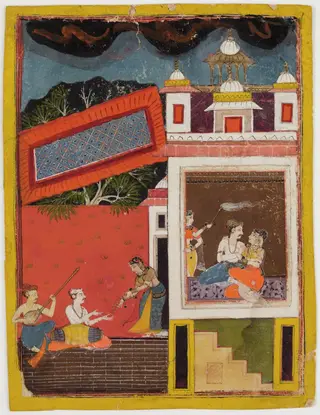 Prince and Lady in Palace Scene with Musicians
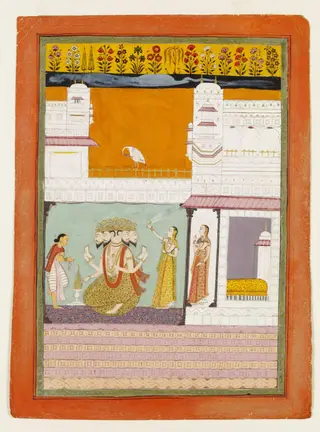 Brahma
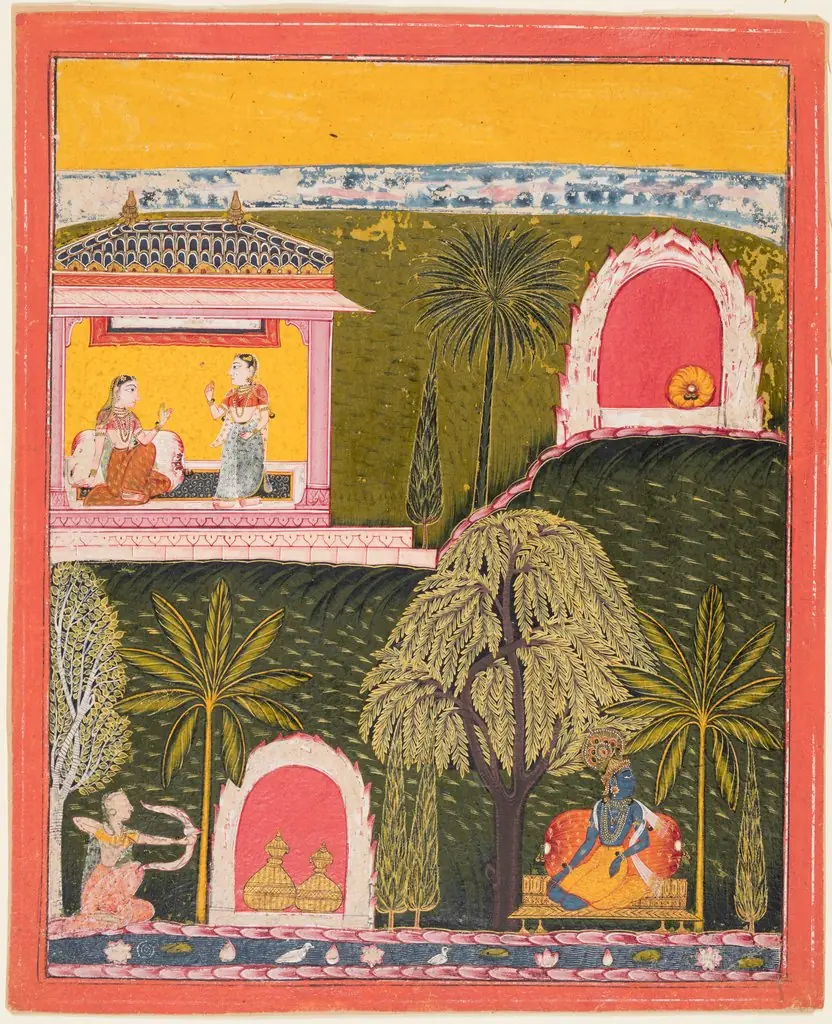 Rati, the Goddess of Erotic Love, Takes Aim at Krishna, from a Rasikapriya
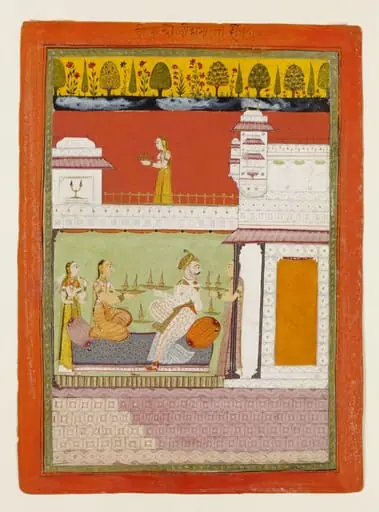 Dipak ragini
 Krishna and Radha
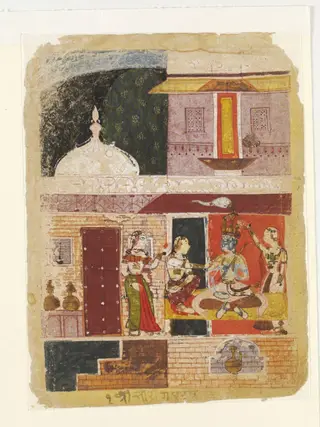 Bhairava Raga
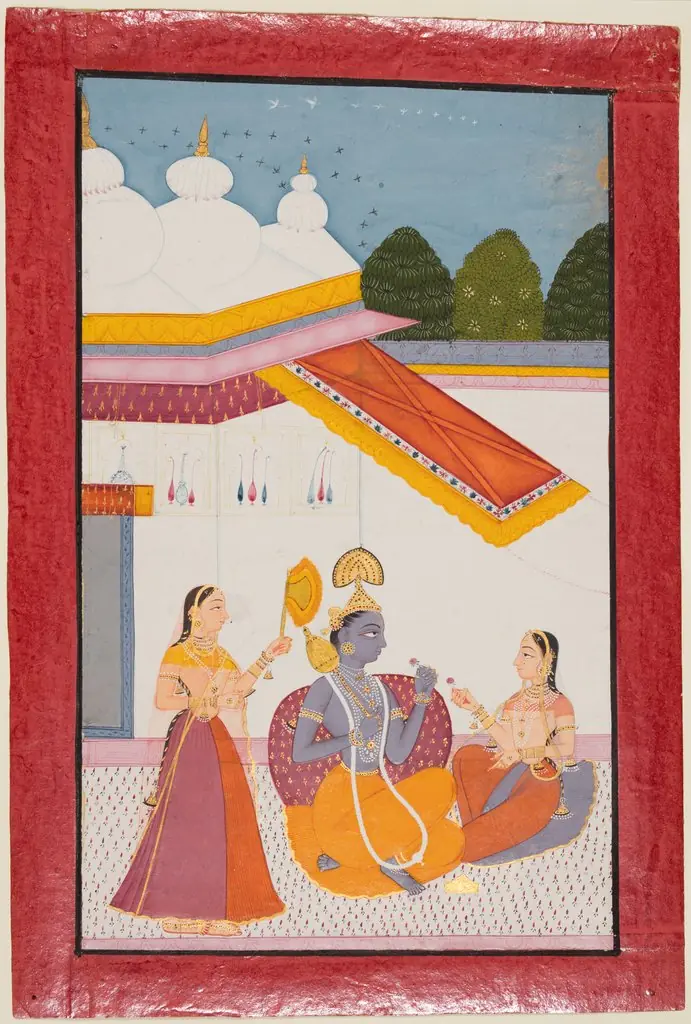 Krishna Under a Canopy
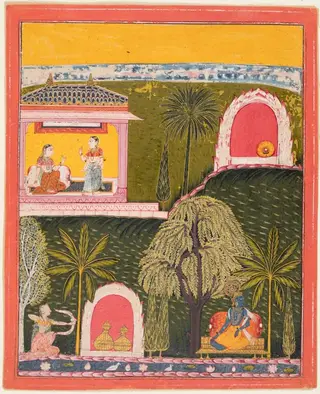 Rati, the Goddess of Erotic Love, Takes Aim at Krishna, from a Rasikapriya
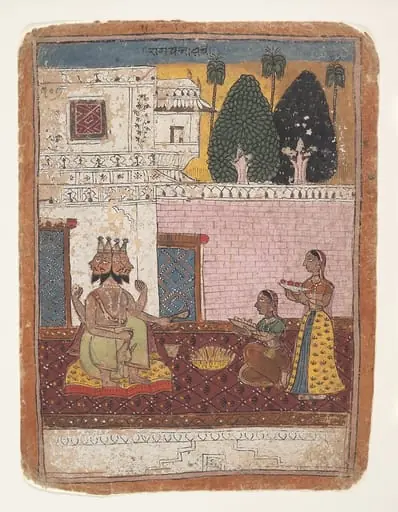 Untitled
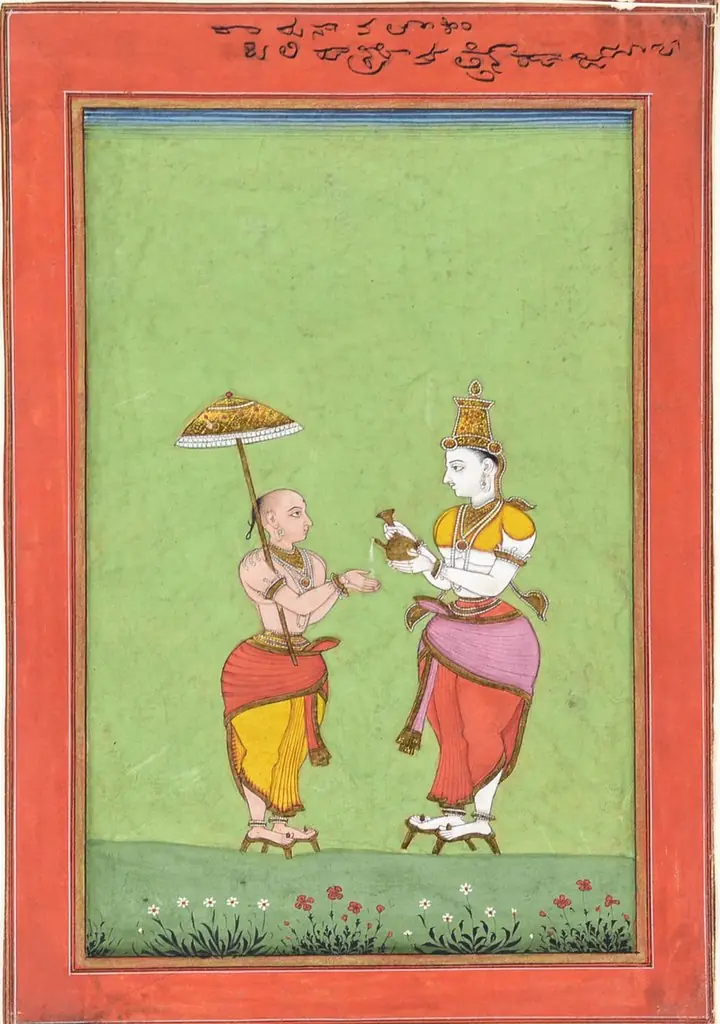 Vamana being blessed by King Bali
- Rama, Sita, and Lakshmana visit the hermitage of the sage Bharadvaja at Prayaga, from Chapter 48 of the Ayodhya Kanda (Book of Ayodhya) of a Ramayana (Rama’s Journey)