Artwork
Maharao Ram Singh II of Kota (r. 1828–66) Worships Brij Nathji as the Bridegroom
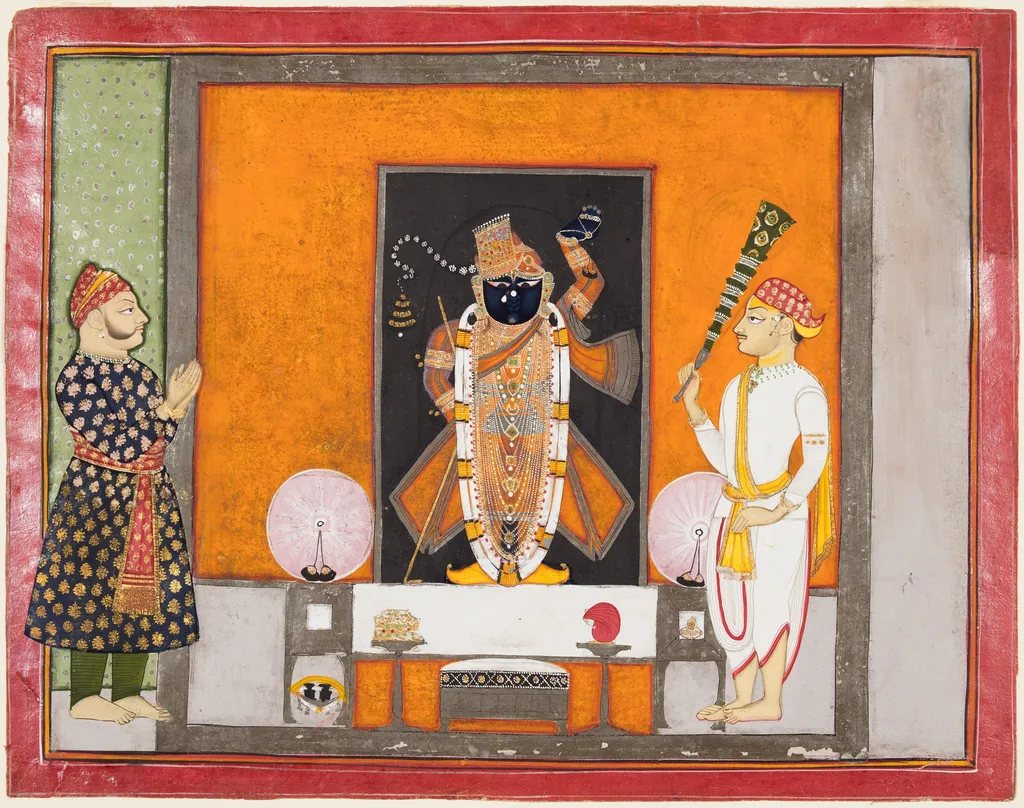
Maharao Ram Singh II of Kota (r. 1828–66) Worships Brij Nathji as the Bridegroom is an unspecified painting. It dates from 1820 and is held in the collection of the Cleveland Museum of Art. The work depicts a ceremonial scene in which three figures are arranged on a raised platform.
About this work
Subject & Meaning
The symbolism underscores the fusion of royal and religious identities, emphasizing the Maharao’s role as both a temporal leader and a pious devotee.
The painting depicts Maharao Ram Singh II of Kota (r. 1828–66) engaged in a devotional act, worshiping the Hindu deity Brij Nathji, who is portrayed as a bridegroom. Brij Nathji, a form of Krishna, is central to the iconography, symbolizing divine love and the sacred union between the devotee and the deity. The scene likely references the ritual of darshan, where the ruler seeks spiritual blessing and divine favor through personal devotion.
The symbolism underscores the fusion of royal and religious identities, emphasizing the Maharao’s role as both a temporal leader and a pious devotee. By depicting the deity as a bridegroom, the work evokes the bhakti tradition, where the relationship between the worshiper and the divine mirrors the intimacy of human relationships, particularly marriage. This representation reinforces the idea of divine grace as accessible through personal devotion.
History & Provenance
Created in 1820, this painting depicts Maharao Ram Singh II of Kota worshipping Brij Nathji. The work is attributed to an unknown artist. It currently resides in the collection of the Cleveland Museum of Art, where it is cataloged under the accession number 2018.181.
The museum lists the inception date as January 1, 1820, though the specific year 1820 is the primary chronological marker provided for its creation.
Legacy
The painting has been exhibited at the Cleveland Museum of Art, where it is part of the collection. Its depiction of Maharao Ram Singh II of Kota in a devotional scene was noted for blending Rajput courtly imagery with devotional Krishna worship, influencing later interpretations of Rajput visual narratives. Scholars have cited its composition as a reference point in studies of 19th‑century Rajput art, though the work remains in the museum’s storage rather than on public display.
Overview
The work depicts a ceremonial scene in which three figures are arranged on a raised platform. The central figure, adorned with a tall golden crown and extensive jewelry, holds a fan and a pot, while flanking attendants in blue and white garments bow or present a staff. The composition is framed by a red border with gold ornamentation, and the colors are applied in flat, vivid tones.
Technique & Style
Executed in a traditional Indian miniature manner, the painting employs precise brushwork to delineate intricate jewelry and patterned textiles. The use of flat, saturated pigments and a minimal background focuses attention on the figures, while the gold detailing in the border underscores the work’s ceremonial significance.
Context
The depiction aligns with the 19th‑century Rajput tradition of portraying deities as regal patrons, merging courtly splendor with religious iconography. Such works often served both as objects of worship and as affirmations of the ruler’s piety and cultural patronage.
Artist & collection

 Head Priest Govardhan Lalji (1862–1934) Offers a Lamp to Shri Nathji in Celebration of the Spring Festival
 Krishna and Radha
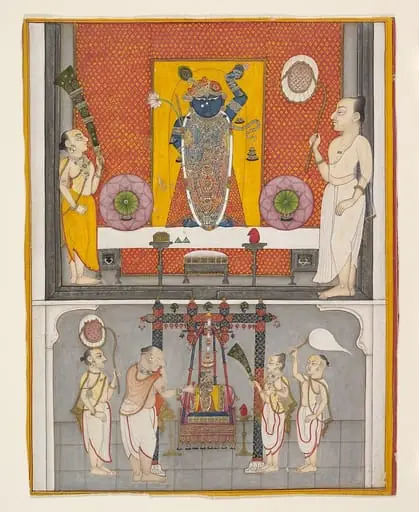 Untitled
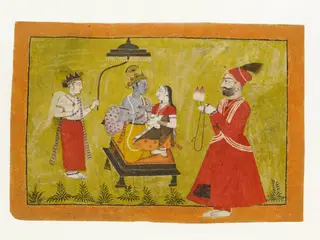 Raja Ajmer Chand of Bilaspur
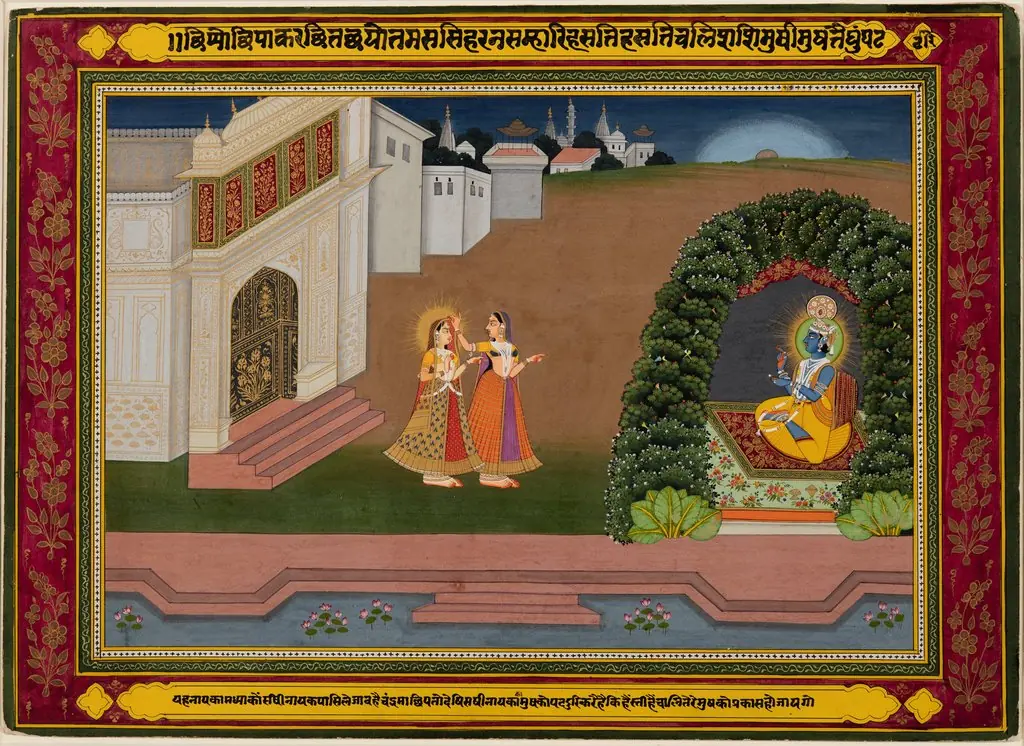 Radha’s Confidante Brings Her to Krishna, based on poetry of Bihari (Indian, 1595–1663)
 Radha’s Confidante Brings Her to Krishna, based on poetry of Bihari (Indian, 1595–1663)
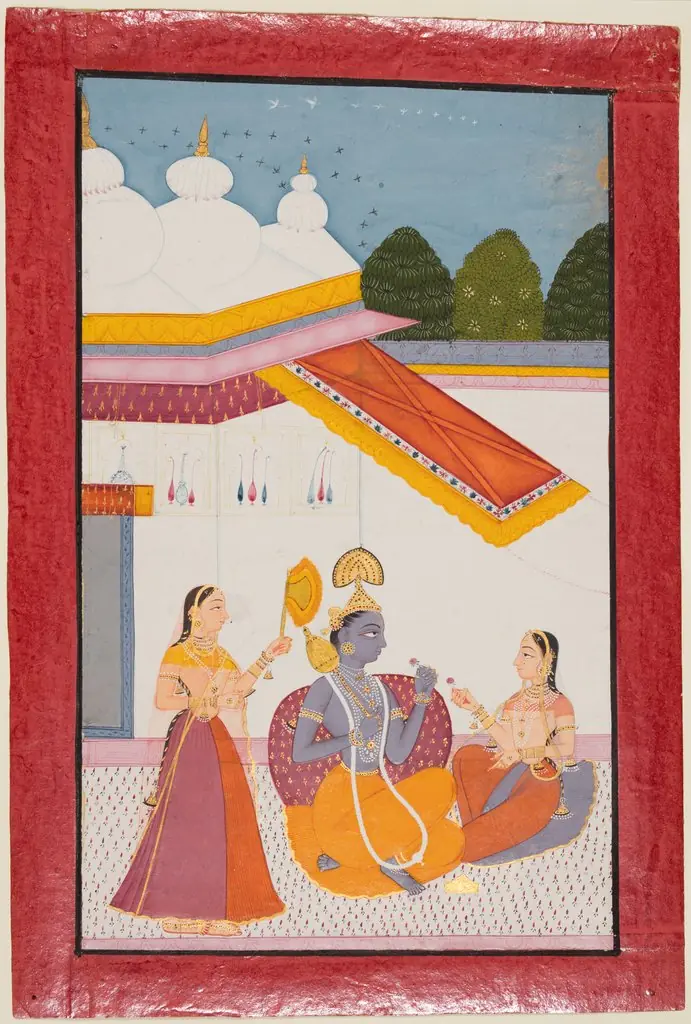 Krishna Under a Canopy
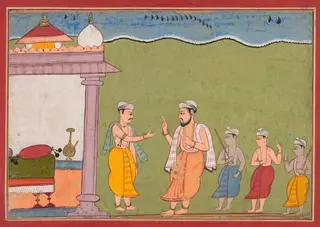 Nanda Solves Vasudeva’s Dilemma, from a Bhagavata Purana
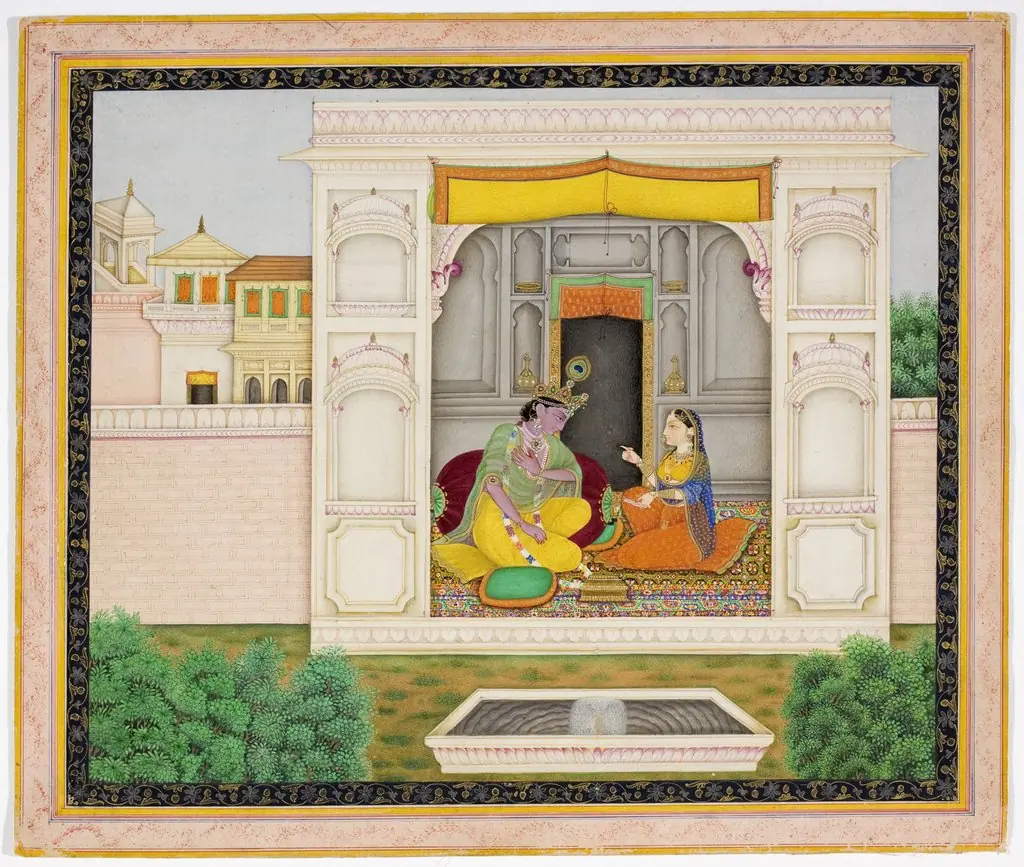 Krishna and Radha in Palace Scene
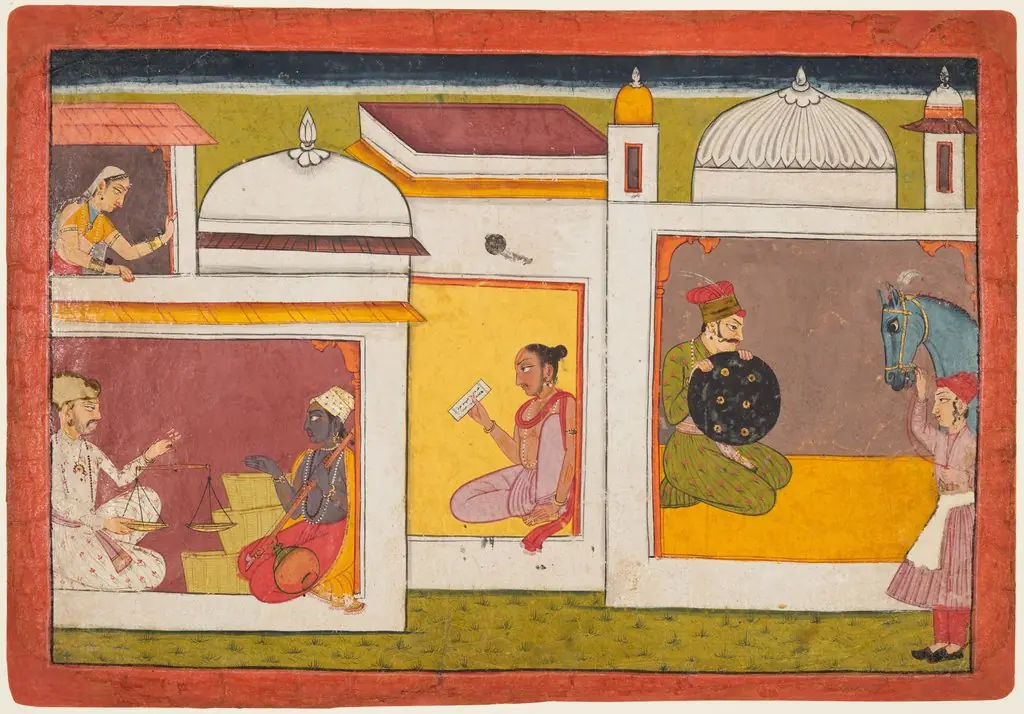 Madhava Faces a Man Holding a Scale, from a Madhavanala Kamakandala