Artwork
Rama, Sita, and Lakshmana in the forest
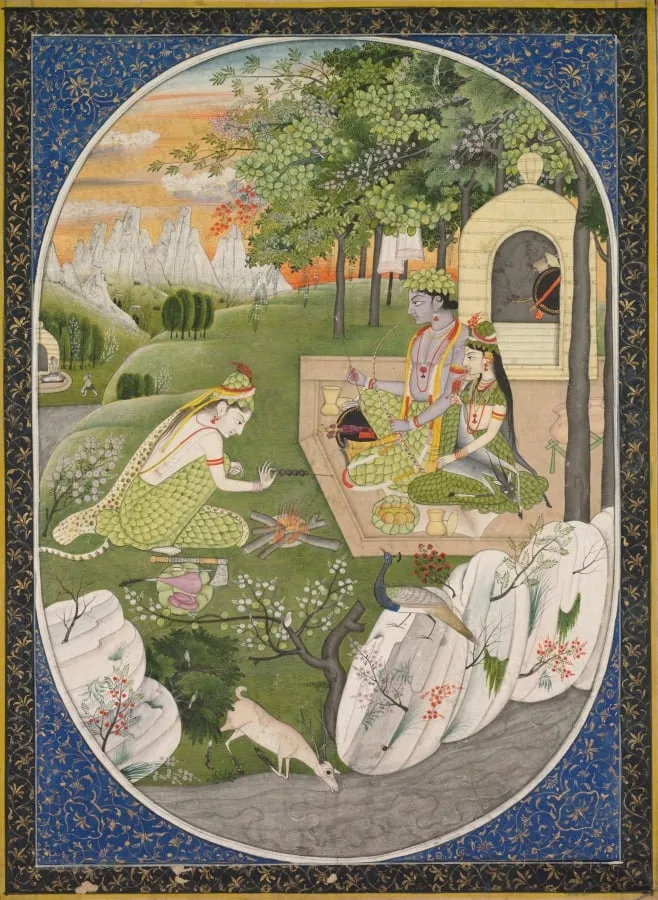
Rama, Sita, and Lakshmana in the forest is an unspecified painting by the Rajput painting artist Unknown. It dates from 1830 and is held in the collection of the Cleveland Museum of Art. This painting depicts Rama, Sita, and Lakshmana during their exile, engaged in quiet daily life amid a forested landscape.
- Accession no.
- 1989.332
- Credit line
- Bequest of Mrs. Severance A. Millikin
About this work
Overview
Executed in an oval format, it was likely one panel in a serialized album, reflecting a trend among Kangra court artists to adapt European compositional forms.
This painting depicts Rama, Sita, and Lakshmana during their exile, engaged in quiet daily life amid a forested landscape. Executed in an oval format, it was likely one panel in a serialized album, reflecting a trend among Kangra court artists to adapt European compositional forms. The subdued palette and spatial depth suggest engagement with Mughal aesthetic traditions, while the setting draws from the natural topography of the Kangra Valley.
Subject & Meaning
The scene portrays a moment of domestic tranquility amid exile, emphasizing resilience and harmony with nature. Rama and Sita, dressed in bark cloth, sit quietly as Lakshmana prepares food over a fire. The act of cooking, rendered with care, underscores their adaptation to forest life without abandoning duty or dignity. The narrative avoids grandeur, instead highlighting the moral endurance central to the Ramayana’s exile episode.
Technique & Style
The figures are arranged with deliberate spatial recession, a technique borrowed from Mughal painting traditions. Soft, pale washes create atmospheric depth, while the oval frame reflects European album conventions adopted by Kangra artists. Brushwork is precise yet gentle, with delicate modeling of forms and naturalistic rendering of foliage, blending regional sensibilities with external influences without overt mimicry.
History & Provenance
Created in the Kangra royal atelier during the late 18th century, the work emerged from a period of active artistic exchange between local Rajput traditions and Mughal, as well as emerging European, visual languages. It belonged to a larger series illustrating episodes from the Ramayana, commissioned by Kangra patrons who valued both devotional narrative and refined pictorial aesthetics.
Context
Kangra artists were known for synthesizing diverse influences, Mughal naturalism, European framing, and local Himalayan landscapes, into a distinct regional style. This painting reflects a broader cultural shift in the Punjab Hills, where courtly patronage supported devotional themes rendered with intimate, lyrical detail. The choice of the Ramayana as subject aligned with rising bhakti sentiments in the region.
Legacy
The Kangra school’s approach to narrative painting, exemplified here, influenced later Pahari styles and remains a touchstone for understanding regional Indian art’s capacity to absorb and transform external forms. Though not widely exhibited, such works are studied for their quiet innovation, bridging spiritual storytelling with evolving visual vocabularies in pre-colonial India.
Artist & collection









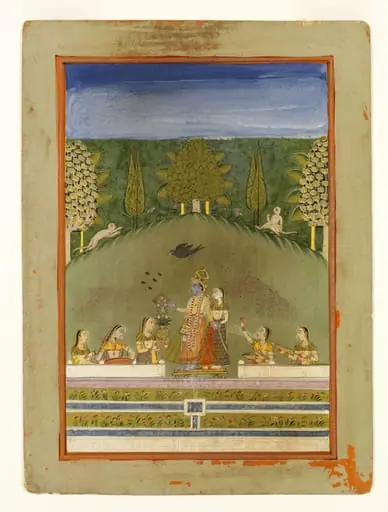 Vasant Ragini
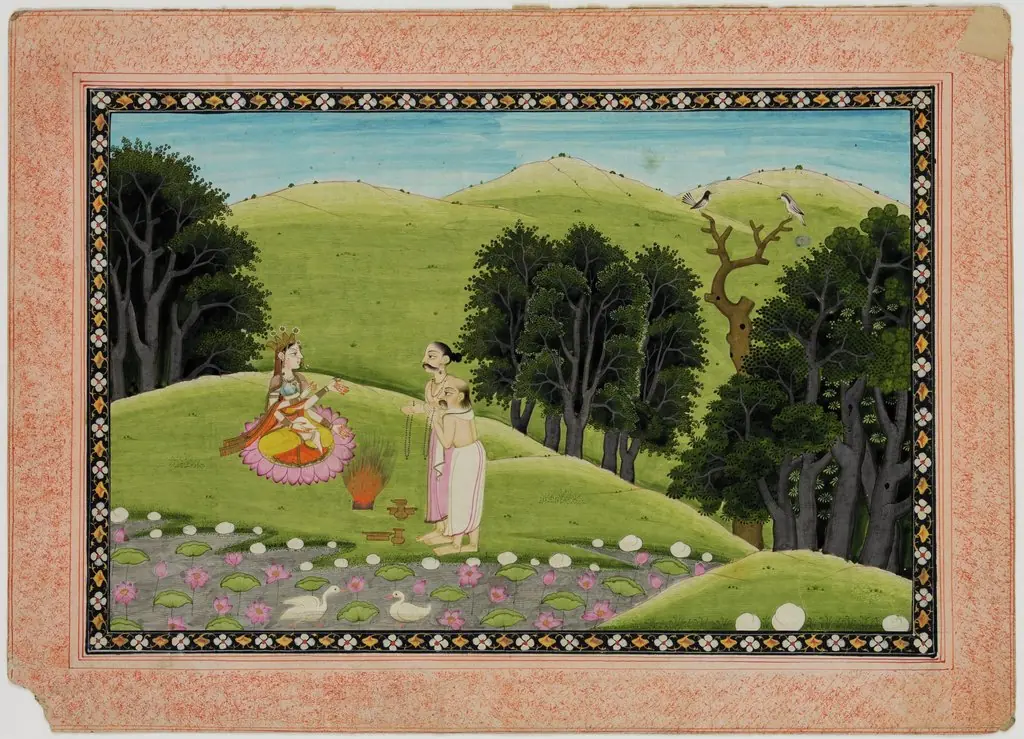 Lakshmi and Devotees
 Maharaja Raj Singh
 Rati, the Goddess of Erotic Love, Takes Aim at Krishna, from a Rasikapriya
 A Heroine and Her Paramour: Malavi Ragini, from a Ragamala
 Untitled
 Gaura-Mallara Ragini (A Musical Mode)
 Radha Awaiting Reconciliation with Krishna, from a Gita Govinda of Jayadeva
 Rati, the Goddess of Erotic Love, Takes Aim at Krishna, from a Rasikapriya