Artwork
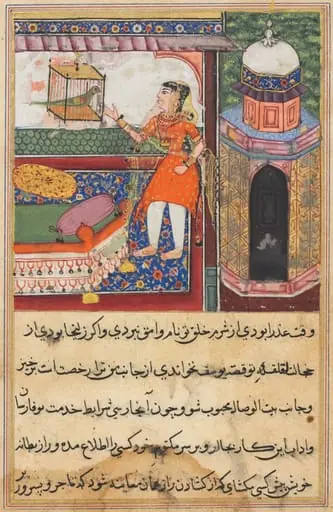
The Brahman, unable to select from the four gifts of the king of the Ocean seeks the Raja’s advice, from a Tuti-nama (Tales of a Parrot): Eleventh Night
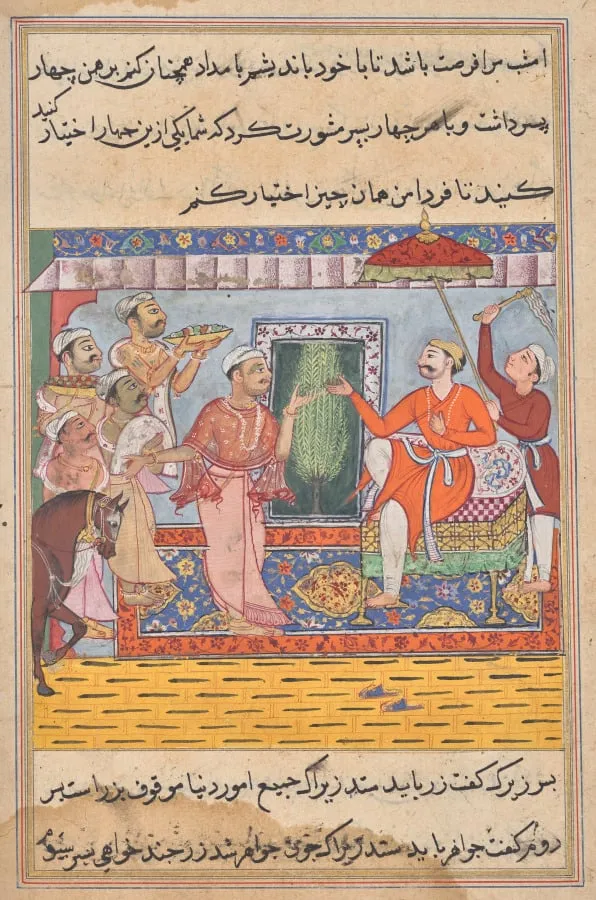
The Brahman, unable to select from the four gifts of the king of the Ocean seeks the Raja’s advice, from a Tuti-nama (Tales of a Parrot): Eleventh Night is an unspecified painting by the Patna School of Painting artist Unknown. It dates from 1560 and is held in the collection of the Cleveland Museum of Art. This painting illustrates a scene from the Tuti-nama, a collection of moral tales compiled for the Mughal court.
- Accession no.
- 1962.279.93.b
- Credit line
- Gift of Mrs. A. Dean Perry
About this work
You see a Brahman priest standing before a king on a golden throne, four gifts, gold, jewels, a robe, and a horse, lined up behind him.
You see a Brahman priest standing before a king on a golden throne, four gifts, gold, jewels, a robe, and a horse, lined up behind him.
The story comes from a book of parrot tales told to a queen to keep her from sneaking out at night. The priest can’t pick one gift, so the king lets him take all four. The bright colors and flat figures make the scene feel like a storybook page.
To see more paintings like this, look up Mughal India, court of Akbar (reigned 1556–1605).
Overview
This painting illustrates a scene from the Tuti-nama, a collection of moral tales compiled for the Mughal court. It depicts a Brahman priest consulting with a king after being offered four valuable gifts by the Ocean’s ruler. Unable to decide which to accept, he returns to the king, who, impressed by his integrity, grants him all four. The scene is rendered in the vibrant, stylized manner characteristic of Akbar-era manuscript illustration.
Subject & Meaning
The narrative centers on moral discernment rather than material gain. The Brahman’s hesitation reflects a virtue of humility and thoughtful deliberation, contrasting with the temptation of wealth. The king’s decision to award all gifts rewards honesty over strategic choice, reinforcing a theme of ethical conduct valued in courtly literature. The tale functions as a parable on wisdom and restraint.
Technique & Style
The composition uses flat planes of saturated color and minimal spatial depth, typical of early Mughal painting. Figures are outlined with precision, and decorative patterns adorn clothing and architecture. The gifts are arranged symmetrically behind the priest, emphasizing their equal value.
The lack of perspective and stylized forms create a narrative clarity suited to manuscript illustration, prioritizing storytelling over naturalism.
History & Provenance
Created during the reign of Emperor Akbar (1556–1605), this work was part of a larger illustrated manuscript commissioned for the imperial court. The Tuti-nama was among the first major projects of the Mughal atelier, blending Persian literary tradition with Indian artistic conventions. The painting likely originated in the royal workshop in Fatehpur Sikri or Agra, where artists from diverse regions collaborated.
Context
The Tuti-nama was designed to entertain and instruct the royal harem, particularly Akbar’s queen, by recounting the nightly tales of a talking parrot. These stories, often drawn from older Sanskrit and Persian sources, served as vehicles for ethical instruction under the guise of entertainment. The visual style of the illustrations reflected the emperor’s interest in synthesizing cultural traditions across his empire.
Legacy
This painting exemplifies the early Mughal synthesis of Persian narrative form and Indian pictorial language. Its influence extended to later imperial manuscripts, setting precedents for figure composition and color use. Though the Tuti-nama itself was not widely copied, its approach to storytelling through imagery helped define the aesthetic of Mughal book art in the late 16th century.
Artist & collection









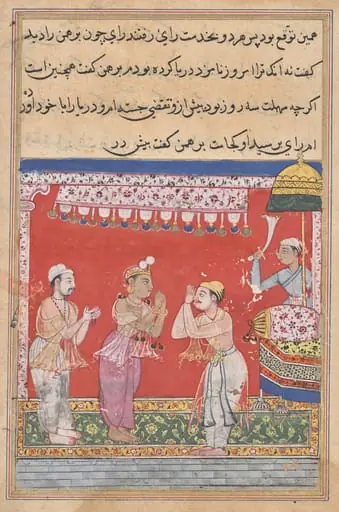
- The king of the Ocean, having assumed human form, arrives at the court of the Raja, from a Tuti-nama (Tales of a Parrot): Eleventh Night
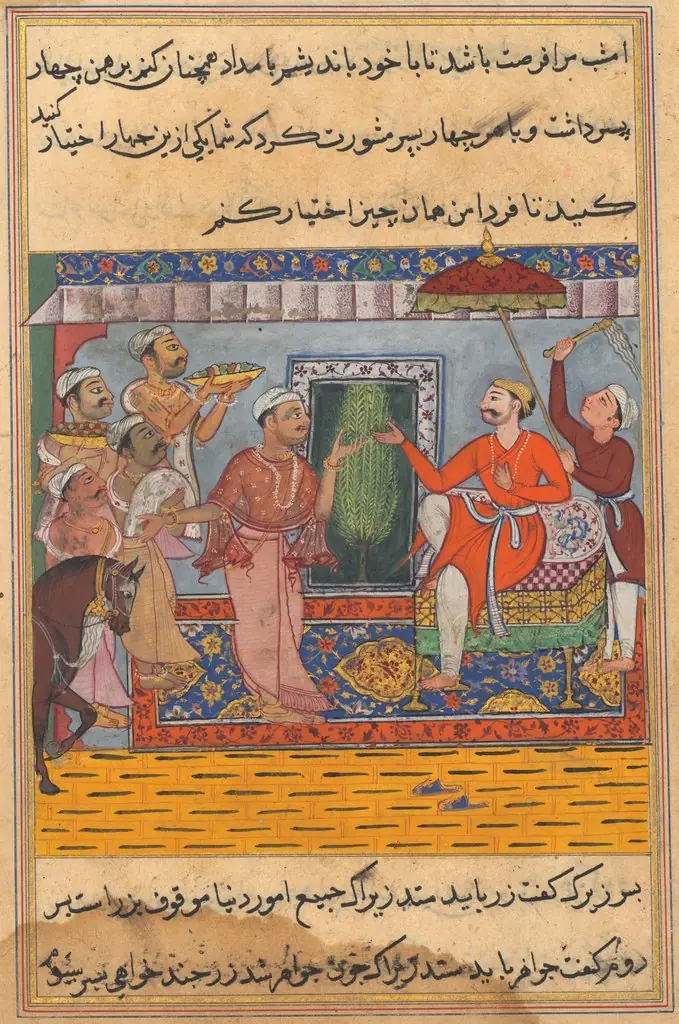 The Brahman, unable to select from the four gifts of the king of the Ocean seeks the Raja’s advice, from a Tuti-nama (Tales of a Parrot): Eleventh Night
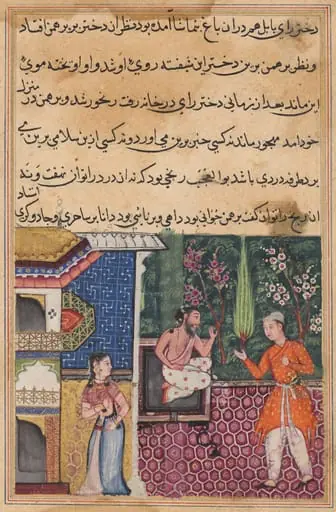 The Brahman gives an account of his falling in love with the king of Babylon’s daughter to his friend, the magician, from a Tuti-nama (Tales of a Parrot): Thirty-fifth Night
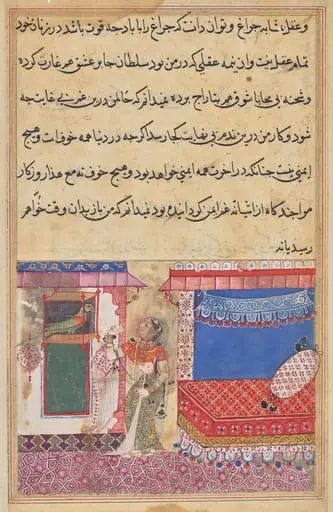 The Parrot Addresses Khujasta at the Beginning of the Eighteenth Night, from a Tuti-nama (Tales of a Parrot)
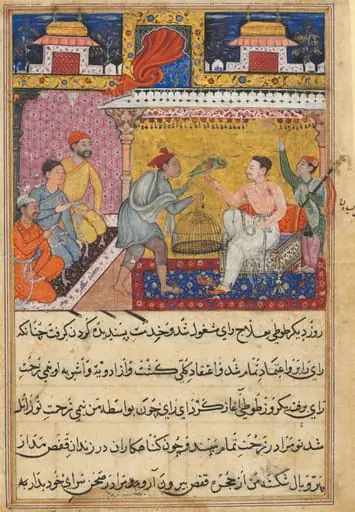 The hunter offers the mother parrot to the king of Kamarupa, from a Tuti-nama (Tales of a Parrot): Fifth Night
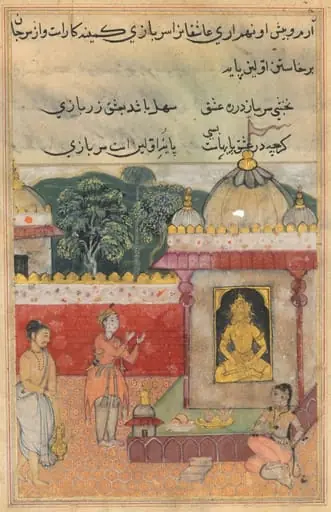 The Raja’s son vows to sever his head and offer it to the image if he is united with the princess he has seen in the temple, from a Tuti-nama (Tales of a Parrot): Thirty-fourth Night
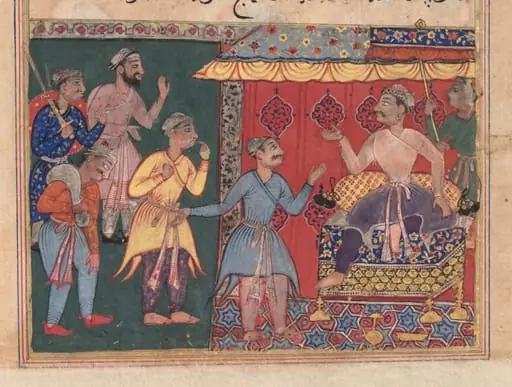 King Bhojaraja tries in vain to ascertain the whereabouts of the pearl from the four travelling companions, from a Tuti-nama (Tales of a Parrot): Twelfth Night
 The Parrot Addresses Khujasta at the Beginning of the Tenth Night, from a Tuti-nama (Tales of a Parrot)