Artwork
The Bucintoro at the Molo on Ascension Day
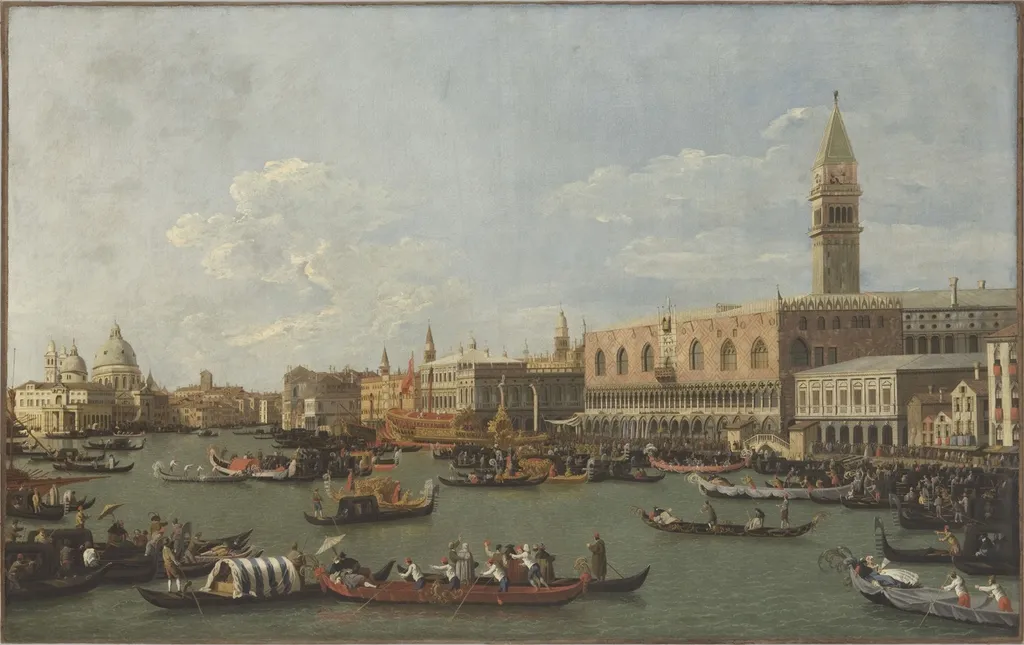
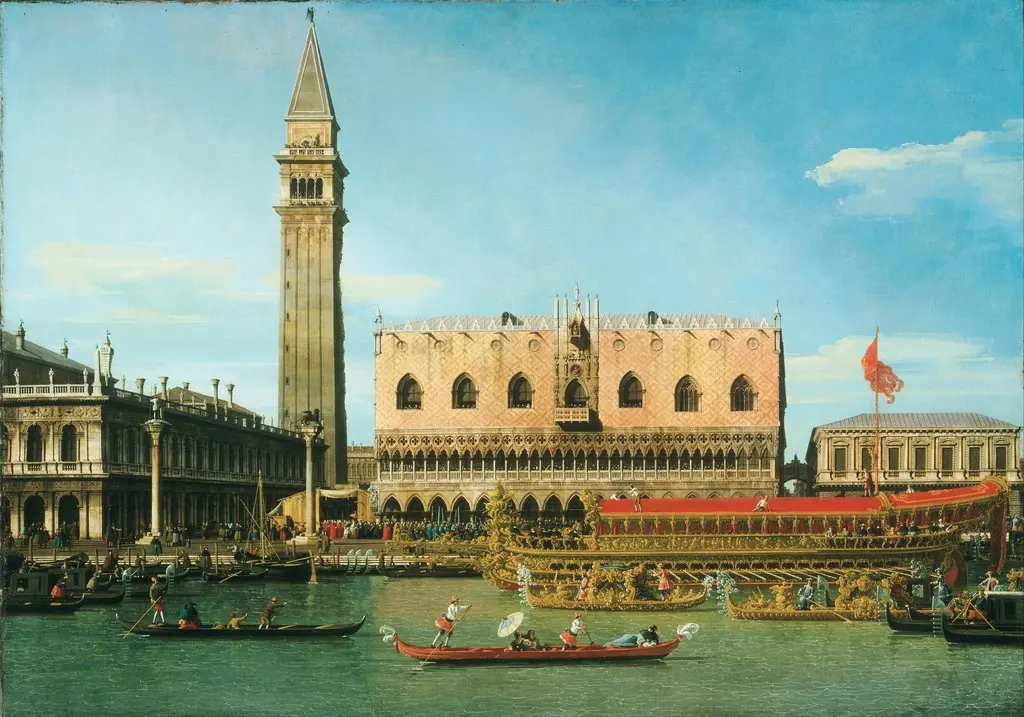
The Bucintoro at the Molo on Ascension Day is an oil painting by the Rococo painting artist Unknown. It dates from 1730 and is held in the collection of the Philadelphia Museum of Art.
About this work
Overview
Another version, dated circa 1745 by the jagged edge of St Mark's Campanile (struck by lightning in 1745), is at the Philadelphia Museum of Art.
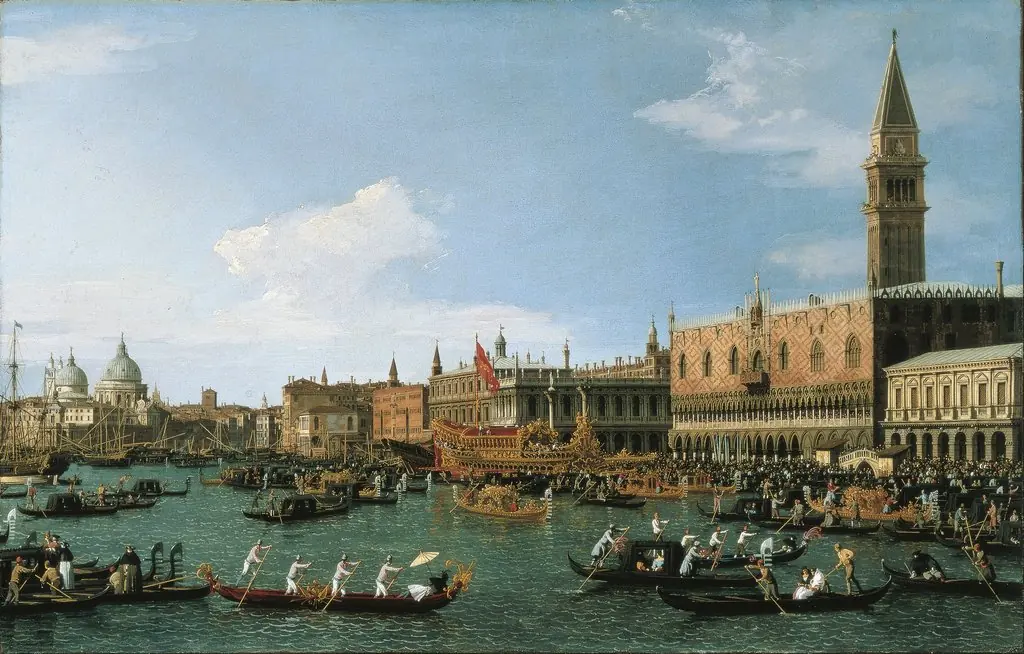
The Bucintoro at the Molo on Ascension Day is an oil on canvas painting by Giovanni Antonio Canal, known as Canaletto (1697-1768), the preeminent Venetian veduta painter of the eighteenth century. The work exists in multiple versions with differing dates and locations, reflecting Canaletto's repeated engagement with this celebrated subject throughout his career. One significant version, dated 1760 by an inscription on the reverse of the canvas, is held at the Dulwich Picture Gallery in London, acquired through a gift from Henry Yates Thompson in 1919. Another version, dated circa 1745 by the jagged edge of St Mark's Campanile (struck by lightning in 1745), is at the Philadelphia Museum of Art. A third version, circa 1732-1734, is in the Royal Collection in the United Kingdom. The painting matters as one of Canaletto's most iconic compositions, capturing the ceremonial heart of the Venetian Republic at the height of its ritual splendor, and it exemplifies the veduta genre that made Canaletto internationally famous.
Subject & Meaning
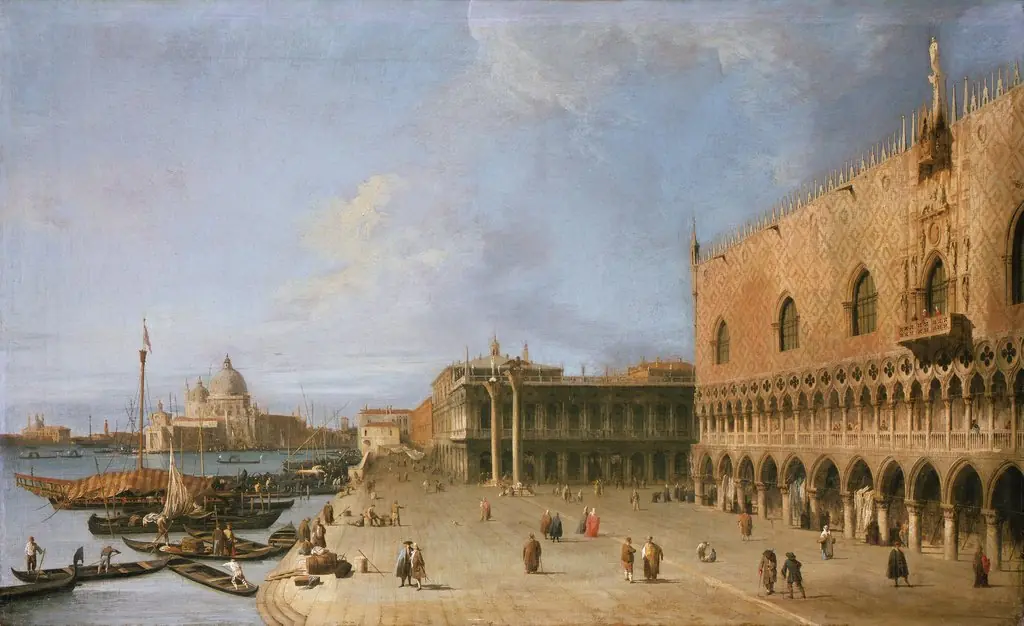
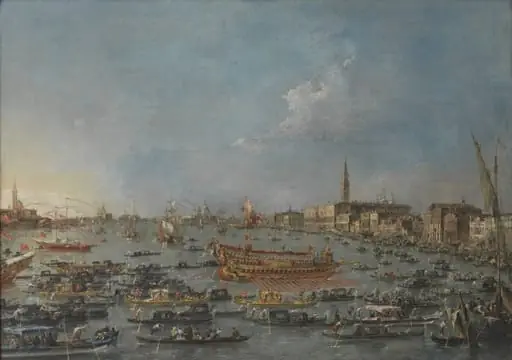
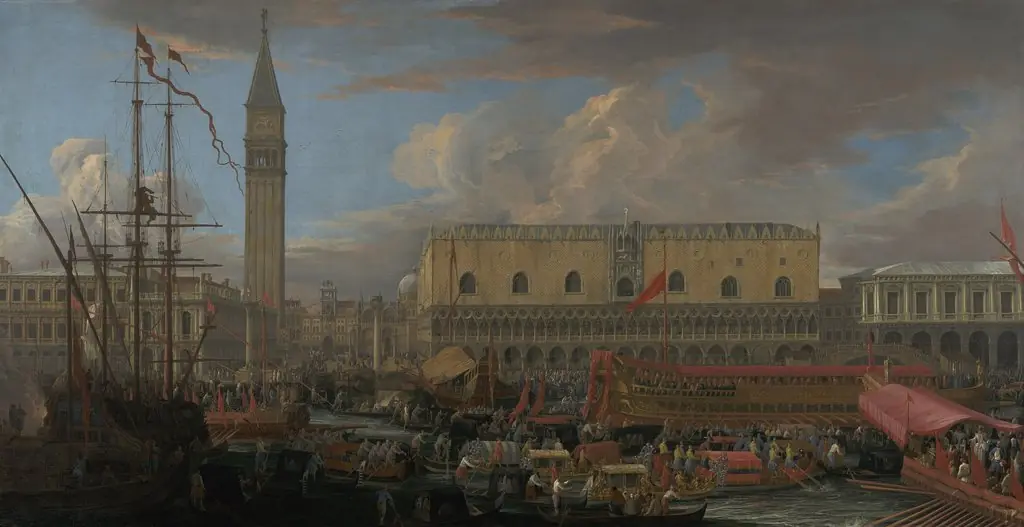
The painting depicts the Bucintoro, the magnificent ceremonial barge of the Doge, moored at the Molo (the quayside before the Doge's Palace) on Ascension Day. The subject is the Festa della Sensa, Venice's principal annual ceremony, which commemorated two traditions: the sailing of Doge Pietro II Orseolo's war fleet on Ascension Day in 998 or 1000 to assert Venetian power along the Istrian coast, and the gift of a ring by Pope Alexander III to Doge Sebastiano Ziani in 1177, sanctioning Venice's authority over the Adriatic. The ritual involved the Doge and officials boarding the Bucintoro, sailing into the Adriatic, and casting a gold ring blessed by the Patriarch into the waters to symbolize the marriage of Venice to the sea. The composition typically shows the Bucintoro returned and docking, surrounded by gondolas filled with spectators in festive attire. Iconographic elements include the Doge's Palace with its arched colonnades, St Mark's Campanile, the domed church of San Marco, the Zecca, the Libreria, and the Torre dell'Orologio. The Ascension Day market marquee in the Piazzetta appears as an integral part of the festival. The fusta, the Doge's usual single-masted galleon, may appear moored nearby with oars raised.
Technique & Style
Canaletto executed the painting in oil on canvas, his characteristic medium. The Dulwich version measures 58.3 by 101.8 cm, while the Philadelphia version measures 122.2 by 193.7 cm, and the Royal Collection version 76.8 by 125.4 cm. The visual evidence reveals smooth, precise brushwork with careful architectural detail and small, individualized figures. The palette consists of muted earth tones, soft blues, and pale pinks, with touches of red and gold on the boats. Light falls evenly across the scene, suggesting a bright but overcast day, with subtle shadows under the boats and building arcades. The composition stretches horizontally, emphasizing the expanse of water and the ceremonial gathering of vessels. In the 1754 version painted for Thomas King, 5th Baron King, Canaletto employed broader brushwork and a more brightly colored palette than in earlier treatments, and adopted a rare upright format that allowed St Mark's Campanile to appear especially elongated. The Philadelphia version, dated circa 1745, shows the campanile with its distinctive jagged edge after the lightning strike. Canaletto typically took liberties with architectural proportions for compositional effect, shortening the campanile or reducing and shifting domes to fit his pictorial scheme.
History & Provenance
The earliest known version of this subject dates to circa 1731-1732 and was acquired by Sir Robert Walpole, Britain's first Prime Minister, for 10 Downing Street; this painting sold ati at Christie's in July 2025 for £31.94 million, the highest auction price ever recorded for a Canaletto. The Royal Collection version (circa 1732-1734) was owned by Joseph Smith before being purchased by George III of Great Britain. The Dulwich Picture Gallery version, dated 1760 by an inscription on the reverse reading 'Io, Antonio Canal, detto il Canalletto [sic], fecit - 1760', was acquired through a gift from Henry Yates Thompson in 1919. The Philadelphia Museum of Art version, dated circa 1745, was owned by John G. Johnson. The 1754 version, painted for Thomas King, 5th Baron King, was sold at Christie's in New York on 4 February 2026 for $30,535,000. Canaletto produced this subject repeatedly from the early 1730s through his late career, with the 1760 Dulwich painting representing one of his final treatments of the theme.
Context
Canaletto was born in Venice in 1697 and apprenticed with his father, a painter of stage scenery, an background that informed his theatrical sense of composition. He became the foremost practitioner of the veduta, or view painting, genre that documented Venice's architectural splendor for an international clientele. The Bucintoro subject held particular appeal for British aristocrats undertaking the Grand Tour, who sought pictorial souvenirs of Venetian pageantry. After a nine-year stay in Britain (1746-1755), Canaletto returned to Venice and struggled for recognition in his native republic compared to the acclaim he enjoyed abroad. The 1760 Dulwich version belongs to this final Venetian period. The repeated treatment of this subject across decades demonstrates Canaletto's commercial acumen and the enduring demand for this iconic scene among his patrons. The 1754 version painted in London reflects his continued engagement with the subject while working for British clients, even from abroad. scholars have noted that Canaletto's depictions of the Bucintoro constitute a significant subset of his oeuvre, with variations in viewpoint, format, and handling that chart his artistic development.
Legacy
The Bucintoro at the Molo on Ascension Day stands as one of Canaletto's most enduring and commercially significant subjects. The 2025 sale of the Walpole version for £31.94 million and the 2026 sale of the King version for over $30 million attest to the continued esteem in which these paintings are held. The subject has become synonymous with the vanished ritual splendor of the Venetian Republic, preserving the image of the last Bucintoro, constructed in 1728-1729 with gilded wooden allegorical sculptures by Antonio Corradini and destroyed after Napoleon's overthrow of the Republic in 1797. The vessel's subsequent fate, upper parts burnt for gold, the hulk armed by Austrians and finally broken up in 1824, lends poignancy to Canaletto's meticulous records. The paintings serve as primary visual documents for historians of Venetian ceremony and as touchstones for the city's cultural memory. Multiple versions in major collections, the Royal Collection, Dulwich Picture Gallery, and Philadelphia Museum of Art ensure the subject's continued public visibility and scholarly attention.
Artist & collection