Artwork
The Heroine Who is Faithfully Loved: Madhya Svadhinapatika Nayika, from a Rasamanjari of Bhanudatta
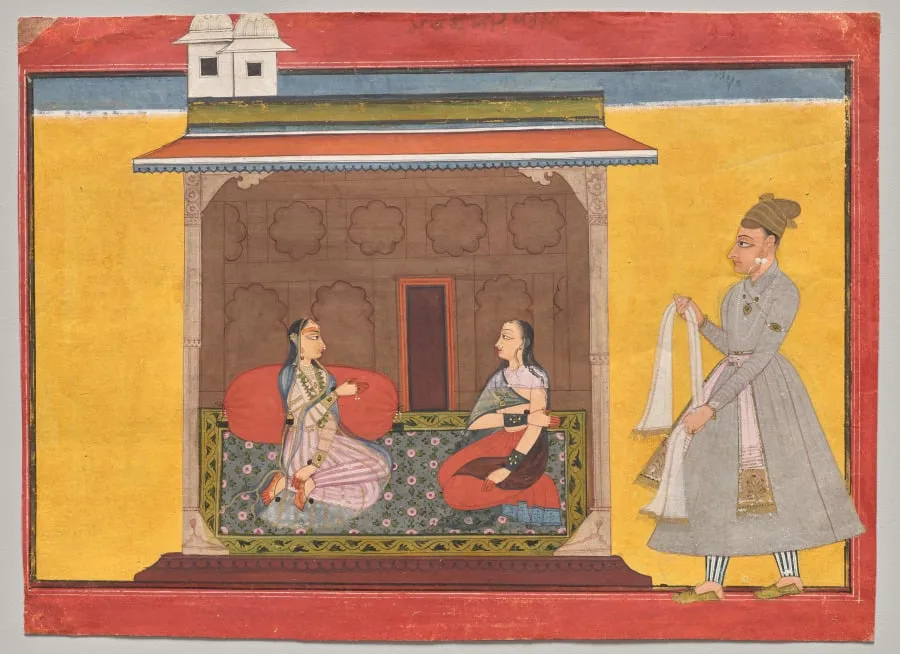
The Heroine Who is Faithfully Loved: Madhya Svadhinapatika Nayika, from a Rasamanjari of Bhanudatta is an unspecified painting by the Baroque artist Unknown. It dates from 1710 and is held in the collection of the Cleveland Museum of Art. The work depicts a woman seated on an elongated red cushion, her hand raised in a gestural exchange with an unseen companion.
- Accession no.
- 1967.239
- Credit line
- Gift of Dr. and Mrs. Sherman E. Lee
About this work
Overview
The work depicts a woman seated on an elongated red cushion, her hand raised in a gestural exchange with an unseen companion. She wears a red sari edged in gold, and a dark doorway behind her opens onto a garden where pink blossoms are visible. The composition conveys an intimate, quiet moment of conversation.
Subject & Meaning
The figure represents a heroine from a love poem, poised between acquiescence to her husband and playful coyness. Her posture and raised hand suggest deliberation, reflecting the emotional tension central to the poem’s narrative.
Technique & Style
Rendered in a regional Pahari aesthetic, the painting combines delicate line work with rich, saturated colors. Gold trim on the sari and the careful rendering of the garden backdrop demonstrate the artist’s attention to ornamental detail typical of northern Indian courtly art of the period.
History & Provenance
The image originates from a 15th‑century collection of love verses compiled by Bhanudatta Misra, a poet active in the late 1400s‑early 1500s in northeastern India. The poem’s text appears on the reverse side of the panel, inscribed in Sanskrit using the Takri script and accompanied by a vernacular translation, an uncommon pairing of visual and literary material.
Context
The painting belongs to the artistic output of the Pahari kingdoms, which flourished in the Himalayan foothills. These courts favored miniature paintings that illustrated poetic themes, often integrating script and image to enhance the viewer’s experience of the literary source.
Artist & collection









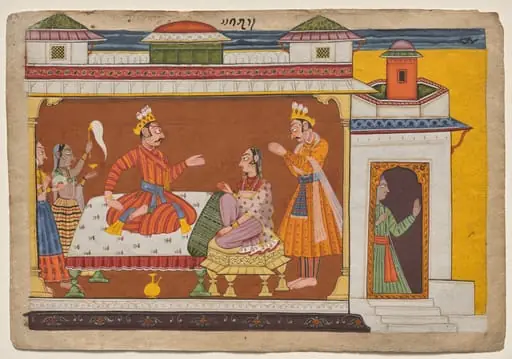 King Dasharatha sends his chief minister Sumantra to summon Rama, from the "Shangri" Ramayana
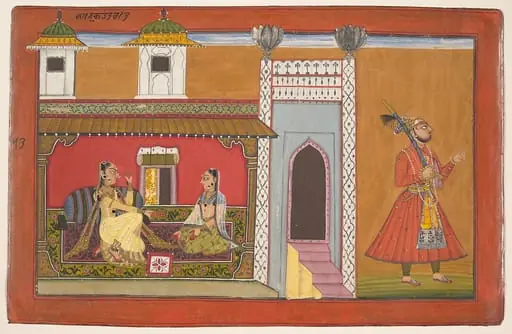 Untitled
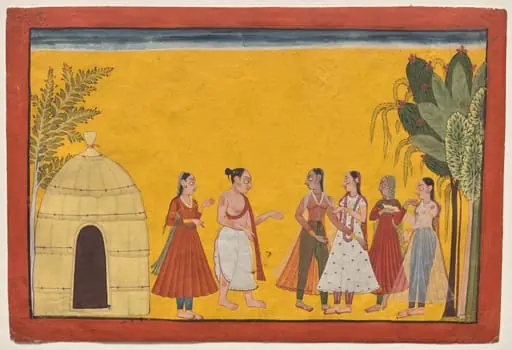 Rishyashringa addresses the courtesans, from the "Shangri" Ramayana
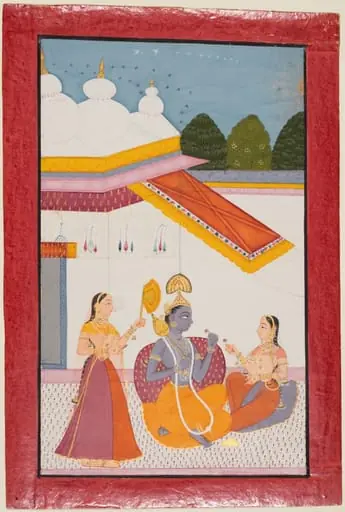 Krishna Under a Canopy
 Untitled
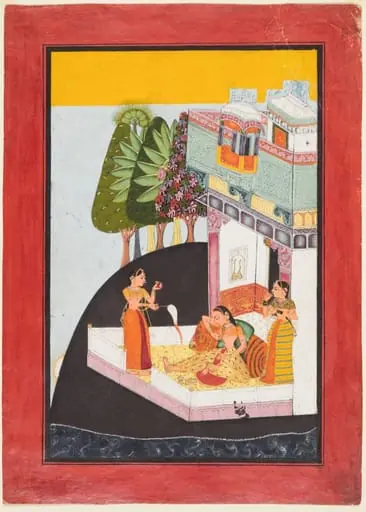 A Disconsolate Lady on a Terrace with Attendants
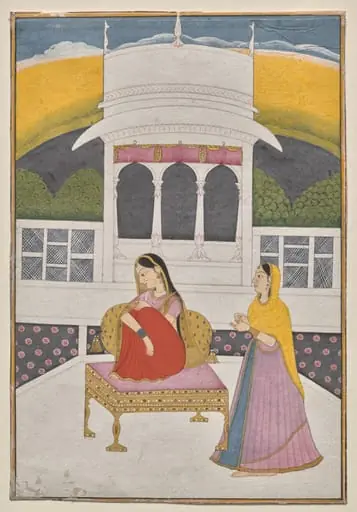 A Nayika, probably Proshitaperyasi Nayika
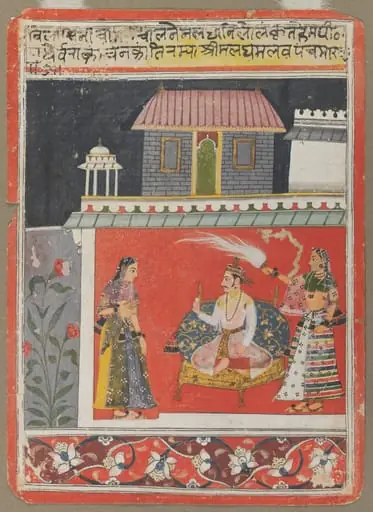 Pancham Raga
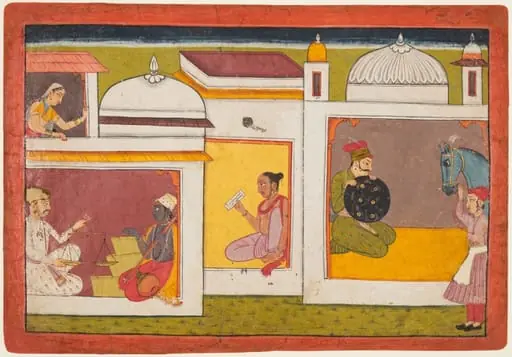 Madhava faces a man holding a scale, folio 1 from a Madhavanala-Kamakandala
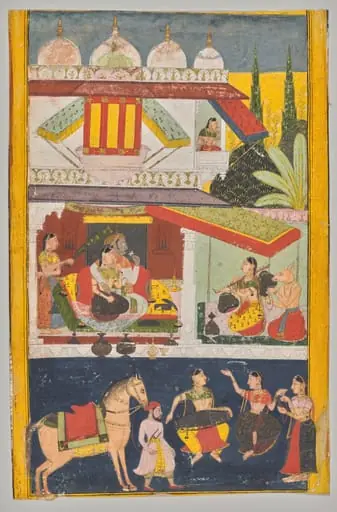 Shri Raga, from a Ragamala