Artwork
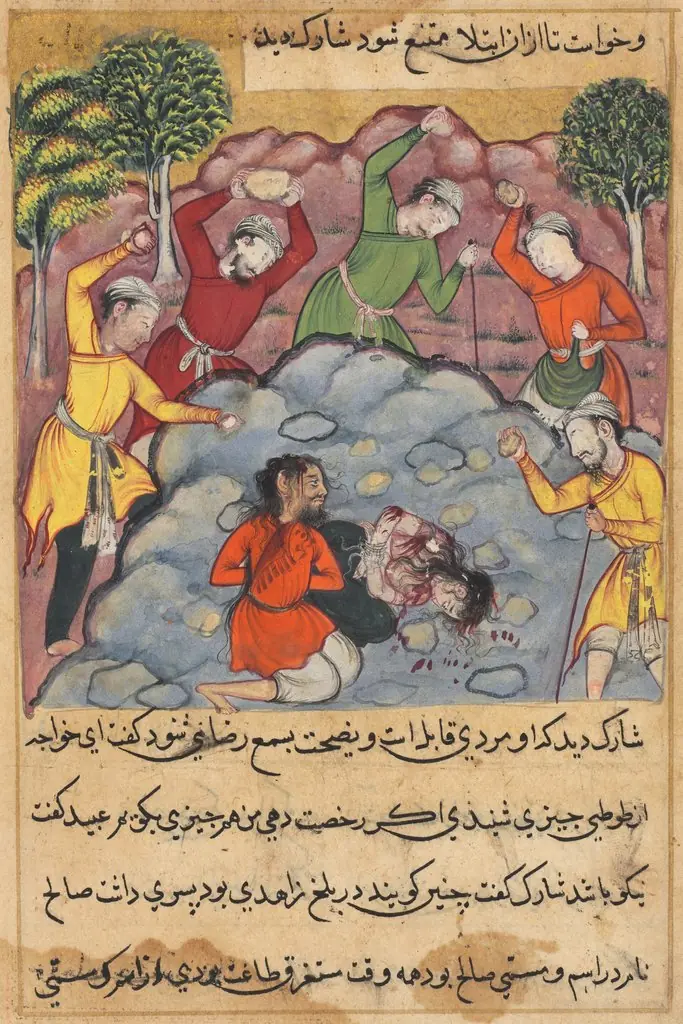
The Raja’s daughter and her lover stoned to death for adultery, from a Tuti-nama (Tales of a Parrot): Forty-Second Night
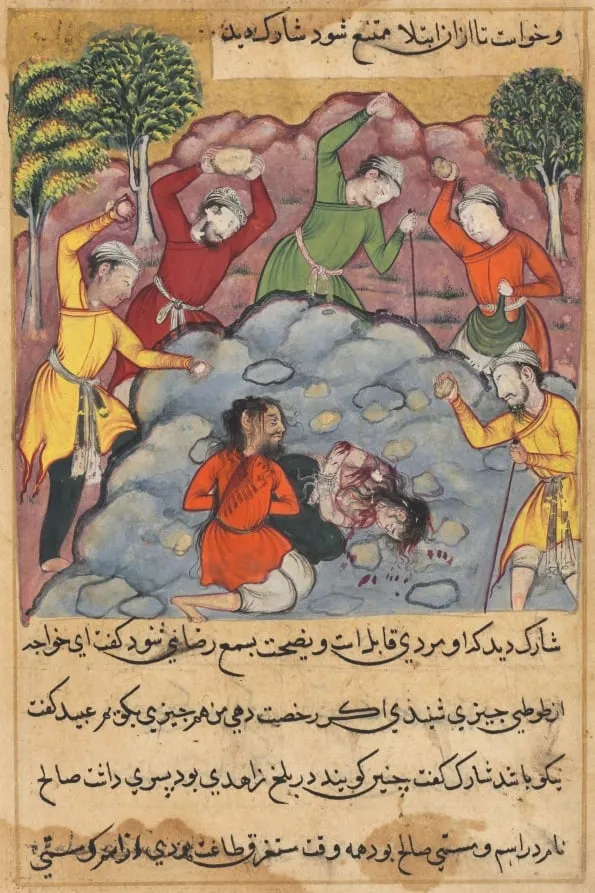
The Raja’s daughter and her lover stoned to death for adultery, from a Tuti-nama (Tales of a Parrot): Forty-Second Night is an unspecified painting by the Mughal Painting artist Unknown. It dates from 1560 and is held in the collection of the Cleveland Museum of Art. This painting depicts a violent scene from a narrative cycle, showing a young couple punished for adultery.
- Accession no.
- 1962.279.272.b
- Credit line
- Gift of Mrs. A. Dean Perry
About this work
You see a young woman lying dead in a pool of blood, her lover sitting beside her, arms tied, as men hurl stones at him.
You see a young woman lying dead in a pool of blood, her lover sitting beside her, arms tied, as men hurl stones at him.
This painting comes from a book of stories told by a parrot to delay a queen’s betrayal. The Mughal emperor Akbar ordered the tales illustrated, blending Persian and Indian styles. The bright colors and flat figures make the violence feel almost dreamlike.
To see more art from this time, look up Mughal India, court of Akbar (reigned 1556–1605).
Overview
This painting depicts a violent scene from a narrative cycle, showing a young couple punished for adultery. It is one of many illustrations from the Tuti-nama, a collection of tales told by a parrot.
Subject & Meaning
The scene shows the raja's daughter and her lover being stoned to death. The woman lies lifeless, while the man, with arms bound, awaits his fate amidst a group of executioners.
Technique & Style
The illustration blends Persian and Indian artistic traditions, as commissioned by Akbar. Bright colors and flat, two-dimensional figures create a sense of detachment, rendering the violent subject matter somewhat dreamlike.
Context
The Tuti-nama was a story collection illustrated during Akbar's reign. This painting is part of a larger series, reflecting the cultural and artistic exchanges that occurred in Mughal India during the 16th century.
Artist & collection









- The Raja’s daughter and her lover stoned to death for adultery, from a Tuti-nama (Tales of a Parrot): Forty-Second Night
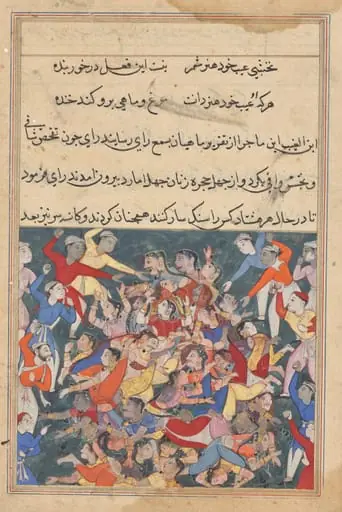 The forty wives and their secret paramours being punished by stoning to death, from a Tuti-nama (Tales of a Parrot): Twenty-third Night
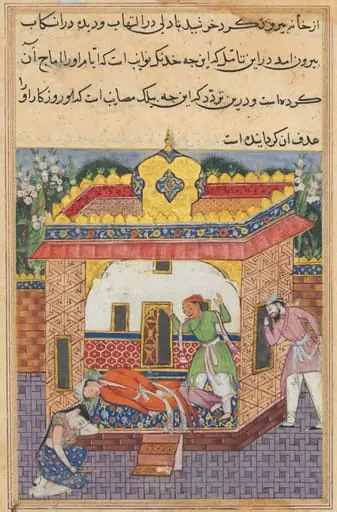 Latif, who has murdered his brother, falsely accuses Khurshid of the deed, from a Tuti-nama (Tales of a Parrot): Thirty-second Night
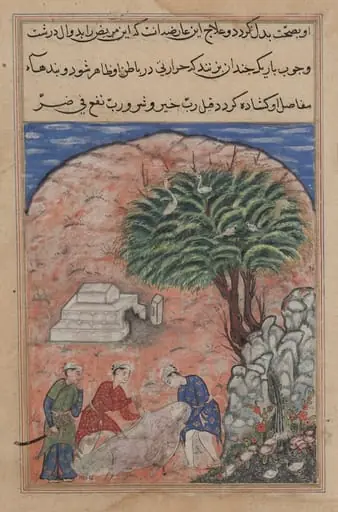 The suitors take the devotee’s daughter out of her tomb after breaking it open, when the physician discovers she is still alive, from a Tuti-nama (Tales of a Parrot): Twentieth Night
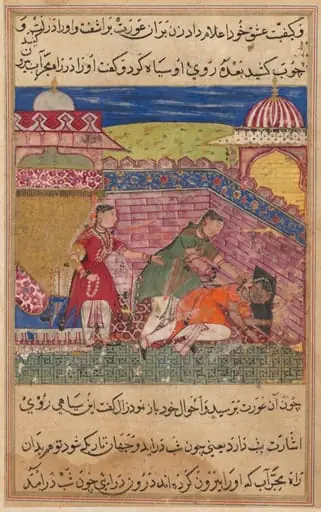 The deceitful wife ejects the procuress after blackening her face, from a Tuti-nama (Tales of a Parrot): Eighth Night
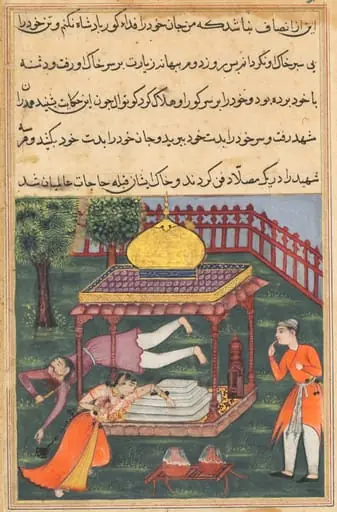 Mahrusa kills herself at the tomb of the king of Zabul, and her husband does likewise, from a Tuti-nama (Tales of a Parrot): Thirty-sixth Night
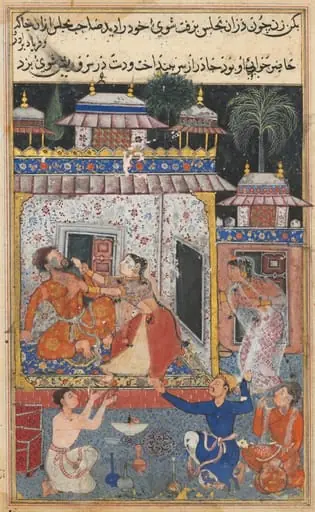 The deceitful wife assaults her erring husband, from a Tuti-nama (Tales of a Parrot): Eighth Night