Artwork
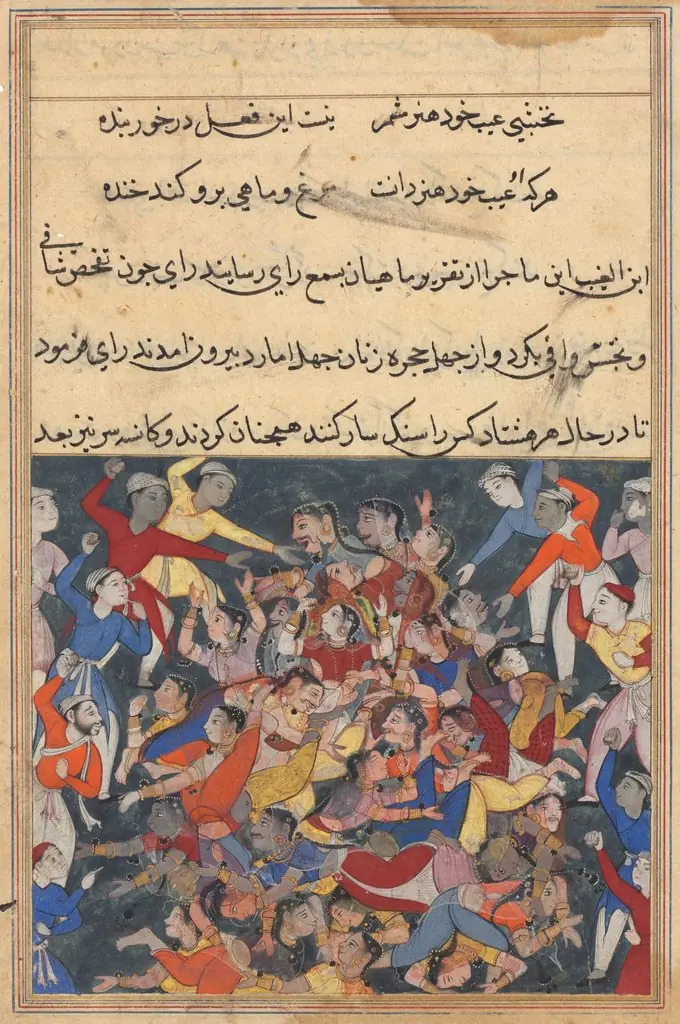
The forty wives and their secret paramours being punished by stoning to death, from a Tuti-nama (Tales of a Parrot): Twenty-third Night
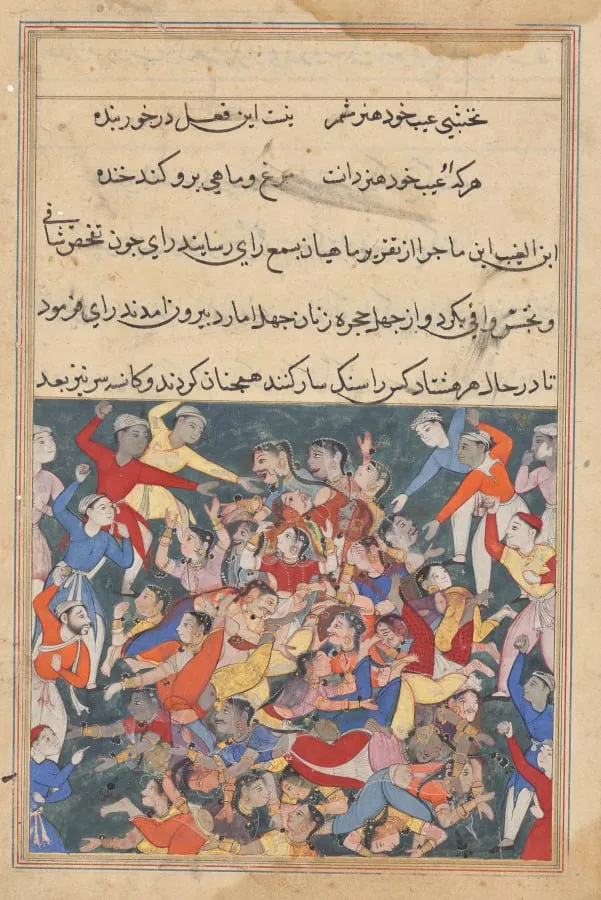
The forty wives and their secret paramours being punished by stoning to death, from a Tuti-nama (Tales of a Parrot): Twenty-third Night is an unspecified painting by the Mughal Painting artist Unknown. It dates from 1560 and is held in the collection of the Cleveland Museum of Art.
- Accession no.
- 1962.279.164.a
- Credit line
- Gift of Mrs. A. Dean Perry
About this work
To see more stories like this, look up mughal india, court of akbar (reigned 1556–1605).
You see a crowded scene of bodies tangled together, stones flying from the edges. Bright reds and blues stand out against pale skin. The figures look almost like dolls, stacked in a heap.
This painting comes from a book of parrot tales made for Emperor Akbar’s court. The story warns against deceit, here, the punishment is swift and brutal. The artist shows every face, even in death, as if each person still matters.
To see more stories like this, look up mughal india, court of akbar (reigned 1556–1605).
Overview
The painting illustrates a violent climax from a tale in the Tuti‑nama, a collection of parrot stories commissioned for Emperor Akbar’s court. In the scene, eighty figures, forty concealed men disguised as women and their forty wives, lie intertwined in a chaotic heap, while soldiers at the periphery hurl stones at the bodies. The composition is dominated by stark reds and blues that contrast with the pallid skin tones of the victims.
Subject & Meaning
The narrative depicts the discovery of a secret liaison in which the Raja’s wives sheltered young men disguised as women. Upon revelation, both the concealed men and their hostesses are executed by stoning, fulfilling a prophecy inscribed on a mysterious skull. The story functions as a moral warning against deceit and illicit desire, emphasizing the swift and brutal retribution meted out by the court.
Technique & Style
The artist employs a densely packed arrangement of figures that resemble stylized dolls, each rendered with individual facial features despite the violent context. Bright pigments of red and blue punctuate the composition, drawing attention to the bloodied violence amid the pale flesh tones. The use of linear perspective places the stone‑throwing guards at the edges, creating a sense of movement toward the central mass of bodies.
Context
Created for the Mughal court of Akbar (reigned 1556–1605), the work reflects the empire’s patronage of illustrated manuscripts that combined Persian literary traditions with local storytelling. The Tuti‑nama, a compilation of moralizing parrot tales, served both entertainment and didactic purposes within the imperial household, reinforcing ethical norms through vivid visual allegories.
Legacy
As a visual record of Mughal narrative art, the painting exemplifies how courtly manuscripts conveyed complex moral lessons through dramatic imagery. Its vivid portrayal of punishment and the meticulous attention to each individual’s visage have informed later studies of Mughal iconography, illustrating the period’s capacity for both elaborate storytelling and stark moral instruction.
Artist & collection









- The forty wives and their secret paramours being punished by stoning to death, from a Tuti-nama (Tales of a Parrot): Twenty-third Night
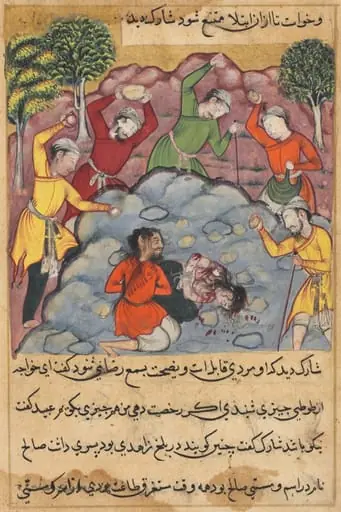 The Raja’s daughter and her lover stoned to death for adultery, from a Tuti-nama (Tales of a Parrot): Forty-Second Night
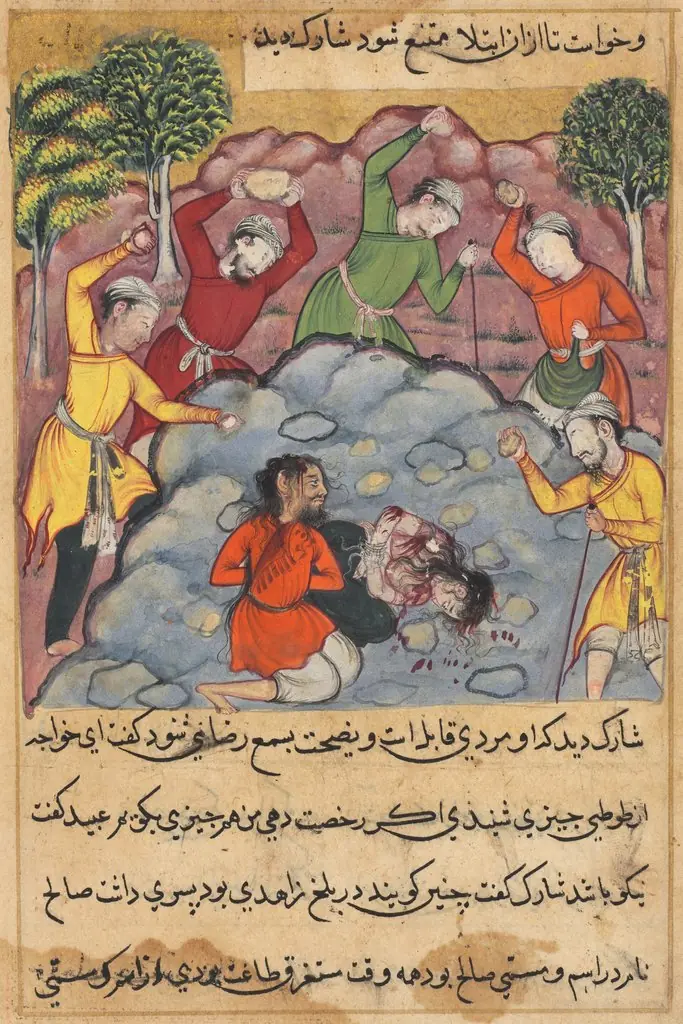 The Raja’s daughter and her lover stoned to death for adultery, from a Tuti-nama (Tales of a Parrot): Forty-Second Night
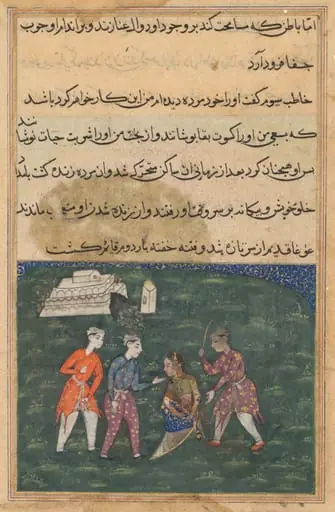 The third suitor strikes the devotee’s daughter and thus restores her to life, from a Tuti-nama (Tales of a Parrot): Twentieth Night
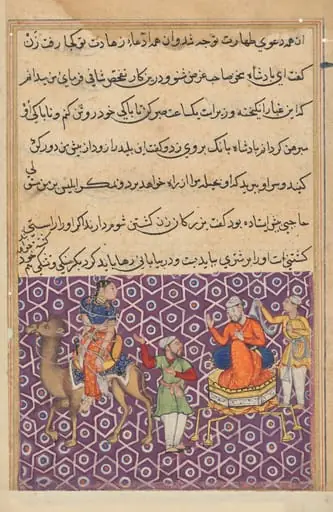 King Bahram, who has married Khassa’s daughter, has her tied to a camel to be abandoned in the desert as a result of false accusations made by Khulasa, from a Tuti-nama (Tales of a Parrot): Fifty-first Night
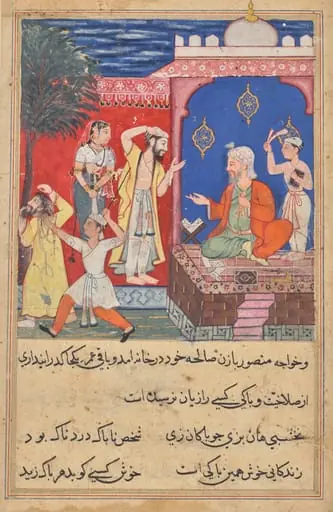 The false Mansur punished before the judge and expelled from the city, from a Tuti-nama (Tales of a Parrot): Seventeenth Night