Artwork
Mahrusa kills herself at the tomb of the king of Zabul, and her husband does likewise, from a Tuti-nama (Tales of a Parrot): Thirty-sixth Night
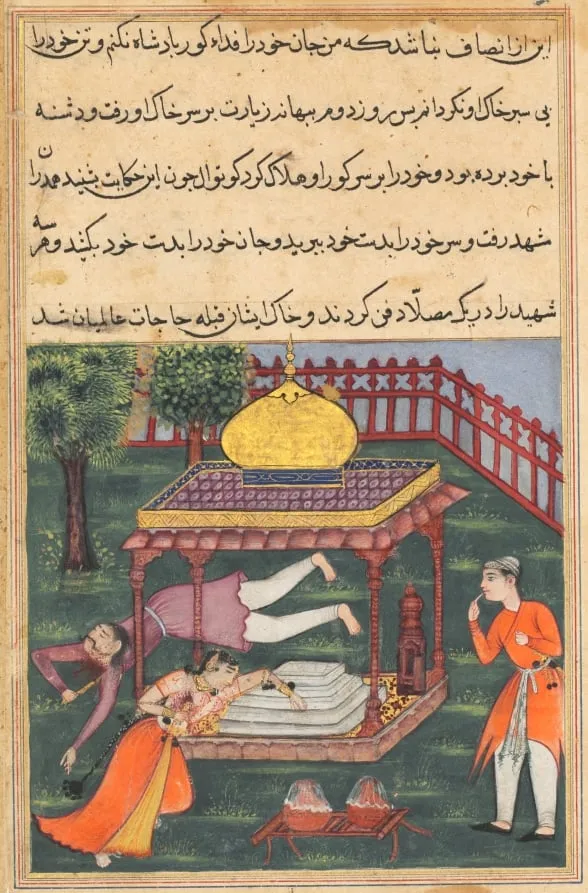
Mahrusa kills herself at the tomb of the king of Zabul, and her husband does likewise, from a Tuti-nama (Tales of a Parrot): Thirty-sixth Night is an unspecified painting by the Mughal Painting artist Unknown. It dates from 1560 and is held in the collection of the Cleveland Museum of Art. The painting illustrates a tragic tableau drawn from the Tuti‑nama, a collection of parrot‑told stories popular in the Mughal court.
- Accession no.
- 1962.279.242.a
- Credit line
- Gift of Mrs. A. Dean Perry
About this work
This painting tells a story from the Tuti-nama, a book of parrot tales read aloud at the Mughal court.
A woman lies across a tomb, a gold knife in her chest. Her husband is next to her, another knife beside him. A man stands to the side, hands raised in shock.
This painting tells a story from the Tuti-nama, a book of parrot tales read aloud at the Mughal court. The couple kills themselves to honor a dead king, turning grief into something sacred. The bright colors and flat figures make the scene feel like a story unfolding, not real life.
To see more paintings like this, look up Mughal India, court of Akbar (reigned 1556–1605).
Overview
The painting illustrates a tragic tableau drawn from the Tuti‑nama, a collection of parrot‑told stories popular in the Mughal court. A woman named Mahrusa lies across a royal tomb, a golden dagger thrust into her chest, while her husband is shown dead beside her, a blood‑stained knife in his hand. A lone onlooker stands to the side, hands raised in astonishment, witnessing the double suicide.
Subject & Meaning
According to the narrative, Mahrusa ends her life as an act of penance for the death of the king whose tomb she occupies, and her husband follows suit, sharing her grief. Their self‑destruction is portrayed as a form of martyrdom, elevating personal sorrow to a sacred sacrifice that honors the deceased monarch.
Technique & Style
Rendered in vivid, saturated pigments, the composition employs a flattened perspective characteristic of Mughal miniature painting. Figures are outlined in fine ink, their gestures exaggerated for narrative clarity. The bright colors and stylized forms create a storybook quality, emphasizing the allegorical nature of the scene rather than striving for realistic representation.
Context
The work belongs to the artistic milieu of Akbar’s court (1556–1605), when Mughal painters frequently illustrated literary texts such as the Tuti‑nama. These visualizations served both decorative and didactic purposes, reinforcing courtly values of loyalty, sacrifice, and the intertwining of personal devotion with royal authority.
Artist & collection









- Mahrusa kills herself at the tomb of the king of Zabul, and her husband does likewise, from a Tuti-nama (Tales of a Parrot): Thirty-sixth Night
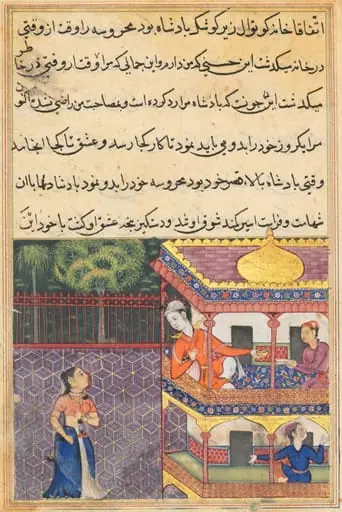 The king of Zabul sees Mahrusa from his palace balcony, from a Tuti-nama (Tales of a Parrot): Thirty-sixth Night
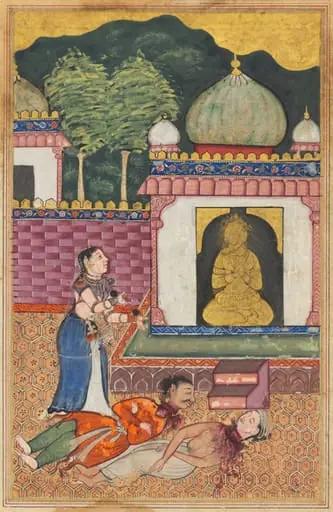 The princess discovers the dead bodies, with heads severed, of her husband and his Brahman friend, from a Tuti-nama (Tales of a Parrot): Thirty-fourth Night
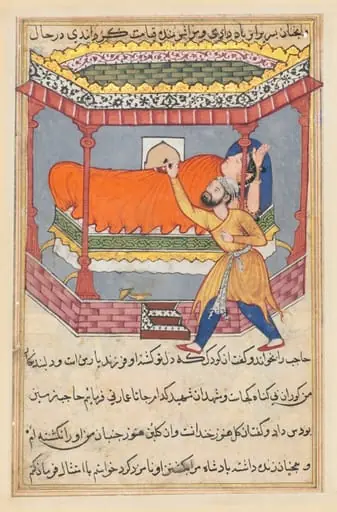 The king places the talisman on his sleeping wife, from a Tuti-nama (Tales of a Parrot): Fiftieth Night
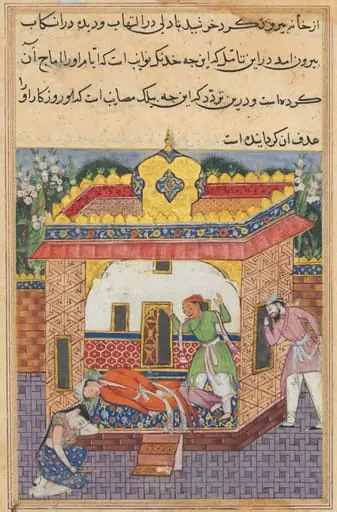 Latif, who has murdered his brother, falsely accuses Khurshid of the deed, from a Tuti-nama (Tales of a Parrot): Thirty-second Night
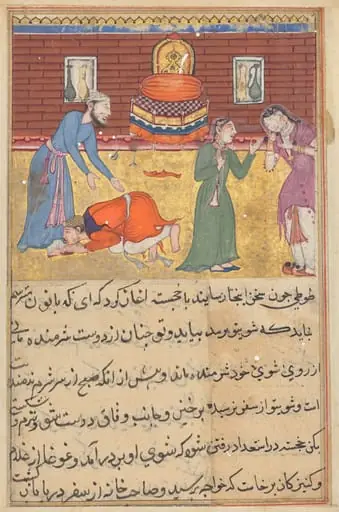 The pious man’s son, now a king, reveals himself to his father; his nurse upbraids his unfaithful mother, from a Tuti-nama (Tales of a Parrot): Fifty-second Night
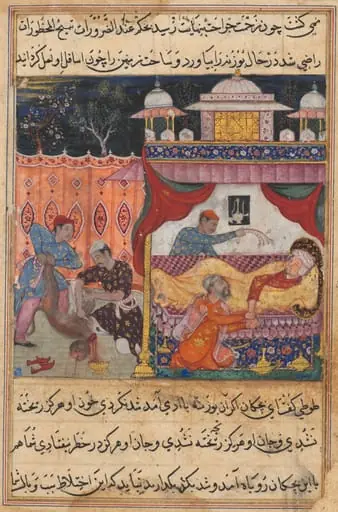 The monkey slain, his blood to be used as medicine for the ailing prince he has bitten, from a Tuti-nama (Tales of a Parrot): Fifth Night
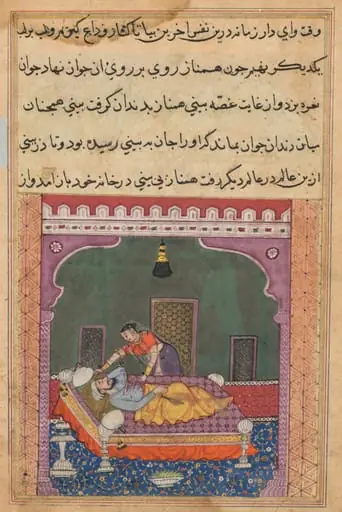 In order to falsely implicate her husband, Hamnaz places a knife by his side and lets the blood dripping from her nose stain his clothes, from a Tuti-nama (Tales of a Parrot): Twenty-fifth Night
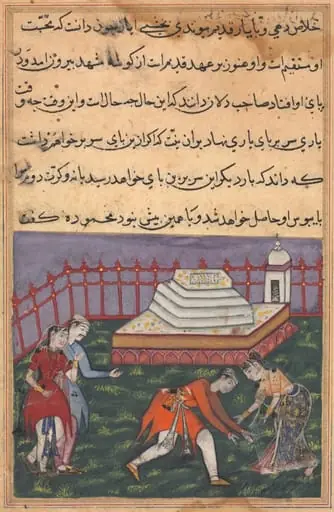 Hearing her declaration of love, Ayaz falls at the feet of Mahmuda at the holy shrine. The scene is witnessed by Salim, Ayaz’s friend, and a maid, from a Tuti-nama (Tales of a Parrot): Thirty-third Night
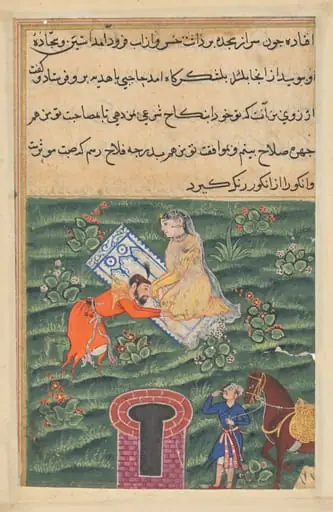 Khusrau, the King of Kings, pays homage to the pious daughter of Khassa, from a Tuti-nama (Tales of a Parrot): Fifty-first Night
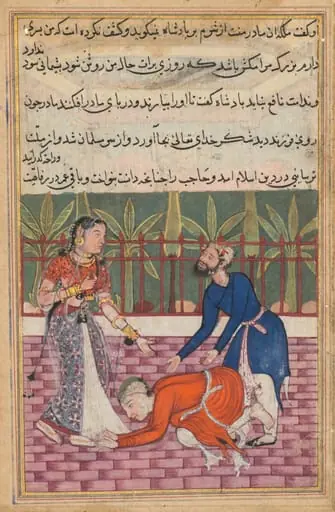 The guard restores the son who falls at his mother’s feet, from a Tuti-nama (Tales of a Parrot): Fiftieth Night