Artwork
The soldier receives a garland of roses from his wife which will remain fresh as long as she is faithful, from a Tuti-nama (Tales of a Parrot): Fourth Night
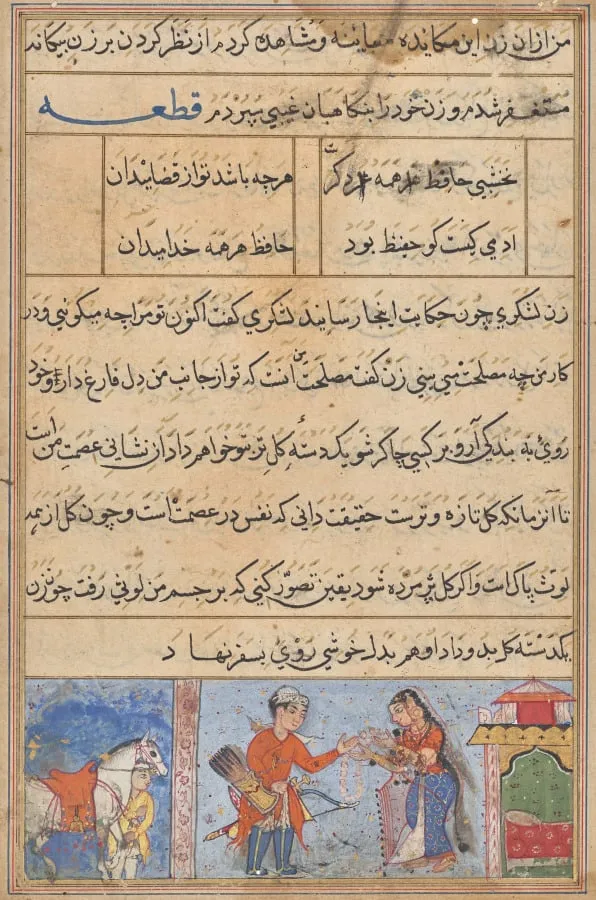
The soldier receives a garland of roses from his wife which will remain fresh as long as she is faithful, from a Tuti-nama (Tales of a Parrot): Fourth Night is an unspecified painting by the Mughal Painting artist Unknown. It dates from 1560 and is held in the collection of the Cleveland Museum of Art. The miniature depicts a mounted soldier receiving a garland of roses from his wife.
- Accession no.
- 1962.279.27.a
- Credit line
- Gift of Mrs. A. Dean Perry
About this work
You see a soldier on horseback taking a rose garland from his wife.
The flowers in the story stay fresh only as long as she stays faithful. It’s a quiet test, nature itself keeps score. The painting comes from a book of parrot tales told in Akbar’s court, where Persian, Indian, and Central Asian stories mixed.
If you like this, look up Mughal India, court of Akbar (reigned 1556–1605).
Overview
The miniature depicts a mounted soldier receiving a garland of roses from his wife. The scene illustrates a narrative in which the roses remain fresh only while the wife’s fidelity endures during her husband’s absence. The image is part of a manuscript of the Tuti‑nama, a collection of parrot‑told tales compiled for the Mughal court.
Subject & Meaning
The episode conveys a moral link between personal virtue and the natural world: the perpetual bloom of the roses symbolizes the wife’s unwavering loyalty. The exchange of the garland functions as a silent test of fidelity, with the flowers serving as a living gauge of the wife’s constancy.
Technique & Style
Executed in the refined Mughal miniature tradition, the painting combines delicate line work with a subtle palette of reds and earth tones. The figures are rendered with a blend of Persian elegance and Indian naturalism, while the composition balances narrative clarity with ornamental detail typical of courtly manuscripts.
History & Provenance
The Tuti‑nama was completed in 1330 by the Central Asian Sufi scholar Ziyāʾ al‑Dīn Nakshābī in Delhi, where he adapted Sanskrit stories into Persian. The manuscript was later illustrated by Indian and Persian artists for Emperor Akbar (r. 1556–1605), reflecting the collaborative artistic environment of his court.
Context
The work exemplifies the cultural synthesis of the Mughal empire, where Persian literary forms, Indian narrative content, and Central Asian artistic practices intersected. Such manuscripts were produced for elite audiences, serving both as entertainment and as vehicles for moral instruction within the imperial milieu.
Artist & collection









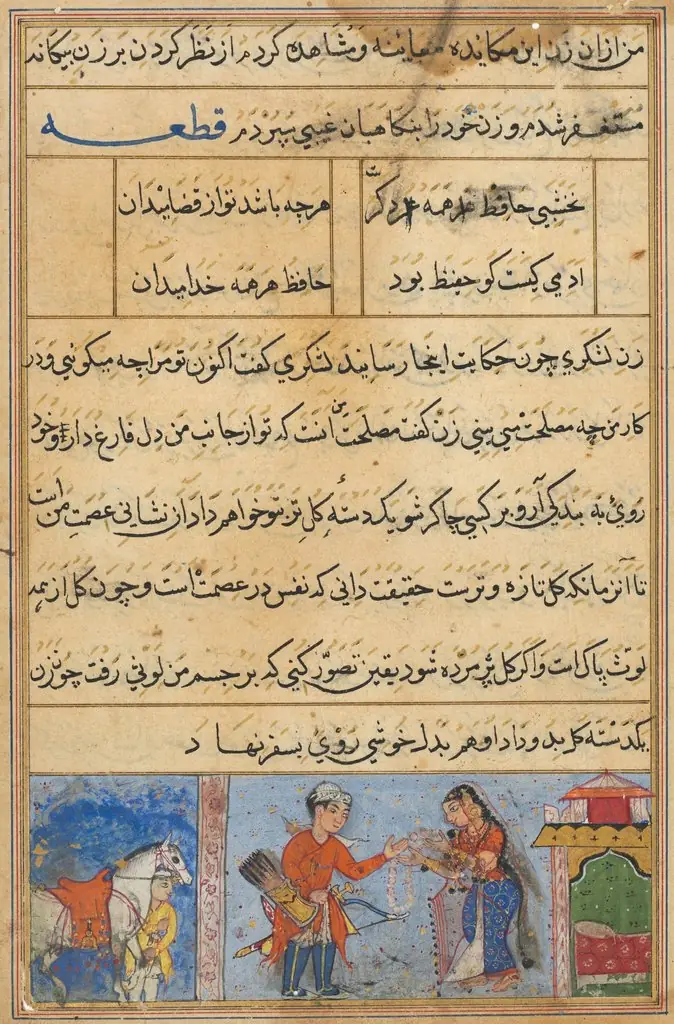 The soldier receives a garland of roses from his wife which will remain fresh as long as she is faithful, from a Tuti-nama (Tales of a Parrot): Fourth Night
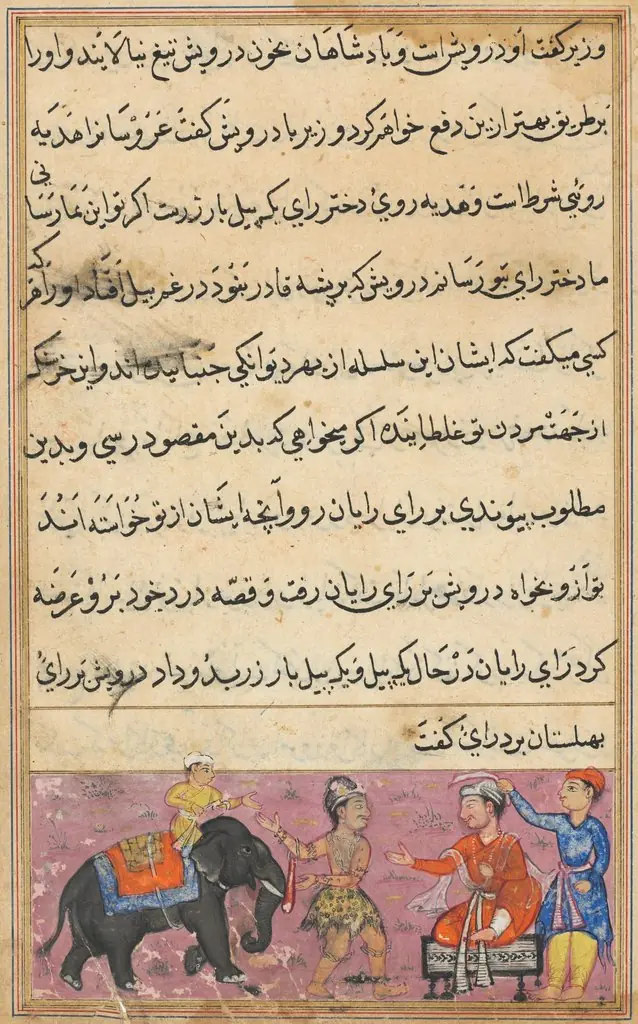 The dervish brings in as dowry an elephant laden with gold, from a Tuti-nama (Tales of a Parrot): Seventh Night
 Page from Tales of a Parrot (Tuti-nama): text page
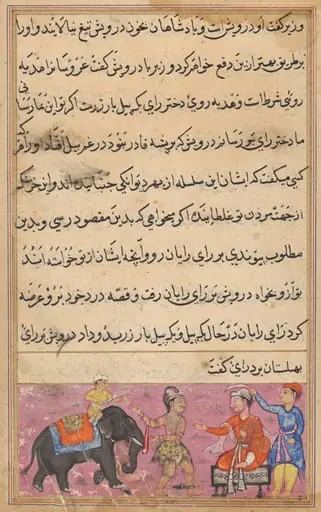 The dervish brings in as dowry an elephant laden with gold, from a Tuti-nama (Tales of a Parrot): Seventh Night
 Page from Tales of a Parrot (Tuti-nama): text page
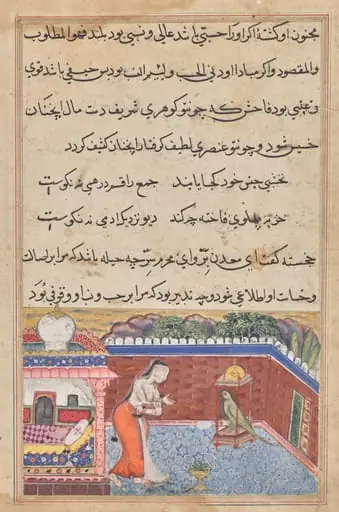 The parrot addresses Khujasta at the beginning of the thirty-first night, from a Tuti-nama (Tales of a Parrot)
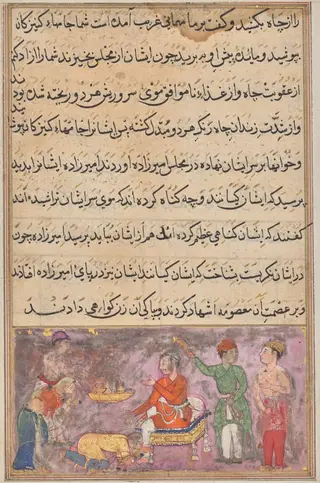 The two erring cooks, dressed as maidservants, fall at the prince’s feet and beg forgiveness, from a Tuti-nama (Tales of the Parrot): Fourth Night