Artwork
Theotokos of Vladimir
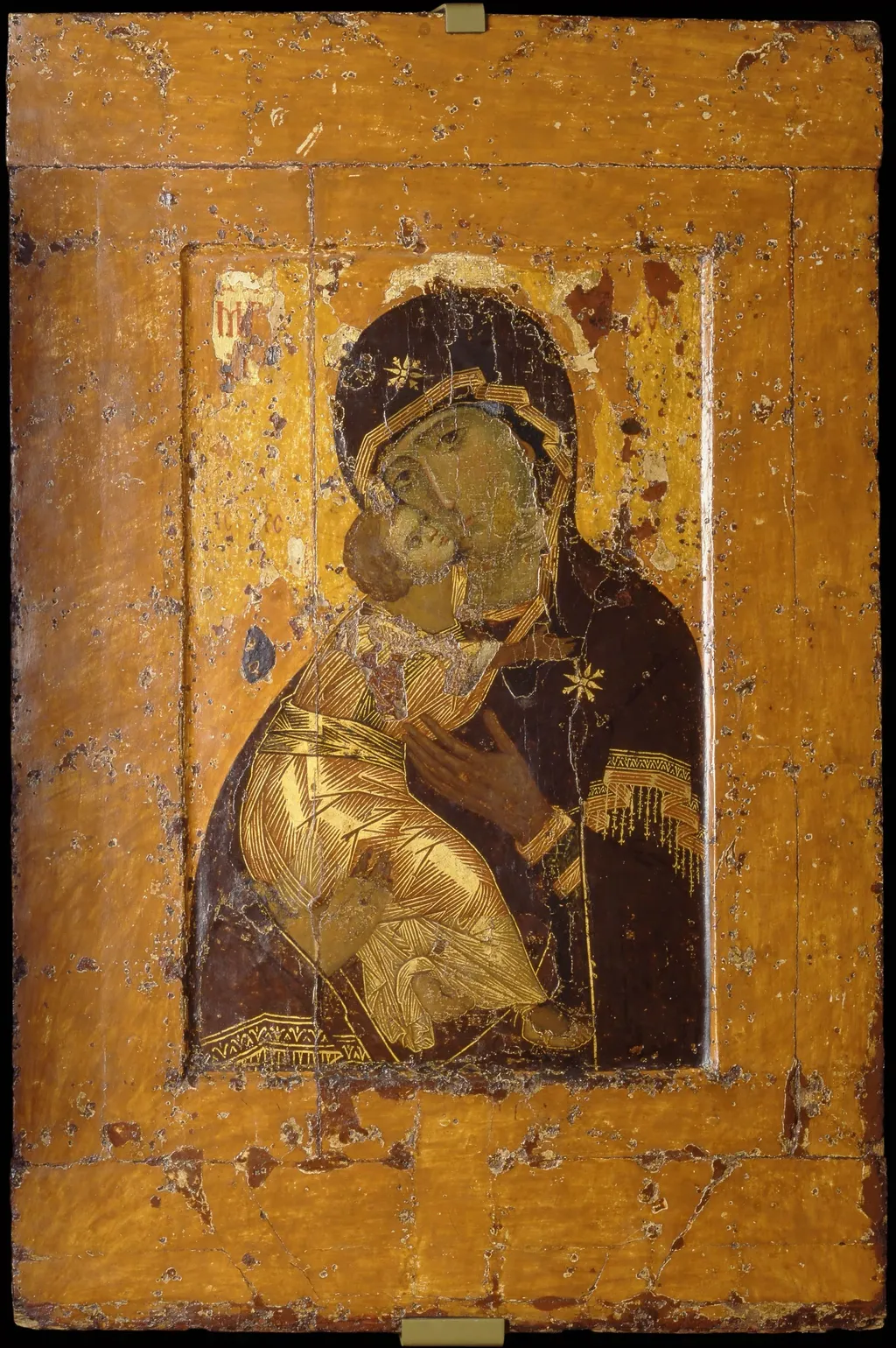
Theotokos of Vladimir is a tempera painting by the Byzantine icon painting artist Unknown. It dates from 1125 and is held in the collection of the Tretyakov Gallery.
About this work
It is an early example of the Eleusa type, a style where mother and child gently touch cheeks.
Theotokos of Vladimir is a tempera icon painted around 1125. It shows the Virgin and Child in a close, tender pose.
It is an early example of the Eleusa type, a style where mother and child gently touch cheeks. The image became a national palladium for Russia, with several miracles linked to it. It survived near destruction in the 13th century and has been restored at least five times. Scholars still study its bright colors.
You can see it at the Tretyakov Gallery.
Overview
The Theotokos of Vladimir, also known as the Vladimir Mother of God or Our Lady of Vladimir (Russian: Владимирская икона Божией Матери), is a 12th-century Byzantine icon depicting the Virgin Mary and Christ Child. Created around 1125 in Constantinople by an unknown artist, this tempera painting on wood measures 104 by 69 centimetres and is now housed in the Tretyakov Gallery in Moscow. It is widely regarded as one of the most culturally significant and celebrated works of art in Russian history, serving as a national palladium with multiple miracles attributed to its intercession. The icon represents the earliest surviving example of the Eleusa type and stands as a supreme achievement of late Comnenian icon painting, embodying the spiritual and political identity of Russian Orthodoxy across nearly nine centuries.
Subject & Meaning
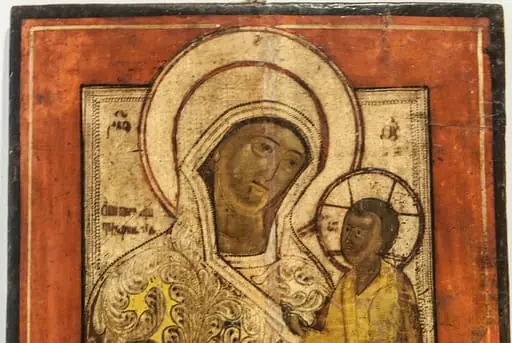
The icon depicts the Theotokos (God-Bearer) holding the Christ Child against her shoulder in an intimate, frontal composition. Both figures bear halos, and the Virgin wears a dark blue or black mantle with gold trim over a golden garment, while the child wears a gold-patterned tunic. She presses her cheek against the child's head while her right hand supports his body, creating a tender physical closeness that defines the Eleusa type, known in Russian as Umilenie (tenderness or movedness). This iconography distinguishes itself from the more formal Hodegetria type through its emotional warmth and maternal affection. The Virgin's gaze, however, does not rest upon her child but turns outward toward the viewer, while her expression carries a premonition of future sorrow, her large eyes seemingly foreseeing the Passion. The Christ Child nestles anxiously against his mother, one arm around her neck, his face turned upward in a gesture of vulnerable dependence. Greek letters in the upper left corner identify the figures. The Star of the Mother of God, called Spica, adorns her maphorion, connecting her to ancient Near Eastern virgin imagery. This dual focus, intimate yet outward-looking, sorrowful yet loving, gives the icon its profound theological resonance, expressing universal maternal love while mediating divine protection to the faithful.
Technique & Style
The Theotokos of Vladimir is executed in tempera on a wooden panel, with dimensions of 104 by 69 centimetres according to museum records, though some sources cite 106 by 69 centimetres with the central original portion measuring 78 by 55 centimetres. The background is gold, now heavily worn and flaking across the entire surface, revealing wood and darker underlayers beneath. The paint surface is cracked and abraded, with significant losses around the faces and hands. Fine gold lines define drapery folds and decorative borders. The overall palette consists of gold, deep blue-black, and olive greenish tones in the faces. Light appears even and non-naturalistic, with minimal modeling, and the brushwork is flat and linear rather than volumetric. Intensive examination by the State Russian Restoration Workshops in 1919 revealed that only the faces and neck of the Virgin, the face of the Christ Child, and insignificant portions of the background survive from the original creation. The clothes were repainted after damage caused by a metal cover or riza, and again after a fire in 1195. The transition from contour line to modeled surface in the faces was executed with exceptional care and confidence. The Virgin's features, narrow and pointed eyes, long nose, and slender mouth and chin area, exemplify the highest Byzantine painting tradition. The composition's frontal intimacy, with figures filling most of the frame and a raised border surrounding the central image, creates immediate emotional engagement. Art historians note that the icon expresses deeper humanity and emotion than typical Byzantine works of the preceding period, anticipating developments that would culminate in the late Byzantine style after 1204.
History & Provenance
The icon was painted in Constantinople around 1125, during the artistic flourishing of the Comnenian dynasty. Around 1131, Greek Patriarch Luke Chrysoberges of Constantinople sent it as a gift to Grand Prince Yuri Dolgorukiy of Kiev, part of broader Byzantine efforts to Christianize the Slavic peoples. It was initially kept in the Vyshhorod nunnery until Yuri's son, Andrey of Bogolyubovo, brought it to Vladimir in 1155. According to tradition,elia, the horses transporting the icon stopped near Vladimir and refused to proceed, interpreted as divine sign that the Theotokos wished the icon to remain there. Andrey built the Assumption Cathedral, consecrated in 1160, to house it, using the icon to legitimize Vladimir's claim to replace Kiev as the principal city of Rus. The icon remained in Vladimir until 1395, though it may have suffered damage during the Mongol sack and burning of the city in 1238, with subsequent restorations. In 1395, during Tamerlane's invasion, it was transferred to Moscow. Vasily I spent a night in prayer before it, and Tamerlane's armies retreated. The Muscovites refused to return it, placing it in the Dormition Cathedral of the Moscow Kremlin, where from the 16th century it became the most venerated icon in Moscow. It was used in coronations of tsars, elections of patriarchs, and state ceremonies. After the Russian Revolution, the Bolsheviks transferred it to the State Tretyakov Gallery, where it was first displayed in 1930. During the Battle of Moscow in 1941, Joseph Stalin allegedly ordered the icon flown around the city. In 1993, it was moved to the Epiphany Cathedral for a Divine Liturgy, suffering damage that required restoration. An ownership dispute between the gallery and Moscow Patriarchate in the 1990s resulted in its relocation to the Church of St. Nicholas in Tolmachi, operated with dual status as house church and museum annex, accessible via underground passage from the gallery. On 3 April 2026, the icon was transferred to the Cathedral of Christ the Saviour in Moscow, with the Russian Orthodox Church granted free use for forty-nine years.
Context
The Theotokos of Vladimir emerged from the high atelier culture of Constantinople during the Comnenian period, when Byzantine artistic production reached extraordinary refinement. Its arrival in Kievan Rus around 1131 responded to the massive demand for religious objects following the conversion of Vladimir I in 988. The icon's transfer to Vladimir in 1155 coincided with Andrey of Bogolyubovo's political project to elevate his city above Kiev, making the icon an instrument of territorial and spiritual legitimation. By the 16th century, the Vladimirskaya became embedded in politicized legends linking Moscow to pre-Mongol Rus and positioning it as the center of Christianity after Rome and Byzantium, initially to sustain Ivan IV's imperial pretensions and later to influence state policy under the Riurikid and Romanov dynasties. Scholarly examination, particularly the 1919 restoration by Chirikov, transformed understanding by revealing the extent of original paint survival and distinguishing Comnenian workmanship from later interventions. Academic David Miller has questioned the traditional narrative of its 1395 transfer, suggesting the icon remained primarily in Vladimir with occasional Moscow excursions until the 1520s, with the full saving-Moscow legend not appearing until accounts of 1512 and the 1560s. The icon's treatment under Soviet power, its 1990s ecclesiastical-museum compromise, and its 2026 transfer illustrate ongoing tensions between secular state authority and religious heritage in Russia. Art historians including David Talbot Rice have emphasized its pivotal position in painting history, marking a transition toward greater humanism within Byzantine tradition.
Legacy
The Theotokos of Vladimir has generated one of the most extensive copy traditions in Orthodox iconography, with numerous replicas acquiring independent artistic and religious significance across centuries. As the oldest surviving Eleusa type, it established a compositional model that achieved particular popularity in Russia, influencing countless devotional images. Its reputation as a miracle-working palladium shaped Russian political theology, with attributed interventions in 1395, 1451, and 1480 reinforcing conceptions of divine protection for the Muscovite state. The 1480 Stand on the Ugra, following which Ivan III consolidated power against the Golden Horde, became especially consequential for Russian self-understanding as an independent Orthodox power. The icon's veneration at coronations and patriarchal elections institutionalized its role in legitimizing secular and religious authority. During the Soviet period, its display in the Tretyakov Gallery represented the transformation of sacred object into museum-preserved art, a fate shared by much Russian ecclesiastical heritage. The 1993 compromise establishing dual church-museum status at St. Nicholas in Tolmachi offered a model for managing contested religious property in post-communist Russia. The icon's image has permeated popular culture, notably appearing in the logo of Mel Gibson's production company Icon Productions. The Church of Our Lady of Vladimir in Penzberg, Bavaria, is dedicated to it. Its 2026 transfer to the Cathedral of Christ the Saviour with forty-nine-year church use rights suggests continued negotiation between cultural heritage institutions and religious bodies over control of objects that simultaneously function as art historical monuments and living devotional focus. The icon's feast day is celebrated on 3 June.
Artist & collection









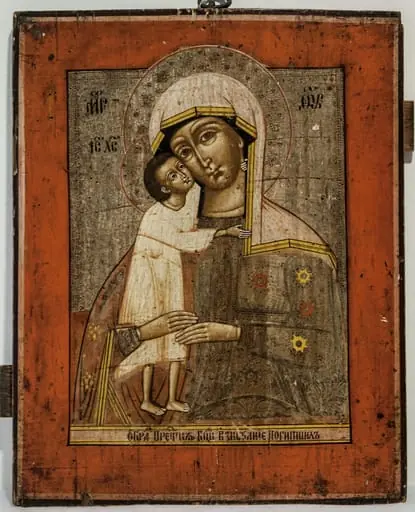
- Maica Domnului, tipul Eleusa(dulcea sărutare, Mângâietoarea) îl ține strâns în brațe pe Iisus prunc, în picioare, cu obrazul lipit de cel al Maicii și o mână petrecută pe după gâtul ei. Iisus are nimbul cruciger, marcat cu motive florale punctate, Este înveșmântat într-o tunică 3/4 alb-gălbuie, care lasă să i se vadă picioarele. Maica poartă un maforion alb, bordat cu galben, partea din stânga a veșmântului din foiță metalică, decorată cu motive florale pictate cu roșu și galben, motive fitomorfe și geometrice incizate. În partea dreaptă veșmântul este roșu, decorat cu motive florale de culoare galbenă, foița fiind prezentă doar la mânecă. Nimbul decorat cu motive florale punctate în stratul de foiță metalică, Figurile modelate din culoare (alb, ocru) cu accente grafice fine, albe, sunt specifice icoanei rusești. Cromatica: alb, galben, roșu, auriu, brun, negru, foiță metalică, chenar roșu deschis, mărginit de două linii în nuanțe de roșu deschis și brun.Chenarul interior dublat de două șiruri de cercuri ștanțate în foiță. Inscripția dispusă pe o bandă dreptunghiulară în partea de jops a icoanei : Icoana Preacuratei Fecioare Prevăzând Jertfa (lui Iisus).
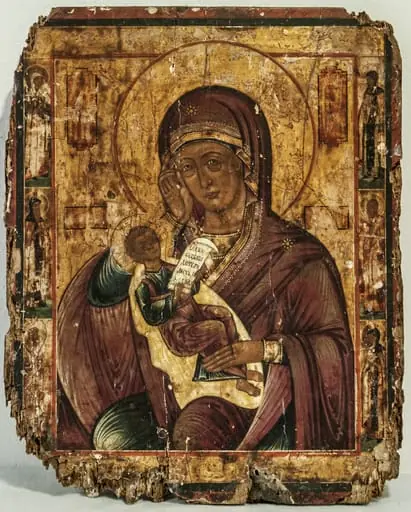 Icoana „Potolește întristările noastre” o înfățișează pe Maica Domnului ținând mâna stângă sub cap, care este ușor înclinat. Aceasta sugerează că Născătoarea de Dumnezeu ascultă lacrimile și rugăciunile tuturor credincioșilor care apelează la ea, în nevoile, necazurile și întristările lor. Cu mâna dreaptă, Fecioara Maria ține Pruncul Iisus. Mântuitorul ține în mâinile Sale un sul desfăcut, pe care sunt înscrise următoarele cuvinte: „Judecați cu dreptate, arătând milă unii față de alții, nu jigniți văduvele și orfanii și nu țineți răutate în inima voastră față de fratele vostru”.Maica este pictată pe fondul foiței aurite, cu o expresie blândă. Înveșmântată cu maforion grena, cu borduri aurite , dublate de o dantelărie fină, albă, pe umeri și frunte stelele întreitei feciorii. Stola verde cu galon lat aurit, la gât și mâneci. Pruncul , culcat în brațele Maicii pe o pânză albă, are o expresie tristă. Picioarele desculțe. Nimb cruciger, cu însemnele consacrate. Nimbul Fecioarei, trasat cu roșu, depășește bordura lată, aurită. Lateral, pe chenar, câte trei sfinți, în picioare. Se poate descifra doar inscripția de pe aureola sfântului Zosim și a sfintei Xenia(stânga). Inscripțiile referitoare la Iisus și Maica Domnului sunt casetate pe fondul aurit. Linia desenului foarte fină, drapajul veșmintelor bogat, cu unele accente de repictare(tușele de alb). Icoana prezintă degradări ale stratului pictural(eroziuni, clacuri, desprinderi, lacune, vernis îmbătrânit) și ale suportului(atac xilofag mai vechi care a fragilizat lemnul)
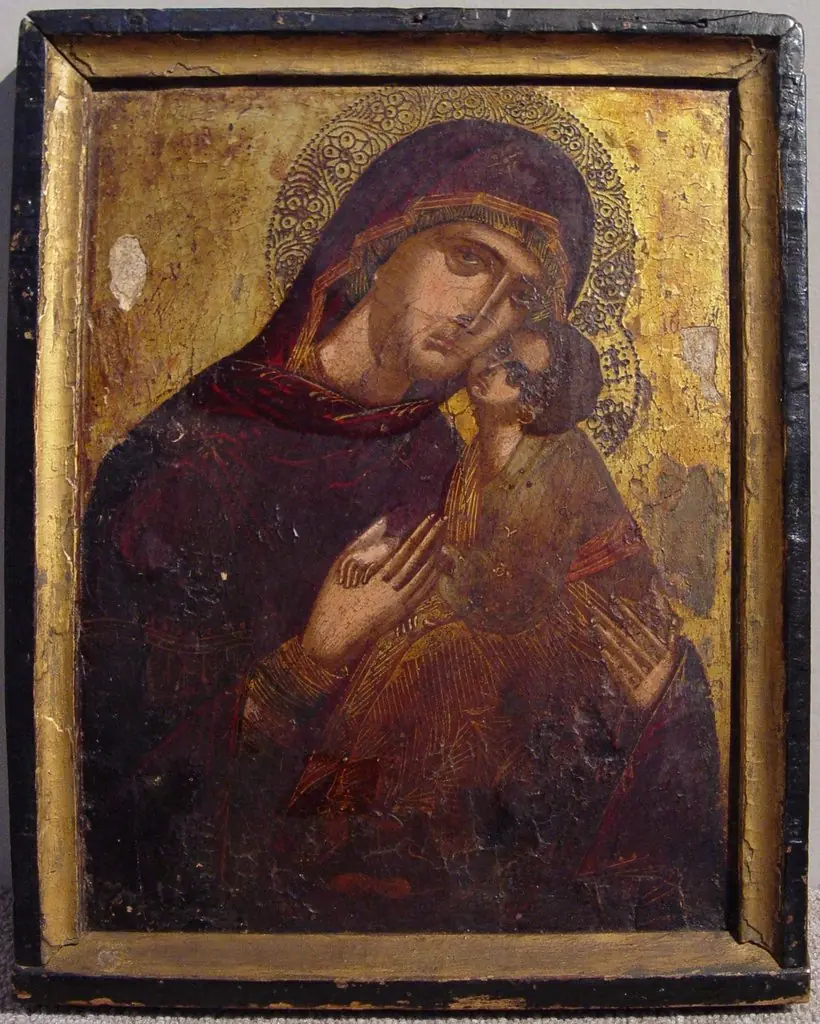 Icon with the Virgin and Child
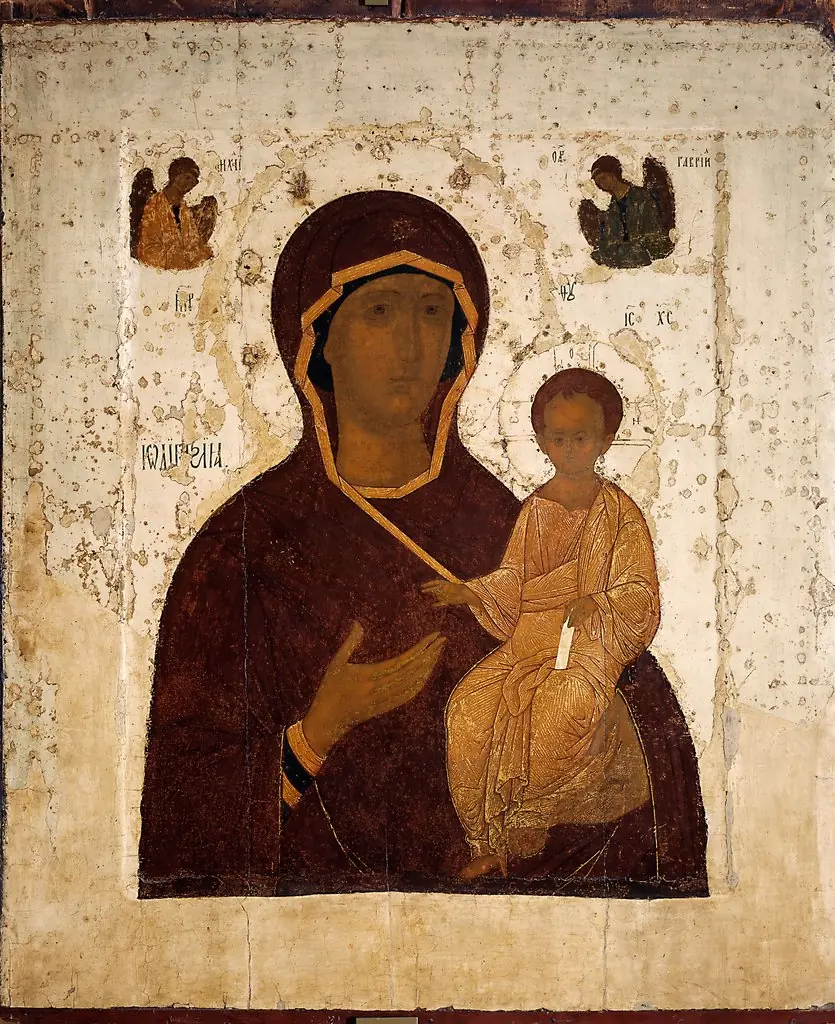 Our Lady of Guide of Wayfarers (Odigitria)
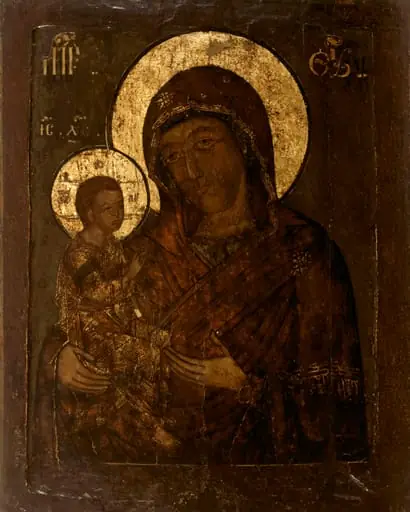 Jerusalemin Jumalanäiti, (Hodigitria), venäläinen ikoni
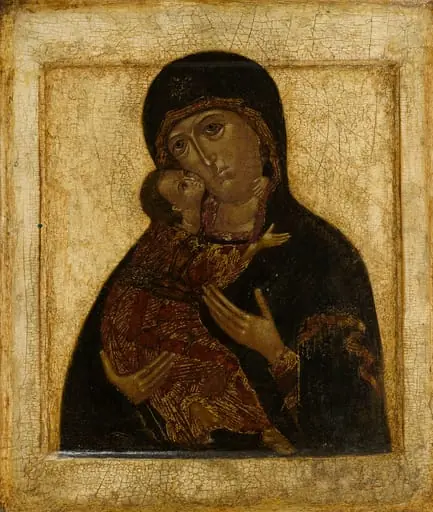 Vladimirin Jumalanäiti, venäläinen ikoni
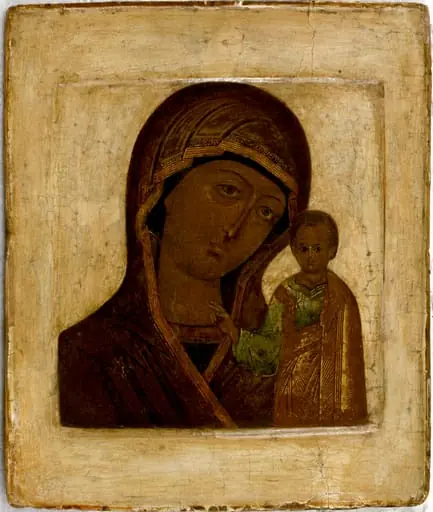 Kazanin Jumalanäiti, venäläinen ikoni
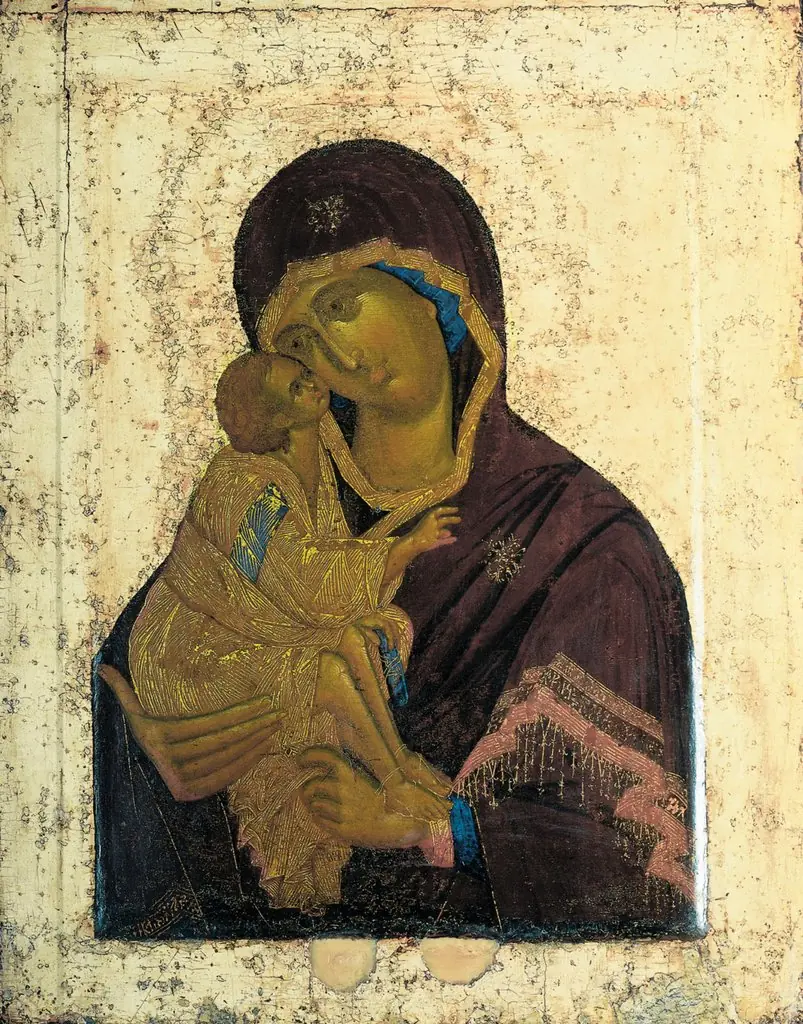 Our Lady of the Don
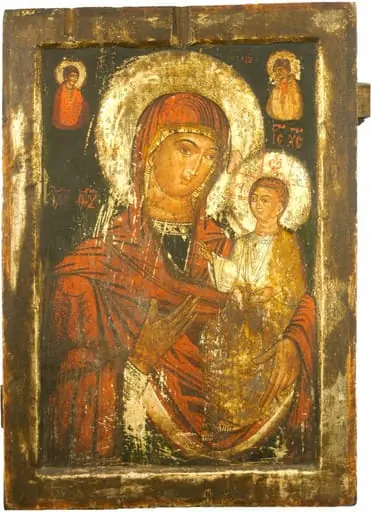 Maica Domnului cu Pruncul
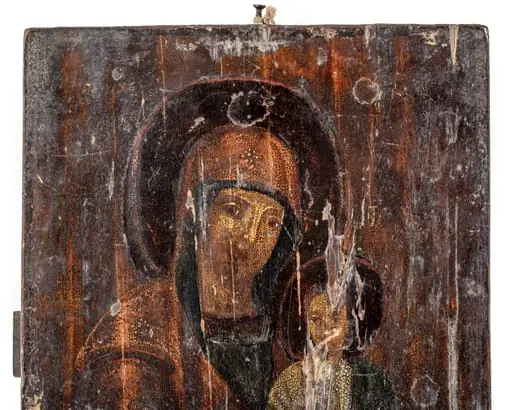 Maica Domnului
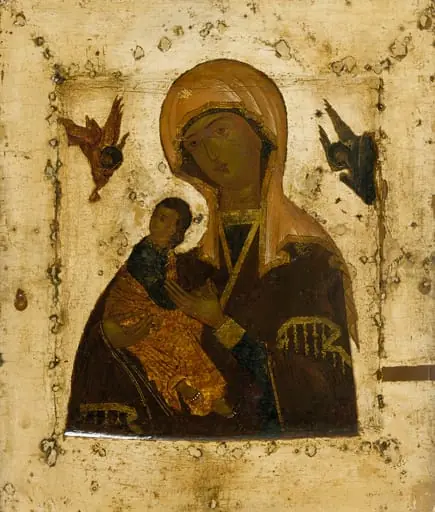 Kärsimyksen Jumalanäiti, venäläinen ikoni
 Icoan in