Artwork
Our Lady of the Don
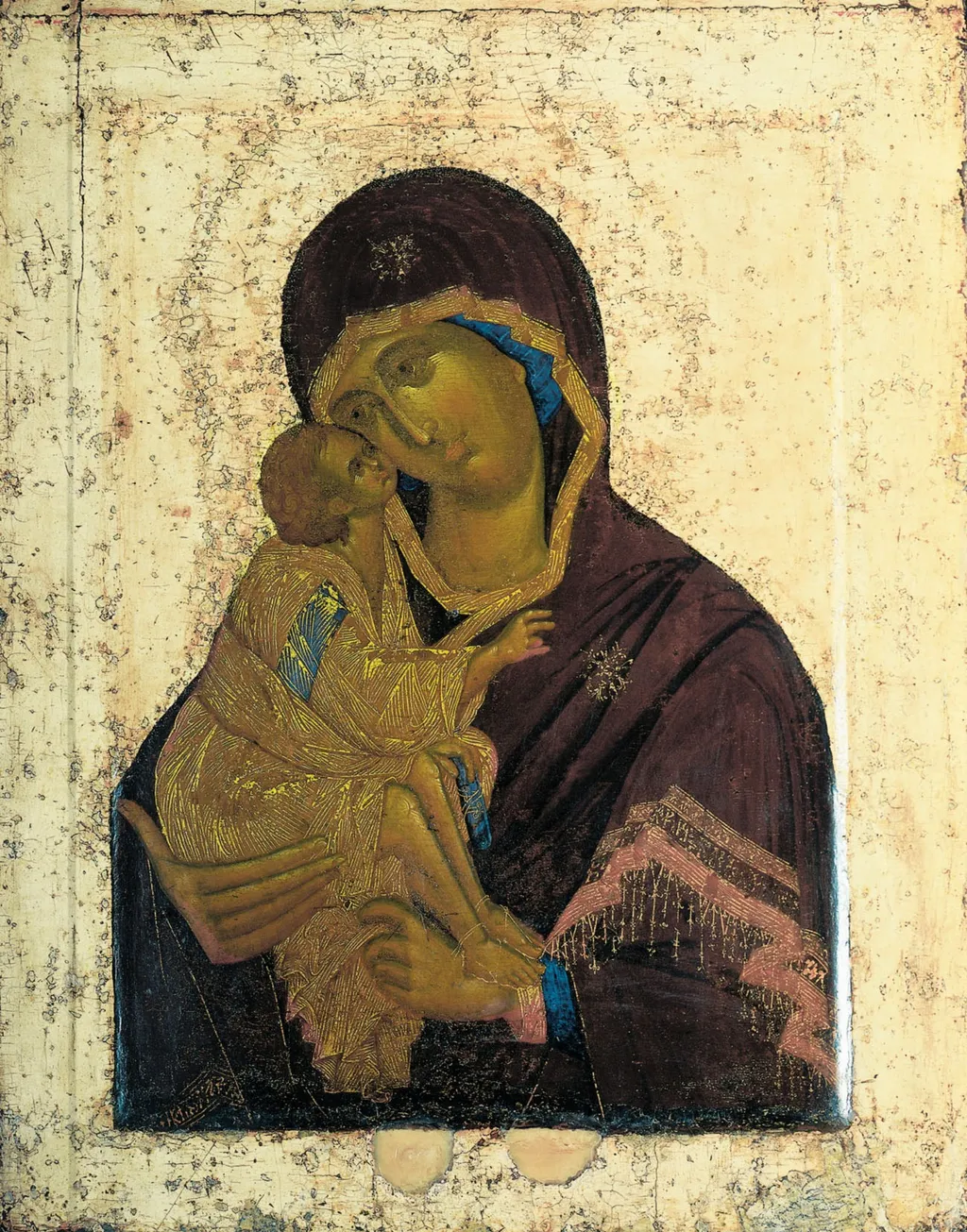
Our Lady of the Don is a tempera painting by the Byzantine icon painting artist Theophanes the Greek. It dates from 1392 and is held in the collection of the Tretyakov Gallery.
About this work
Our Lady of the Don is a painting from 1382. It's a work by Theophanes the Greek.
The painting represents the Virgin Mary with the infant Jesus Christ. This is an example of an Eleusa icon, which is a type of icon that shows the Virgin Mary with her child.
You can learn more about the technique used to create this painting by looking up tempera.
Subject & Meaning
According to the sources, it is venerated as a defender against foreign enemies and heresy, and is commemorated on September 1st (August 19th Julian calendar).
Our Lady of the Don is an Eleusa-type icon depicting the Virgin Mary holding the infant Christ Child, a tender compositional variant in which the Mother of God gazes at her son with sorrowful, loving eyes. The French-language source describes it as one of the most lyrical variants of the Vladimir Mother of God, while the Wikidata entry confirms the depicted figures as Mary, a woman, a mother, the Christ Child, and a boy, with the main subject identified as Madonna and Child.
Beyond its Marian imagery, the icon carries a protective and military symbolism in Russian Orthodox tradition. According to the sources, it is venerated as a defender against foreign enemies and heresy, and is commemorated on September 1st (August 19th Julian calendar). The reverse of the panel bears a separate Dormition of the Virgin image, reinforcing the icon's eschatological and intercessory meaning.
Technique & Style
Our Lady of the Don is executed in tempera on a wooden panel, with the painting measuring approximately 86 by 68 cm. The icon belongs to the Eleusa type, depicting the Virgin Mary with the infant Christ, and is regarded as one of the most lyrical variants of the Vladimir Mother of God type, with sorrowful, tender eyes directed toward the child. Stylistically, the work is closely associated with the manner of Theophanes the Greek. Its handling of light, emanating from the figure of Christ and emerging from surrounding darkness, framed by golden garments, recalls the Novgorod frescoes attributed to the master. The reverse of the panel carries a second composition, the Dormition of the Virgin, which scholars likewise connect to Theophanes's circle or to a Novgorodian painter trained in his workshop.
History & Provenance
The origins and exact creation date of the icon are debated, though it is traditionally attributed to Theophanes the Greek and dated between 1382 and 1395. A 1692 donation book from the Donskoy Monastery claims the work was a gift from the Don Cossacks to Prince Dmitry Donskoy prior to the 1380 Battle of Kulikovo, a narrative many scholars consider folklore. Alternative theories suggest the icon was painted after the battle, possibly for the Dormition Cathedral in the Simonov Monastery or the Assumption Cathedral in Kolomna, where Theophanes and his pupils worked on fresco ensembles. The first written mention appears in the Nikon Chronicle during the second half of the 16th century. The icon entered the Tretyakov Gallery's collection in 1930 and remained there until April 4, 2026, when it was transferred to the Cathedral of Christ the Saviour for public veneration and future placement in the Donskoy Monastery's Great Cathedral, while retaining its status as state property managed by the gallery.
The icon has been part of the Tretyakov Gallery collection since 1930, having previously been exhibited at the State Historical Museum following its 1919 rediscovery. Historically, the work was displayed annually at the Donskoy Monastery around September 1 to coincide with its feast day. In April 2026, the icon was transferred to the Russian Orthodox Church for a forty-nine-year term, debuting for public veneration at the Cathedral of Christ the Saviour in Moscow. It is scheduled to remain there until restoration concludes at the Donskoy Monastery, after which it will be installed in the monastery's Great Cathedral iconostasis. Despite this long-term loan, the artwork retains its status as state property under the administrative management of the Tretyakov Gallery.
Context
The critical reception of Our Lady of the Don reflects its enduring symbolic resonance within Russian cultural memory, particularly through its contested origins and evolving patronage. Scholarship situates the work at the intersection of 14th-century Russian religious art and the political narratives of Muscovy, with debates centering on its authorship and iconographic lineage. The attribution to Theophanes the Greek or his circle remains contested, though stylistic analyses by figures such as Victor Lazarev underscore its technical mastery and potential influence on Novgorodian painting traditions. Historically, the icon’s veneration has been strategically tied to pivotal events like the Battle of Kulikovo (1380) and the capture of Kazan (1552), reinforcing its role as a protective talisman for Russian military endeavors. This symbolic weight persisted through tsarist and Soviet eras, culminating in its state-managed relocation to the Donskoy Monastery and Christ the Saviour Cathedral, underscoring its persistent institutional significance. The icon’s dual function, as a devotional object and a historical artifact, has ensured its continued relevance in both academic discourse and public ritual practice, as evidenced by its annual ceremonial transfers and conservation efforts.
Own this work as a print
Artist & collection
Artist
Theophanes the Greek (Russian: Феофан Грек, romanized: Feofan Grek; Greek: Θεοφάνης; c.

- Our Lady of Guide of Wayfarers (Odigitria)
 Vladimirin Jumalanäiti, venäläinen ikoni
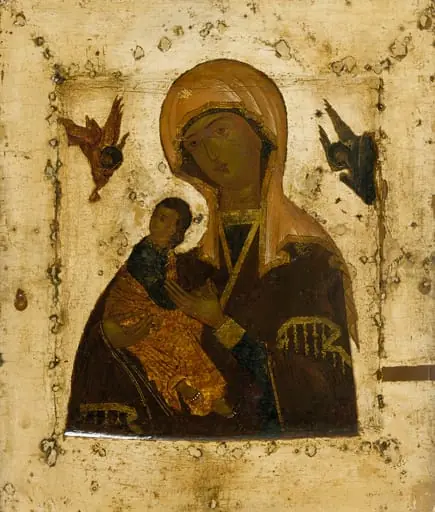 Kärsimyksen Jumalanäiti, venäläinen ikoni
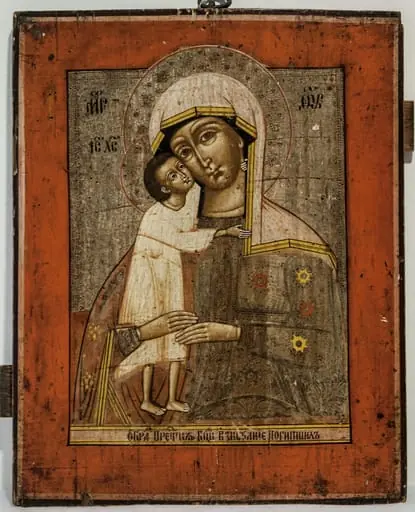 Maica Domnului, tipul Eleusa(dulcea sărutare, Mângâietoarea) îl ține strâns în brațe pe Iisus prunc, în picioare, cu obrazul lipit de cel al Maicii și o mână petrecută pe după gâtul ei. Iisus are nimbul cruciger, marcat cu motive florale punctate, Este înveșmântat într-o tunică 3/4 alb-gălbuie, care lasă să i se vadă picioarele. Maica poartă un maforion alb, bordat cu galben, partea din stânga a veșmântului din foiță metalică, decorată cu motive florale pictate cu roșu și galben, motive fitomorfe și geometrice incizate. În partea dreaptă veșmântul este roșu, decorat cu motive florale de culoare galbenă, foița fiind prezentă doar la mânecă. Nimbul decorat cu motive florale punctate în stratul de foiță metalică, Figurile modelate din culoare (alb, ocru) cu accente grafice fine, albe, sunt specifice icoanei rusești. Cromatica: alb, galben, roșu, auriu, brun, negru, foiță metalică, chenar roșu deschis, mărginit de două linii în nuanțe de roșu deschis și brun.Chenarul interior dublat de două șiruri de cercuri ștanțate în foiță. Inscripția dispusă pe o bandă dreptunghiulară în partea de jops a icoanei : Icoana Preacuratei Fecioare Prevăzând Jertfa (lui Iisus).
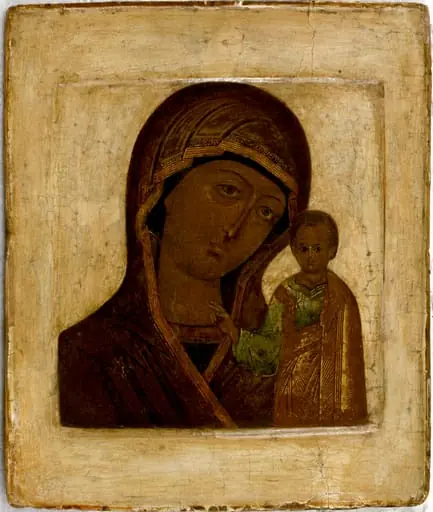 Kazanin Jumalanäiti, venäläinen ikoni
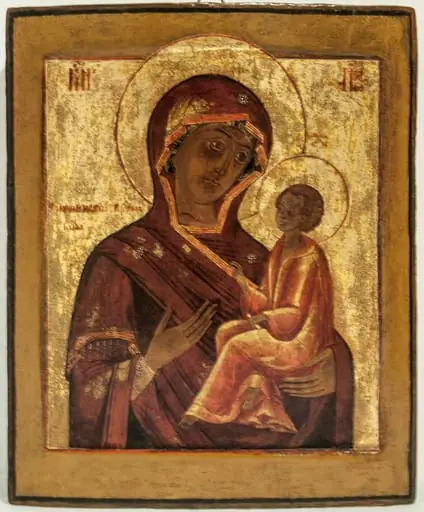 Icoa cee
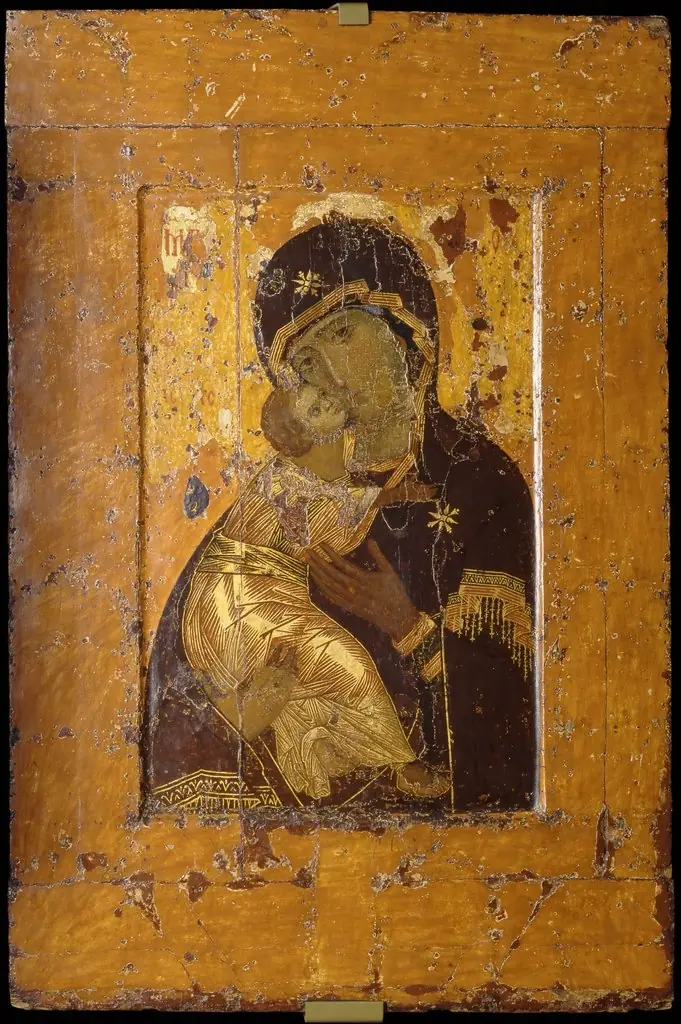 Theotokos of Vladimir
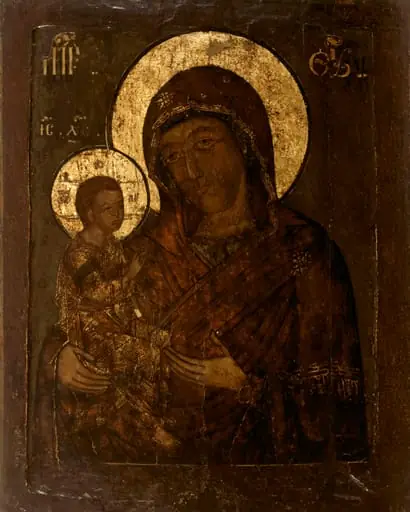 Jerusalemin Jumalanäiti, (Hodigitria), venäläinen ikoni
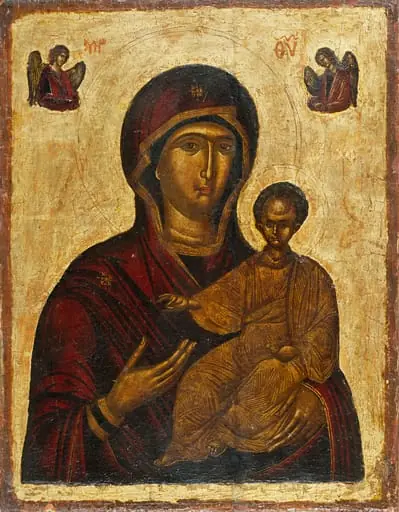 Jumalanäiti, Hodigitria - Tiennäyttäjä, bysanttilainen ikoni
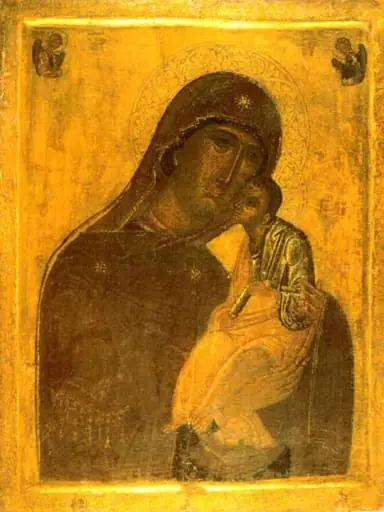 Maica Domnului cu Pruncul - Eleusa
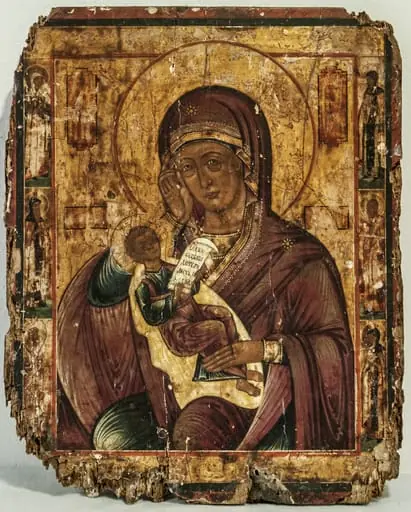 Icoana „Potolește întristările noastre” o înfățișează pe Maica Domnului ținând mâna stângă sub cap, care este ușor înclinat. Aceasta sugerează că Născătoarea de Dumnezeu ascultă lacrimile și rugăciunile tuturor credincioșilor care apelează la ea, în nevoile, necazurile și întristările lor. Cu mâna dreaptă, Fecioara Maria ține Pruncul Iisus. Mântuitorul ține în mâinile Sale un sul desfăcut, pe care sunt înscrise următoarele cuvinte: „Judecați cu dreptate, arătând milă unii față de alții, nu jigniți văduvele și orfanii și nu țineți răutate în inima voastră față de fratele vostru”.Maica este pictată pe fondul foiței aurite, cu o expresie blândă. Înveșmântată cu maforion grena, cu borduri aurite , dublate de o dantelărie fină, albă, pe umeri și frunte stelele întreitei feciorii. Stola verde cu galon lat aurit, la gât și mâneci. Pruncul , culcat în brațele Maicii pe o pânză albă, are o expresie tristă. Picioarele desculțe. Nimb cruciger, cu însemnele consacrate. Nimbul Fecioarei, trasat cu roșu, depășește bordura lată, aurită. Lateral, pe chenar, câte trei sfinți, în picioare. Se poate descifra doar inscripția de pe aureola sfântului Zosim și a sfintei Xenia(stânga). Inscripțiile referitoare la Iisus și Maica Domnului sunt casetate pe fondul aurit. Linia desenului foarte fină, drapajul veșmintelor bogat, cu unele accente de repictare(tușele de alb). Icoana prezintă degradări ale stratului pictural(eroziuni, clacuri, desprinderi, lacune, vernis îmbătrânit) și ale suportului(atac xilofag mai vechi care a fragilizat lemnul)
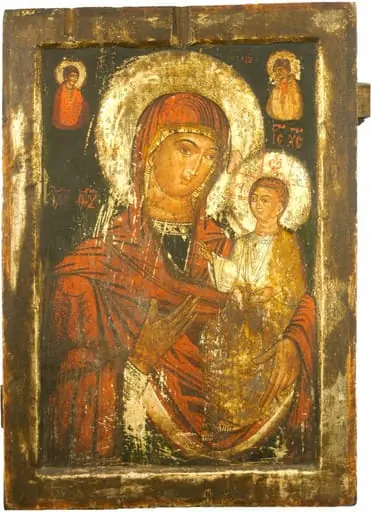 Maica Domnului cu Pruncul
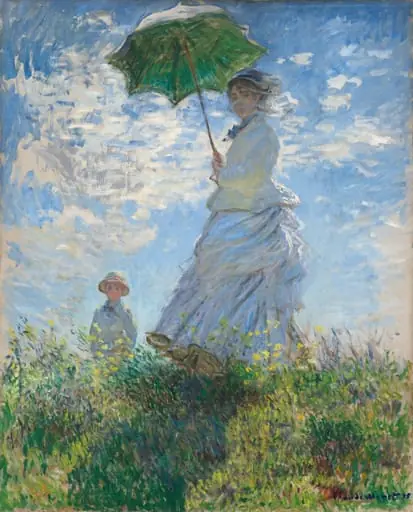 Woman with a Parasol - Madame Monet and Her Son
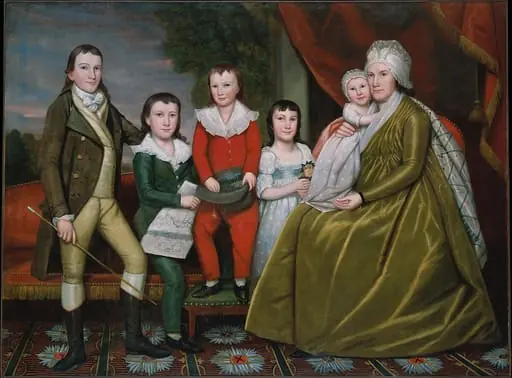 Mrs. Noah Smith and Her Children
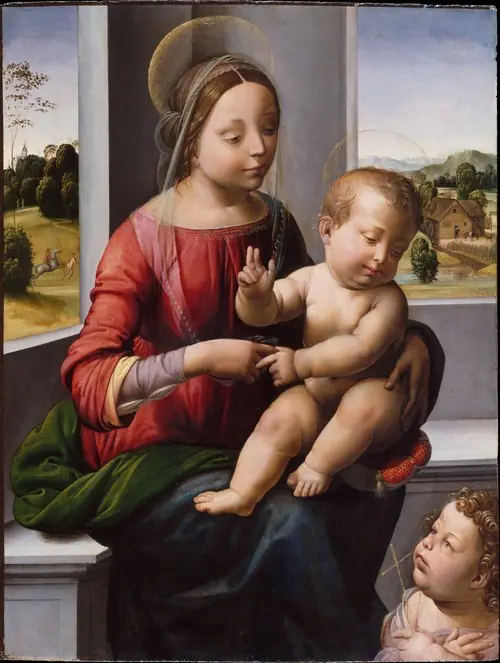 Madonna and Child with the Young Saint John the Baptist
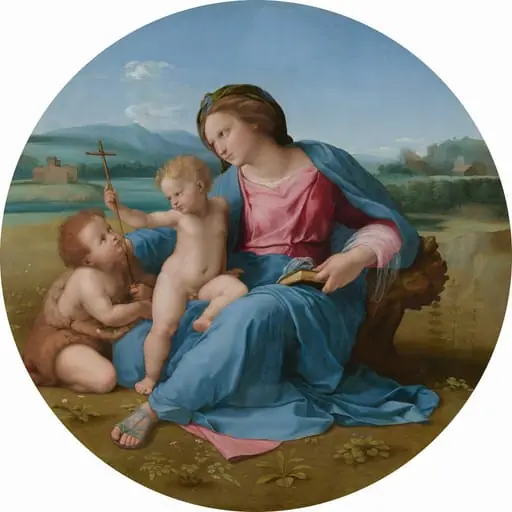 The Alba Madonna
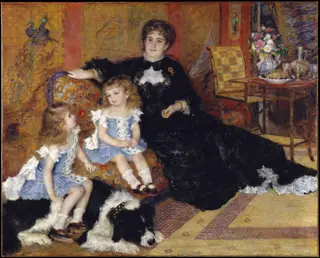 Madame Georges Charpentier and her Children
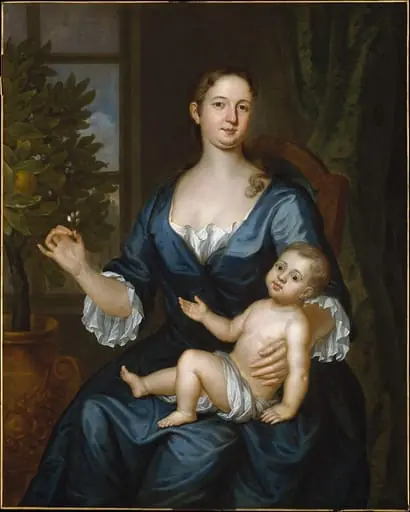 Mrs. Francis Brinley and Her Son Francis
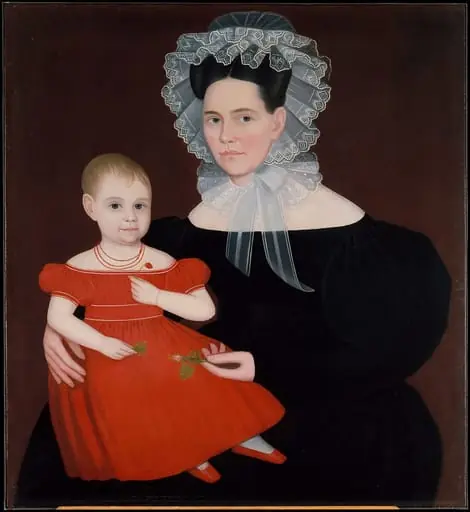 Mrs. Mayer and Daughter
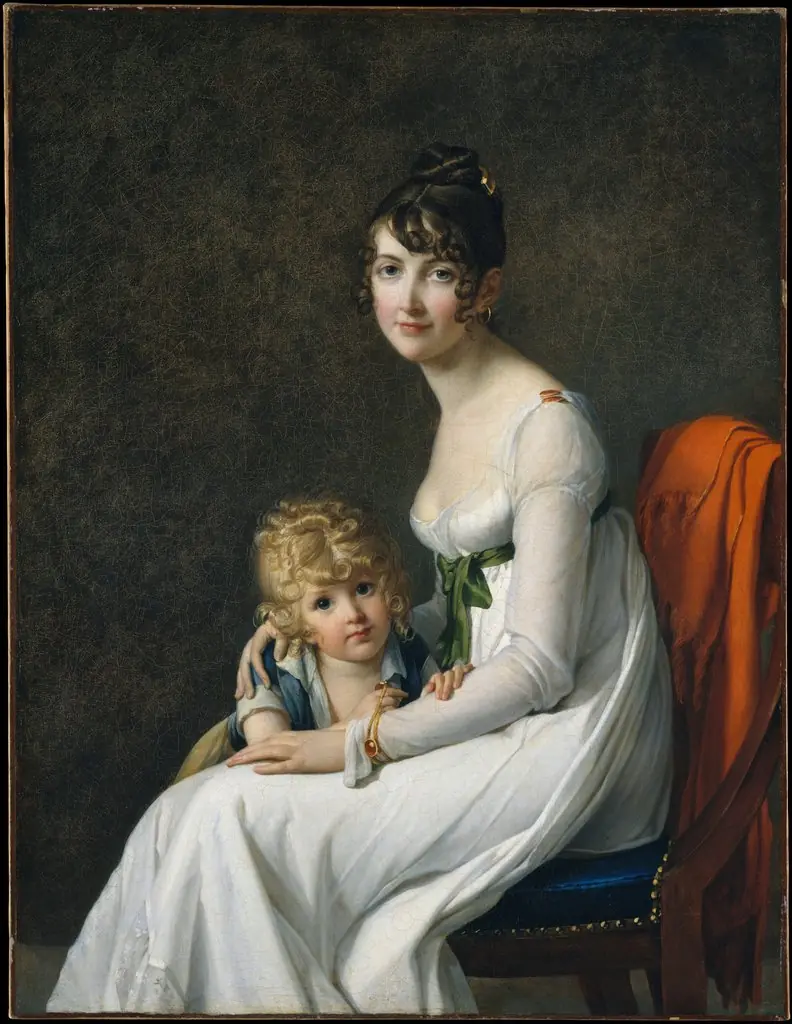 Madame Philippe Panon Desbassayns de Richemont (Jeanne Eglé Mourgue, 1778–1855) and Her Son, Eugène (1800–1859)