Artwork
Untitled
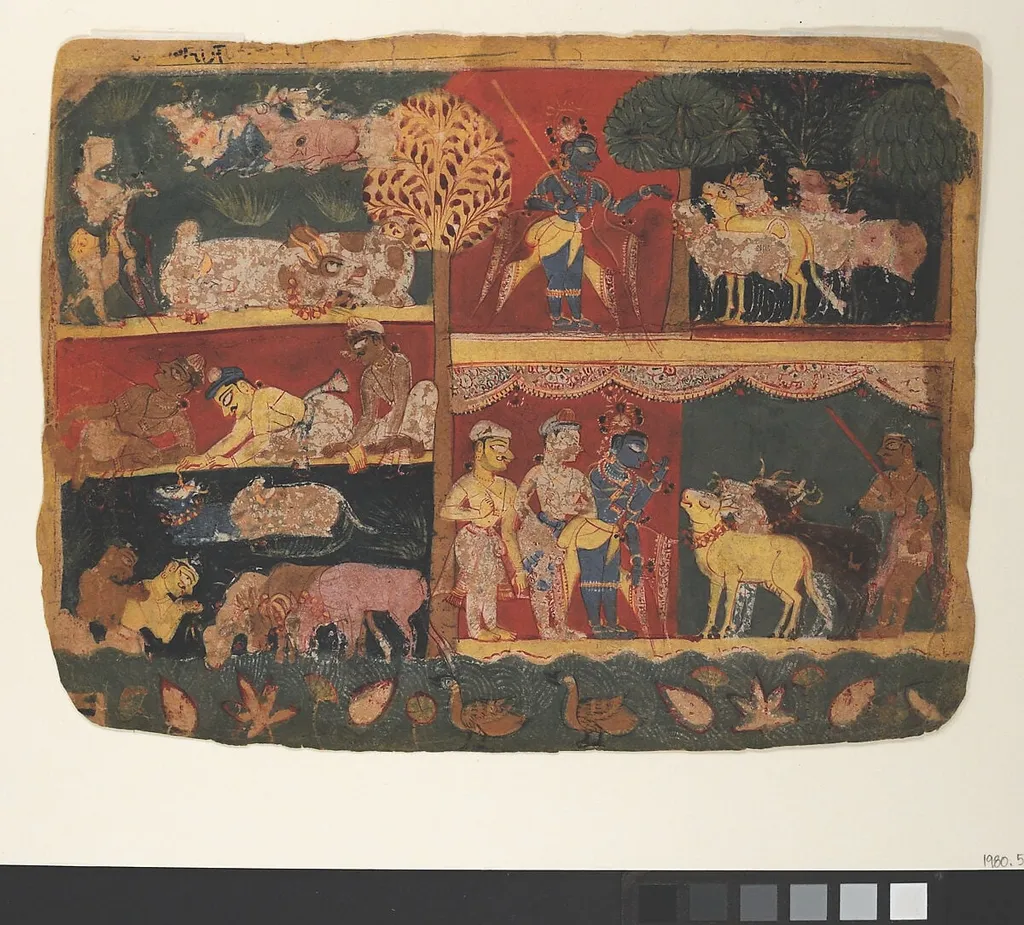
Untitled is a watercolor painting. It dates from 1525 and is held in the collection of the Metropolitan Museum of Art.
About this work
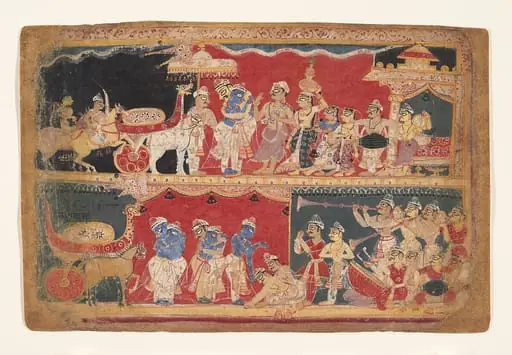
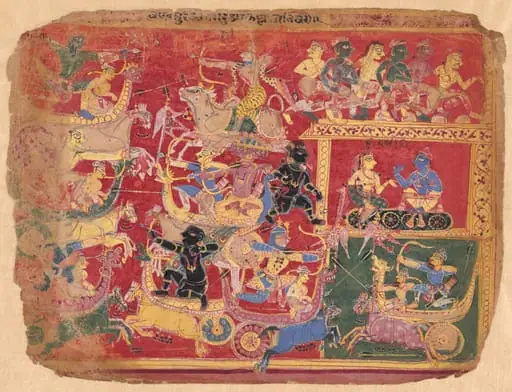
You see a blue-skinned god standing in a field with cows and men. He holds a flute, and the animals gather around him.
This painting was made in India around 1520–30, but no one knows who painted it. The colors are bright and flat, no shadows, just bold outlines. It feels like a storybook scene, not a real place.
To see more like this, look up Krishna.
Technique & Style
No information regarding the present condition of the work is recorded in the available sources.
This 1525 work is executed in ink and opaque watercolor on paper, a combination characteristic of early modern Indian manuscript and devotional painting traditions. The composition is rendered on a modest sheet measuring 18.1 by 23.5 centimeters, a scale suited to intimate viewing. The opaque watercolor provides saturated, flat areas of pigment for the figures of Krishna, the accompanying man, and the cattle, while the ink is used to define contours, facial features, and finer linear detail.
The handling reflects the conventions of religious painting produced in India during the early sixteenth century, with the medium and support enabling both precise linework and bold chromatic passages. No information regarding the present condition of the work is recorded in the available sources.
History & Provenance
The work titled Untitled was created circa 1525 in India by an anonymous painter, as recorded in its catalog entry and corroborated by its Wikidata entry. Executed in ink and opaque watercolor on paper, the painting measures 18.1 × 23.5 cm and belongs to the religious genre, depicting Krishna alongside cattle and a man. Its dating derives from the documented inception year of 1525-01-01 and stylistic assessment of contemporary Indian workshops.
The piece entered the collection of the Metropolitan Museum of Art, where it remains on view, forming part of the museum’s holdings of South Asian religious art. No further commission records or ownership transfers are noted in the available sources.
Context
The work, dated to 1525, portrays the Hindu deity Krishna surrounded by cattle and a male figure, reflecting devotional themes common in Indian religious art of the early modern period. Executed in ink and opaque watercolor on paper, the painting measures 18.1 × 23.5 cm and is housed in the Metropolitan Museum of Art, where it is catalogued as an anonymous work. Its attribution to an unidentified painter illustrates the prevalence of collaborative workshops in which artistic authorship was often subsumed under collective practice.
Scholars consider the piece an early example of narrative illustration that blends indigenous iconography with Mughal‑era stylistic influences, positioning it within the broader trajectory of devotional imagery in South Asian visual culture.
Overview
This untitled painting, rendered with ink and opaque watercolor on paper, depicts a blue-skinned deity amidst a pastoral setting. Created in India between approximately 1520 and 1530, its unknown artist employed a distinctive style characterized by vibrant hues and strong outlines. The scene evokes a narrative quality, presenting an idealized vision rather than a naturalistic portrayal.
Subject & Meaning
The central figure, a god with blue skin, stands in a field surrounded by cows and human figures. He holds a flute, an instrument often associated with divine music, and the animals appear to be drawn to his presence. This imagery strongly aligns with depictions of Krishna, a prominent deity in Hinduism, known for his pastoral associations and musical attributes.
Artist & collection