Artwork
Untitled
Untitled is a watercolor painting. It dates from 1698 and is held in the collection of the Metropolitan Museum of Art.
About this work
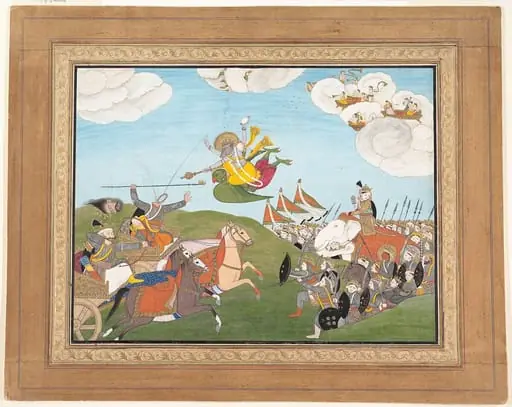
Men and women ride elephants, their bodies small against the great animals. Bright pinks, blues, and greens fill the scene, gold leaf adding shimmer, with a blue figure at the center, likely Krishna. Painted in Rajasthan around 1698 in thickly layered opaque watercolor, where the gold signals importance, a kind of sacred glow. Maker unknown.
Subject & Meaning
The combination of male and female figures with Krishna points toward a courtly or amorous context, common in late seventeenth-century Indian painting.
This opaque watercolor with ink and gold on paper, created in 1698, belongs to the genre of mythology and depicts the Hindu deity Krishna alongside an elephant, a man, and a woman. The inclusion of Krishna situates the work within the devotional iconographic tradition associated with the god, whose mythological narratives often involve pastoral companions and divine play. The elephant alongside the human figures suggests a possible scene drawn from Krishna's life, though the specific narrative moment is not identified in the available documentation.
The combination of male and female figures with Krishna points toward a courtly or amorous context, common in late seventeenth-century Indian painting. The work is held in the collection of the Metropolitan Museum of Art and was made in India.
Technique & Style
The work is executed in opaque watercolor and ink with gold leaf on paper, a technique characteristic of Indian miniature painting of the late 17th century. It measures 26 cm in height by 20.3 cm in width, belonging to the Metropolitan Museum of Art collection. The composition portrays the god Krishna with an elephant, a man, and a woman, rendered in delicate line work and a vibrant, jewel-tone palette.
Gold highlights accentuate divine attributes, while the flat, patterned background and intricate detailing reflect the formal stylistic conventions of Mughal-era manuscript illumination.
History & Provenance
The artwork, titled Untitled, was created in 1698 by an anonymous painter in India. Executed in opaque watercolor, ink, and gold on paper, the piece depicts mythological figures including Krishna, an elephant, a man, and a woman. The work is currently held in the collection of the Metropolitan Museum of Art.
The painting measures 26 cm in height and 20.3 cm in width. The chain of ownership prior to its acquisition by the museum is not specified in the available records.
Overview
This untitled painting, created in Rajasthan, India, around 1700, utilizes opaque watercolor, ink, and gold on paper. The composition features numerous figures, both men and women, mounted on large elephants. A vibrant palette of pinks, blues, and greens characterizes the scene, with gold leaf providing a luminous quality. A prominent figure rendered in blue, likely Krishna, occupies the central position within the lively depiction.
Context
This painting originates from the region of Rajasthan in India, dating to approximately 1700. During this era, artistic production flourished in various Rajput courts across Rajasthan, often patronized by local rulers. Such works frequently depicted mythological narratives, courtly life, or devotional themes, reflecting the cultural and religious landscape of the time. This piece exemplifies the distinct aesthetic traditions of the period.
Artist & collection

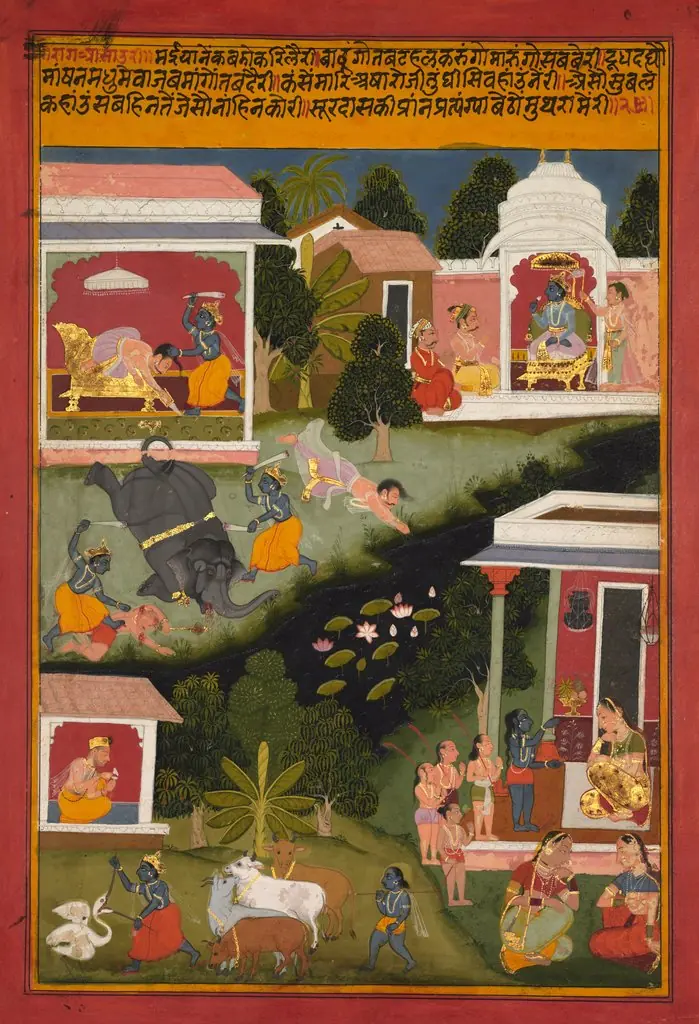
- Krishna asks for sweets, from a Sursagar of Surdas (Indian, c. 1480–1580)
 Worship of Hindu Deities (1 of 18)
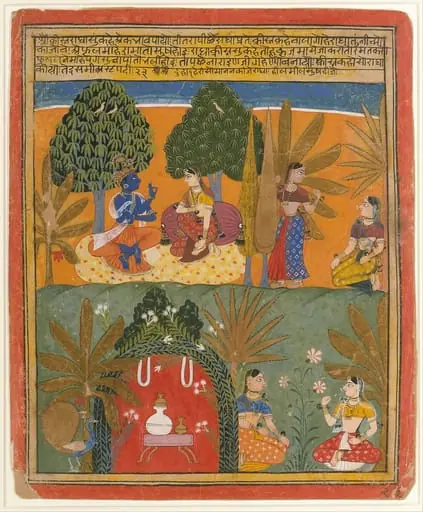 Untitled
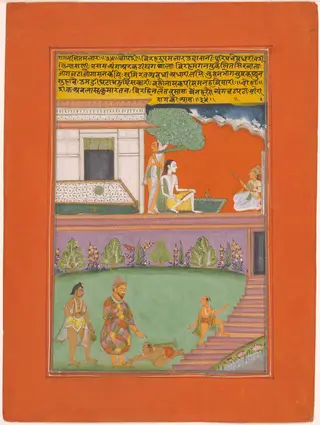 Ragini Setmalar, Page from a Jaipur Ragamala Set
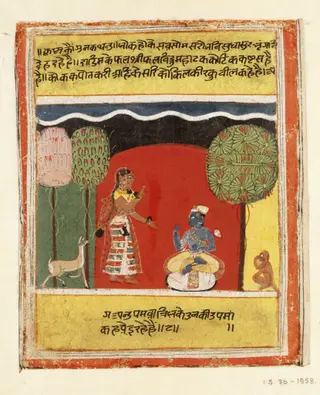 Radha and Krishna
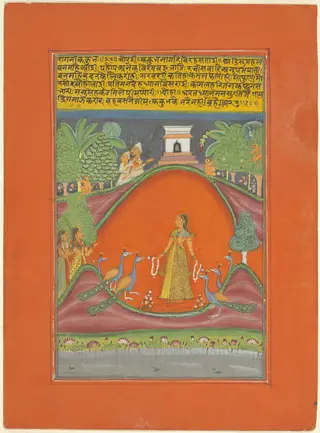 Ragini Kakubha, Page from a Jaipur Ragamala Set
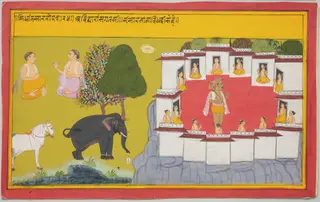 Worship of the Gods (12 of 17)
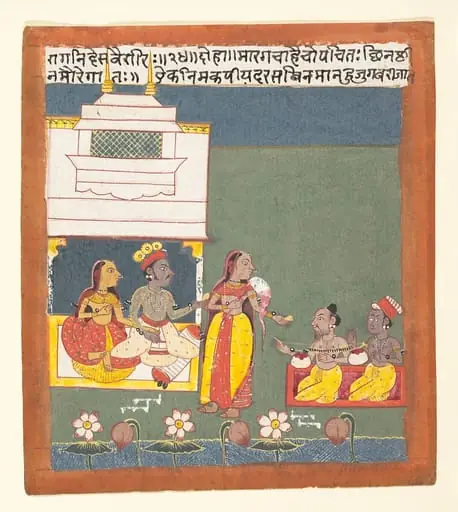 Untitled
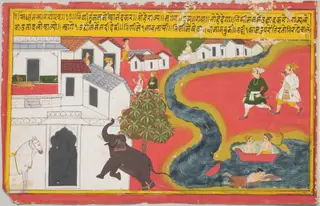 Worship of the Gods (16 of 17)
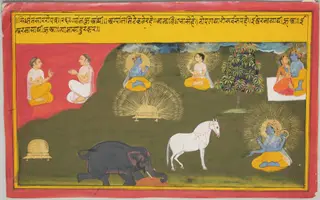 Worship of the Gods (2 of 17)
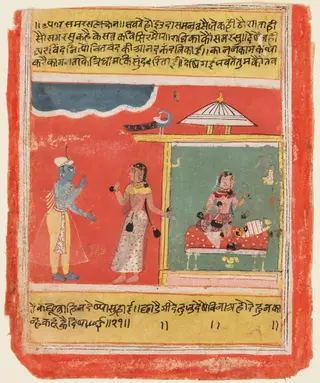 The Sentiment of Peace: Sama Rasa, from a Rasikapriya
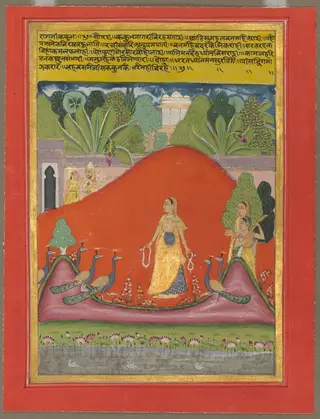 Kakubha Ragini