Artwork
Untitled
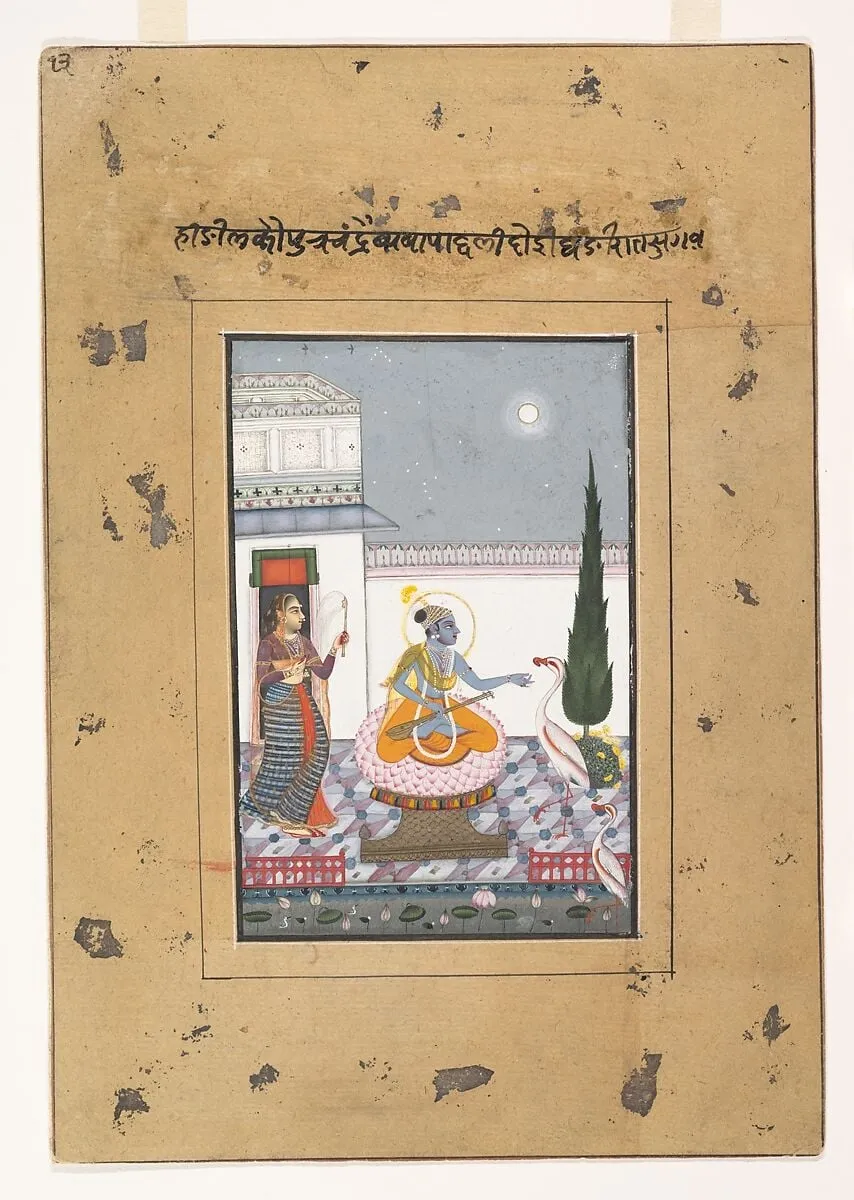
Untitled is a watercolor painting. It dates from 1760 and is held in the collection of the Metropolitan Museum of Art.
About this work
Subject & Meaning
As a genre mythology piece dated to circa 1760, the scene likely references a pastoral episode in which Krishna's music enchants both devotees and nature.
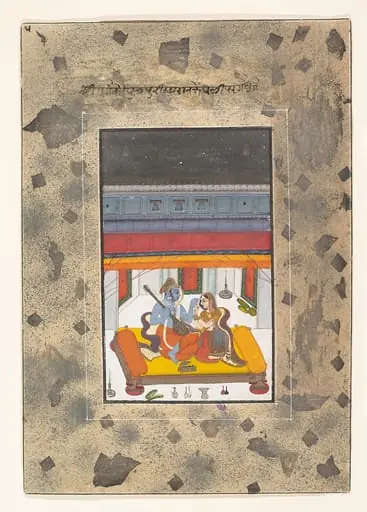
The work portrays Krishna holding a lute while accompanied by a woman and a crane, a composition rooted in Indian mythological painting. As a genre mythology piece dated to circa 1760, the scene likely references a pastoral episode in which Krishna's music enchants both devotees and nature. The lute signifies his role as divine musician, the woman suggests a gopi or devotee engaged in bhakti, and the crane, a traditional emblem of longevity and vigilance, reinforces the auspicious, timeless quality of the setting. Together, the figures convey Krishna's harmonious interplay of devotion, music, and the natural world.
Technique & Style
The work employs refined brushwork in ink and opaque watercolor layered over a paper support, with delicate applications of silver to highlight drapery and jewelry. Stylistically, it belongs to the late eighteenth-century Pahari idiom, characterized by fluid figural contours, restrained palette, and a lyrical, almost calligraphic handling of line. Krishna is shown cradling a lute while a woman kneels beside him and a crane stands nearby, conveying both narrative intimacy and divine grace within a compact composition.
History & Provenance
Created in 1760 in India, the work Untitled is an anonymous painting executed in ink, opaque watercolor, and silver on paper. The piece depicts mythological figures including Krishna, a woman, a crane, and a lute. While the specific commission details and the identity of the original patron remain unrecorded due to the artist's anonymity, the work entered the collection of the Metropolitan Museum of Art, where it measures 18.7 cm in height and 12.5 cm in width.
No specific inventory or accession number is documented in the consulted sources, and no exhibition history or chain of ownership prior to the museum's acquisition is recorded.
Overview
This untitled painting from 18th-century Rajasthan depicts a nocturnal scene rendered with ink, opaque watercolor, and silver on paper. A woman in a pink sari plays a lute by a pond, where two cranes stand. Above, a blue-skinned figure, identified as Krishna, observes the scene from the branches of a tree, adding a divine presence to the tranquil setting.
Context
The inclusion of silver in the artwork's medium was a significant choice in 18th-century Rajasthan. While enhancing the visual experience by mimicking natural light, the use of such a precious material also made the painting exceptionally costly to produce. Consequently, works incorporating silver were considered rare and luxurious, reflecting the patron's wealth and the artist's specialized skill.
Artist & collection

- Untitled
 Krishna and Radha Quarreling: Shatha Nayaka, from a Rasikapriya
 Untitled
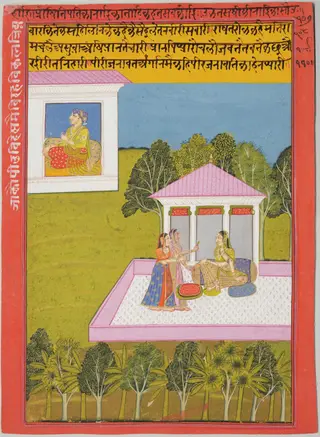 Prince in Pavilion; Princess with Attendants in Court
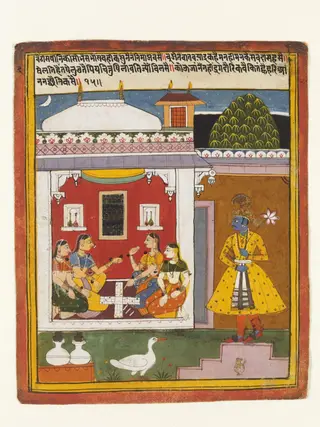 Krishna and Radha
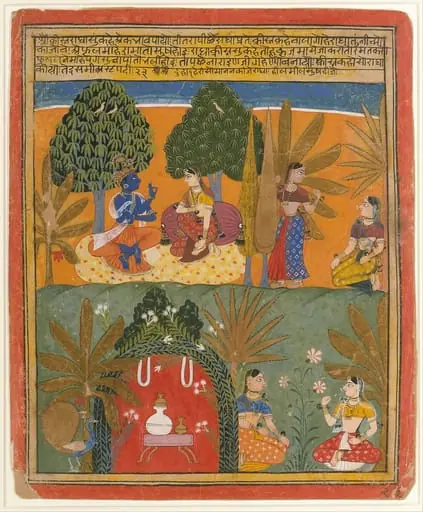 Untitled
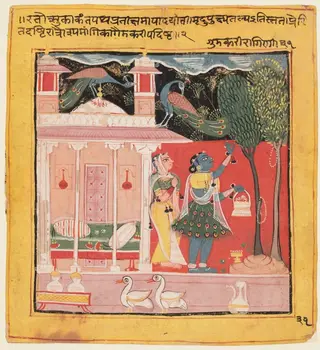 A Woman Plucks Leaves While Awaiting Her Lover: Gunakali Ragini of Malkos, from the “Chawand Ragamala”
 Krishna Under a Canopy
 Dhanasri Ragini
 Sri Raga
 Krishna Watches A Juggler, from a copy of Bihari's Sat Sai
 Untitled