Artwork
Untitled
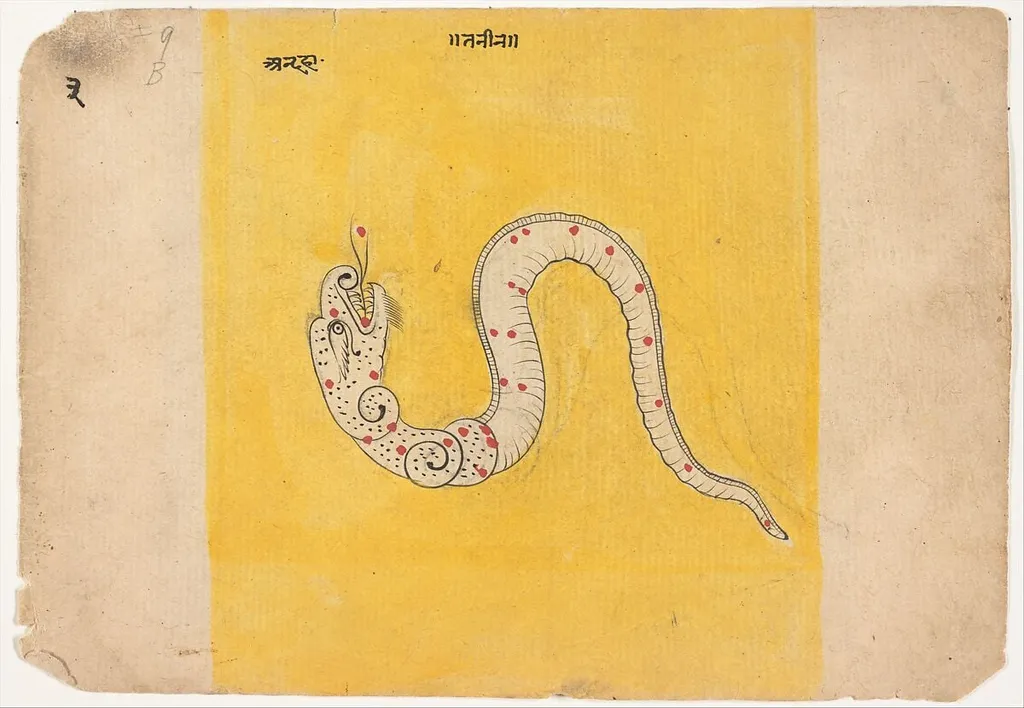
Untitled is a watercolor painting. It dates from 1874 and is held in the collection of the Metropolitan Museum of Art.
About this work
Subject & Meaning
The subject’s symbolic or narrative significance is not elaborated in the available documentation, leaving its meaning open to interpretation.
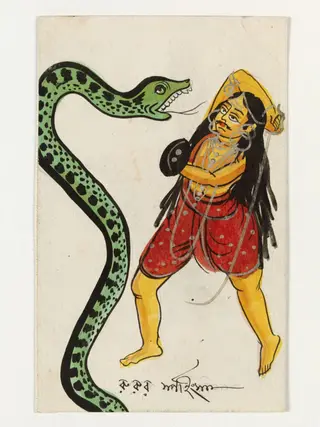
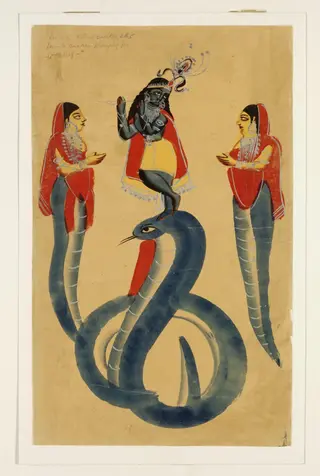
The work titled Untitled, dated 1874 and executed in ink and opaque watercolor on paper, portrays a man together with a snake; this iconography is recorded in the catalog entries of the Metropolitan Museum of Art, which holds the piece in its collection and notes that the painting was made in India. The subject’s symbolic or narrative significance is not elaborated in the available documentation, leaving its meaning open to interpretation.
Technique & Style
The work employs opaque watercolor heightened with ink on paper, a technique common to 19th-century Indian Company School painting. The support is a single sheet of paper, measuring 22.5 cm in width by 15.9 cm in height. Handling shows careful brush control, with precise ink outlines defining the figures and fluid washes modeling the man’s garments and the snake’s sinuous form.
Stylistically, the composition balances naturalistic detail, the man’s turban and posture, with a flattened, graphic treatment of the snake, typical of contemporaneous genre scenes. The palette relies on subdued earth tones and a restrained application of opaque highlights, suggesting a modest palette of indigo, ochre, and vermilion. Condition appears stable, with no visible tears or pigment loss reported in institutional records.
History & Provenance
The work, titled Untitled, was created in 1874 by an anonymous artist in India. Executed in ink and opaque watercolor on paper, the piece depicts a man and a snake. While the specific commission details and the original ownership chain prior to its acquisition by the Metropolitan Museum of Art are not detailed in the available records, the work is currently held within the museum's collection.
The dating is established as January 1, 1874, with physical dimensions recorded as 15.9 by 22.5 units. The attribution remains to an unknown painter, reflecting the work's classification as a genre scene from 19th-century India.
The work is held by the Metropolitan Museum of Art, New York, inventoried as 2023.12.2 with dimensions 15.9 × 22.5 cm. It was first documented in the museum’s holdings in 2023 following acquisition. No prior exhibition history is recorded in the cited sources.
Overview
This untitled painting, rendered in ink and opaque watercolor on paper, depicts a snake charmer from Rajasthan, India. It features a central figure in a red turban, holding a long snake that coils around his arm, observed by a second individual. The artwork exemplifies the region's artistic tradition of vibrant, flat color compositions, capturing a moment of interaction between man and serpent.
Context
Originating from Rajasthan, India, this painting belongs to a regional artistic tradition known for its distinctive visual language. Artists from this area frequently explored themes such as snake charming, often rendering their subjects with a vibrant palette and a two-dimensional aesthetic. The work reflects the cultural practices and artistic conventions prevalent in Rajasthan during its creation, offering insight into local life and artistic expression.
Artist & collection

- Untitled
 Untitled
 Untitled
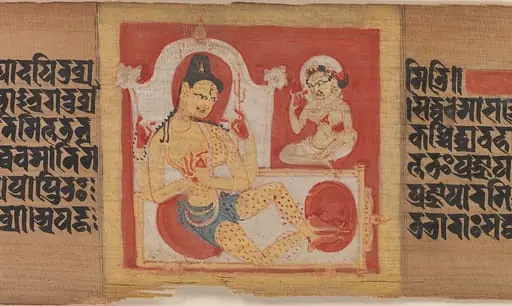 Untitled
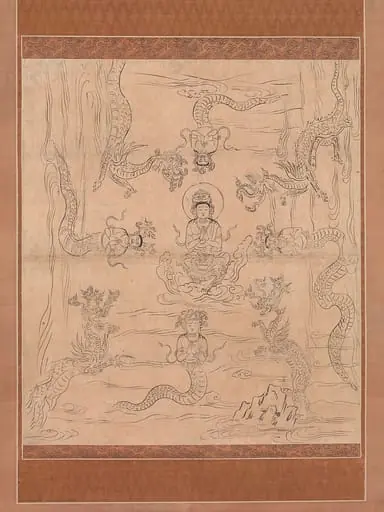 請雨経曼荼羅図像|Iconographic Drawing of a Rainmaking Mandala
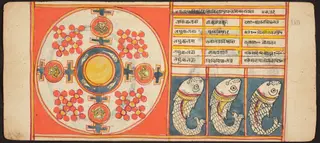 Tantric Manuscript "Sangrahani Sutra"
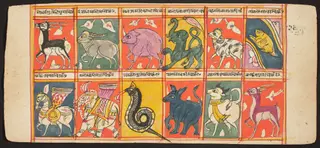 Tantric Manuscript "Sangrahani Sutra"
 Ruru
Ruru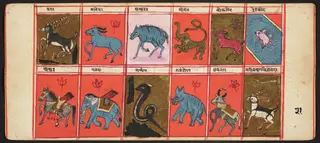 Tantric Manuscript, "Sangrahani Sutra"
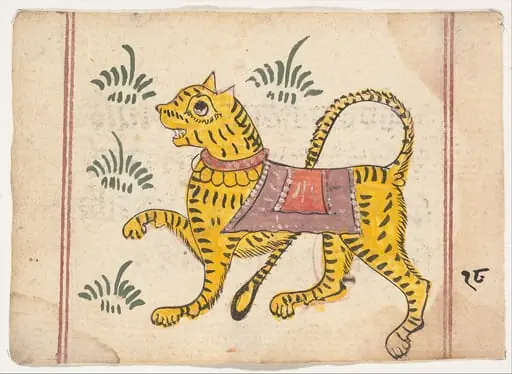 Untitled
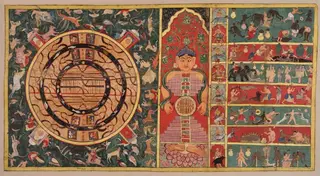 Diagrams of the Universe: The Two-and-a-Half Continents, the Universe in the Shape of a Person, and the Seven Levels of Hell
 Krishna and Kaliya