Artwork
Ryugu Tamatori Hime no su|Recovering the Stolen Jewel from the Palace of the Dragon King
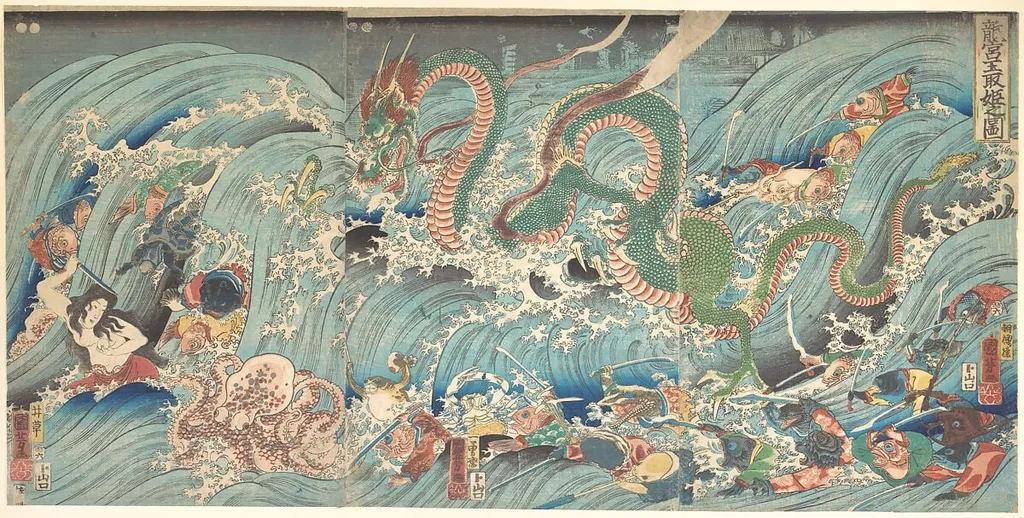
Ryugu Tamatori Hime no su|Recovering the Stolen Jewel from the Palace of the Dragon King is an ink print by the Baroque artist Utagawa Kuniyoshi. It dates from 1853 and is held in the collection of the Metropolitan Museum of Art.
About this work
Subject & Meaning
The print depicts an episode from Japanese folklore in which the diver Tamatori rescues Fujiwara no Kamatari’s stolen jewel by retrieving it from the Dragon King’s palace beneath the sea. Kuniyoshi’s composition shows Tamatori, an ama diver, swimming through a storm-tossed ocean populated by dragons, fish, frogs, and a pieuvre, while a dragon occupies Ryūgū-jō, the palace of the Dragon King. The scene visualizes the perilous journey beneath waves symbolized by stylized wind waves, underscoring the myth’s themes of courage, sacrifice, and the crossing between human and supernatural realms.
Technique & Style
The scene is further animated by the depiction of wind waves, reflecting the dramatic action typical of Kuniyoshi's mythological subjects.
Created in 1853, this work is a triptych executed in the ukiyo-e tradition as a nishiki-e woodblock print. The medium consists of ink and color applied to paper, characteristic of the musha-e (warrior picture) genre within Japanese printmaking. The composition dynamically depicts the mythological narrative of the ama diver recovering a jewel from the Dragon King's palace.
Stylistically, the print features a complex arrangement of figures including the diver, the dragon, and various sea creatures such as fish, frogs, turtles, and an octopus. The scene is further animated by the depiction of wind waves, reflecting the dramatic action typical of Kuniyoshi's mythological subjects.
History & Provenance
Recovering the Stolen Jewel from the Palace of the Dragon King is a triptych of woodblock prints produced by Utagawa Kuniyoshi in 1853, rendered in ink and color on paper as a mythological scene. The work was created during the mature phase of Kuniyoshi's ukiyo-e career, when nishiki-e and musha-e subjects were prominent in his output.
The print is now held in the collection of the Metropolitan Museum of Art, where it is documented under that institution's holdings of Kuniyoshi's work. No earlier ownership history, commissioning patron, or intermediate provenance is recorded in the available sources.
The work titled Ryugu Tamatori Hime no su, also known as Recovering the Stolen Jewel from the Palace of the Dragon King, is a woodblock triptych printed in 1853 by Utagawa Kuniyoshi. It belongs to the mythology genre and portrays figures from the Japanese legend of Ryūgū‑jō. The piece is housed in the collection of the Metropolitan Museum of Art in New York, where it is catalogued as part of the museum’s ukiyo‑e holdings.
No specific accession number is recorded in the available documentation, and the print has not been listed in major exhibition catalogues according to the sources consulted.
Overview
This triptych of woodblock prints, titled Recovering the Stolen Jewel from the Palace of the Dragon King (Ryugu Tamatori Hime no su), was created by Utagawa Kuniyoshi in 1853. Rendered with ink and color on paper, the artwork illustrates a dramatic episode from Japanese mythology, characteristic of Kuniyoshi's interest in heroic narratives. It presents a dynamic confrontation between a human figure and a powerful sea creature within a fantastical underwater realm.
Context
Utagawa Kuniyoshi frequently explored themes of heroism, folklore, and the supernatural in his ukiyo-e prints. This work exemplifies his fascination with epic battles and encounters between humans and formidable creatures from Japanese legend, particularly sea monsters. Such bold and imaginative narratives resonated with the public during the Edo period, establishing Kuniyoshi as a prominent artist known for his dramatic and emotionally charged compositions.
Artist & collection
Artist
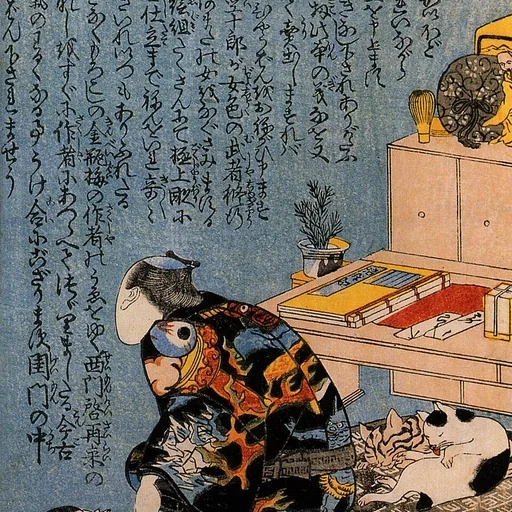
Kuniyoshi grew up in old Tokyo when the city was still called Edo. His dad ran a silk shop, but Kuniyoshi loved anything with pictures, scrolls, screens, comic books. He talked his way into the Utagawa school, a kind of…

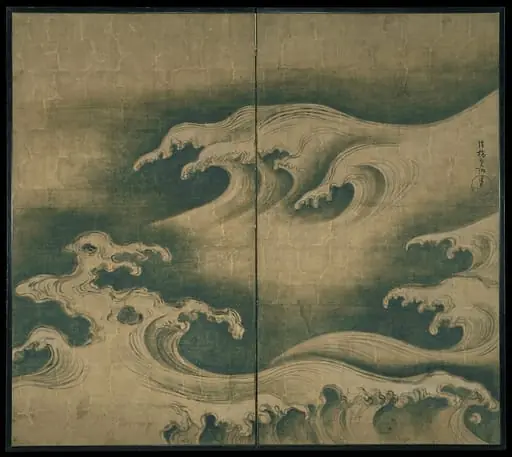
- 波濤図屏風|Rough Waves
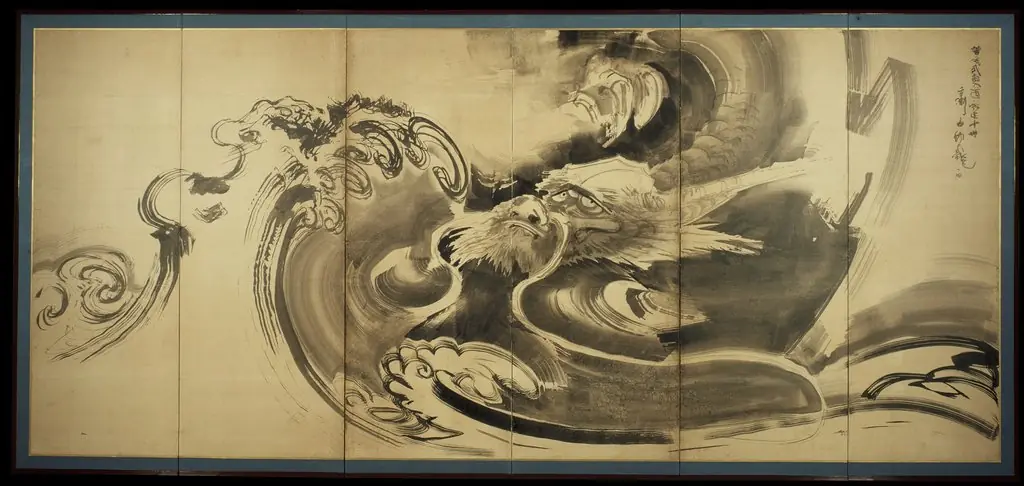 Dragon Amid Waves
 Untitled
 Untitled
 歌川国芳画 「高祖御一代略図 佐州流刑角田波題目」|Concise Illustrated Biography of Monk Nichiren: Calming the Stormy Sea at Tsunoda in Exile to Sado Island
 冨嶽三十六景 東海道金谷の不二|Fuji Seen from Kanaya on the Tōkaidō (Tōkaidō Kanaya no Fuji), from the series Thirty-six Views of Mount Fuji (Fugaku sanjūrokkei)
 The Tale of Genji
 Kamakura no Gengoro Seizing Torinoumi Tasaburo
 Lions and Tigers in Peony and Bamboo
 Lions and Tigers in Peony and Bamboo
 Waves at Matsushima
 Li Wenzhong Clears the North