Artwork
Tea-Party in Mytishchi near Moscow
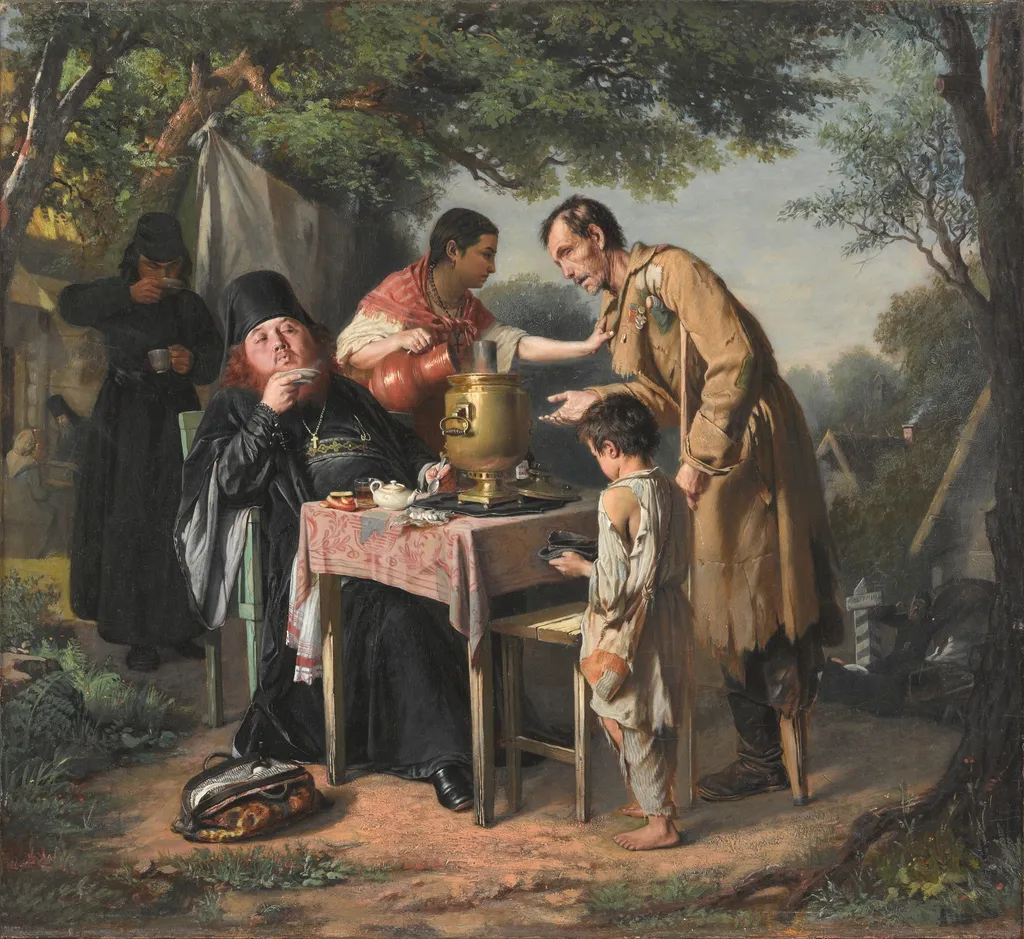
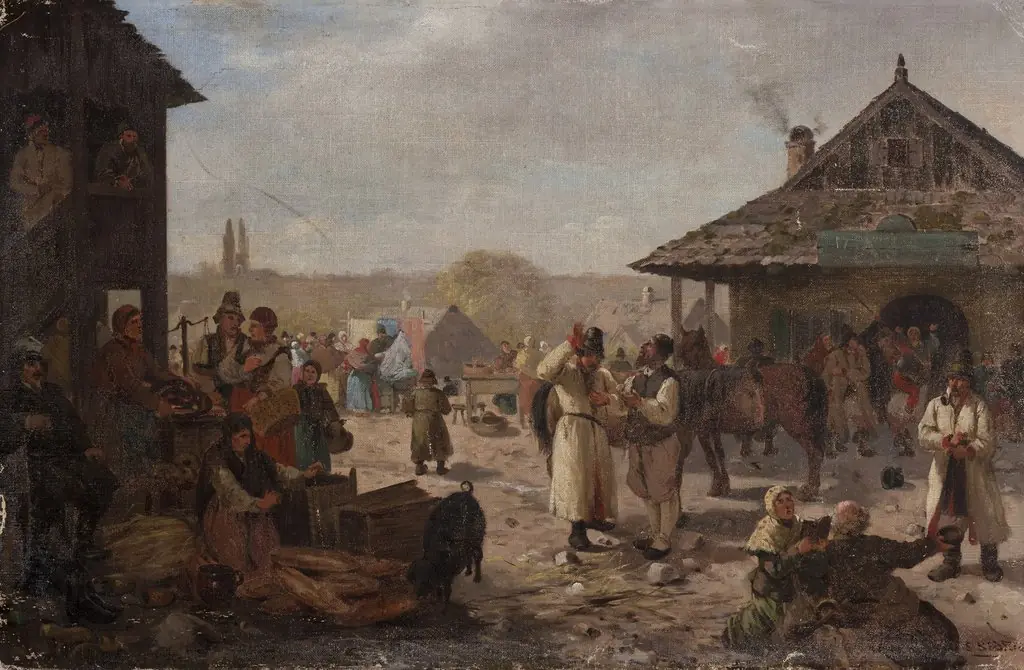
Tea-Party in Mytishchi near Moscow is an oil painting by the Realist artist Vasily Perov. It dates from 1862 and is held in the collection of the Tretyakov Gallery.
About this work
Subject & Meaning
The scene portrays Russian tea culture, with figures assembled around a table in the town of Mytishchi.
Vasily Perov's "Tea-Party in Mytishchi near Moscow" depicts a gathering centered on a samovar, the traditional Russian tea urn, which serves as the focal point of the composition. The scene portrays Russian tea culture, with figures assembled around a table in the town of Mytishchi. Among those present are a beggar, a blind person, and a veteran, including a person with disabilities.
The inclusion of these marginalized figures alongside the everyday ritual of tea drinking suggests a social commentary on the lives of the poor, disabled, and former servicemen in mid-nineteenth-century Russia. By framing the samovar and tea as a shared moment among society's most vulnerable, Perov uses a familiar domestic custom to draw attention to human suffering and social inequality, transforming a humble tea-party into a pointed observation on compassion and hardship.
Technique & Style
The work is executed in oil on canvas, a standard support for easel paintings of the period. Perov renders the domestic interior with careful attention to light and texture, emphasizing the quiet domestic ritual of tea. The composition balances narrative detail with a restrained formal arrangement, reflecting the realist interest in everyday Russian life.
The surface shows typical handling of oil medium, preserving the subtle gradations of tone across the figures and furnishings.
History & Provenance
The painting Tea-Party in Mytishchi near Moscow was created in 1862 by Vasily Perov, who both painted and commissioned the work. Executed in oil on canvas, it measures 43.5 cm in height and 47.3 cm in width. The artwork entered the collection of the Tretyakov Gallery, where it remains on display.
Its subject matter includes elements of Russian tea culture such as a samovar, and it portrays figures including a beggar, a veteran, and a person with disabilities in the setting of Mytishchi near Moscow.
Overview
Vasily Grigorevich Perov’s 1862 oil painting, Tea‑Party in Mytishchi near Moscow, captures a modest gathering in a forest clearing outside the town of Mytishchi. A group of figures in traditional Russian dress surrounds a wooden table dominated by a large samovar, while a beggar and a blind man linger at the edge, suggesting a slice of everyday life.
Context
The piece belongs to the broader realist agenda of the Peredvizhniki, who sought to move art beyond academic subjects toward the lives of ordinary people. In the 1860s, tea‑parties served as both social ritual and visual shorthand for domestic stability, making the scene a timely commentary on contemporary Russian society.
Own this work as a print
Artist & collection
Artist
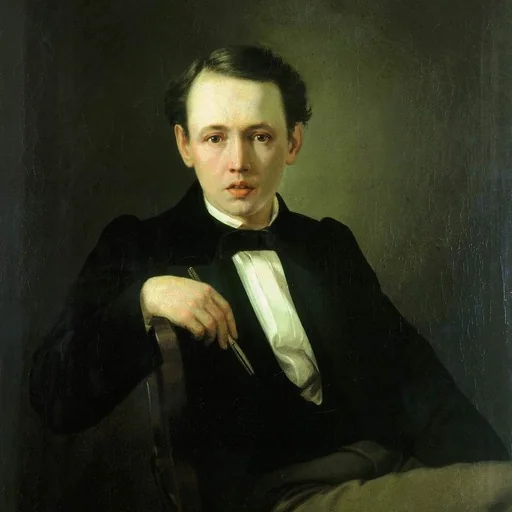
Vasily Grigorevich Perov (Russian: Василий Григорьевич Перов; 2 January 1834 – 10 June 1882) was a Russian painter, a key figure of the Russian Realist movement and one of the founding members of Peredvizhniki.