Artwork
Head of a Peasant Woman
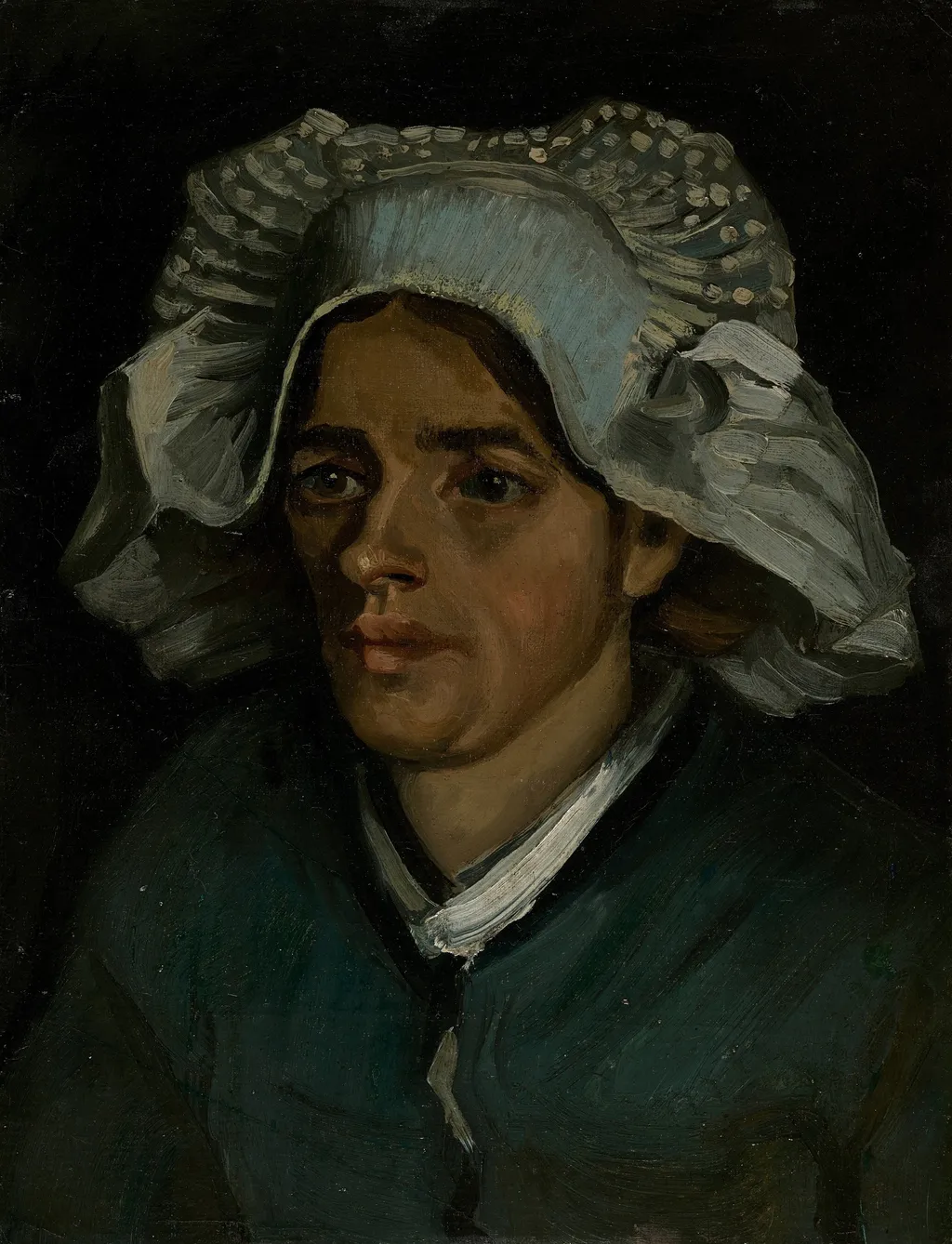
Head of a Peasant Woman is an oil painting by the Post-Impressionist artist Vincent van Gogh. It dates from 1885 and is held in the collection of the National Galleries Scotland.
About this work
Overview
Head of a Peasant Woman is an oil painting on canvas laid on millboard created by Vincent van Gogh in 1885 during his residence in Nuenen, Netherlands.
Head of a Peasant Woman is an oil painting on canvas laid on millboard created by Vincent van Gogh in 1885 during his residence in Nuenen, Netherlands. Measuring 46.4 by 35.3 cm, the work is held by the Scottish National Gallery in Edinburgh, where it is catalogued under accession number NG 2216. The painting belongs to a concentrated series of approximately forty peasant head studies that Van Gogh executed from life during the winter of 1884-1885, a period of intense productivity that culminated in his first major composition, The Potato Eaters. The work exemplifies the artist's early commitment to social realism and his desire to portray rural laborers with unvarnished directness, making it a significant document of his formative Dutch period.
Subject & Meaning
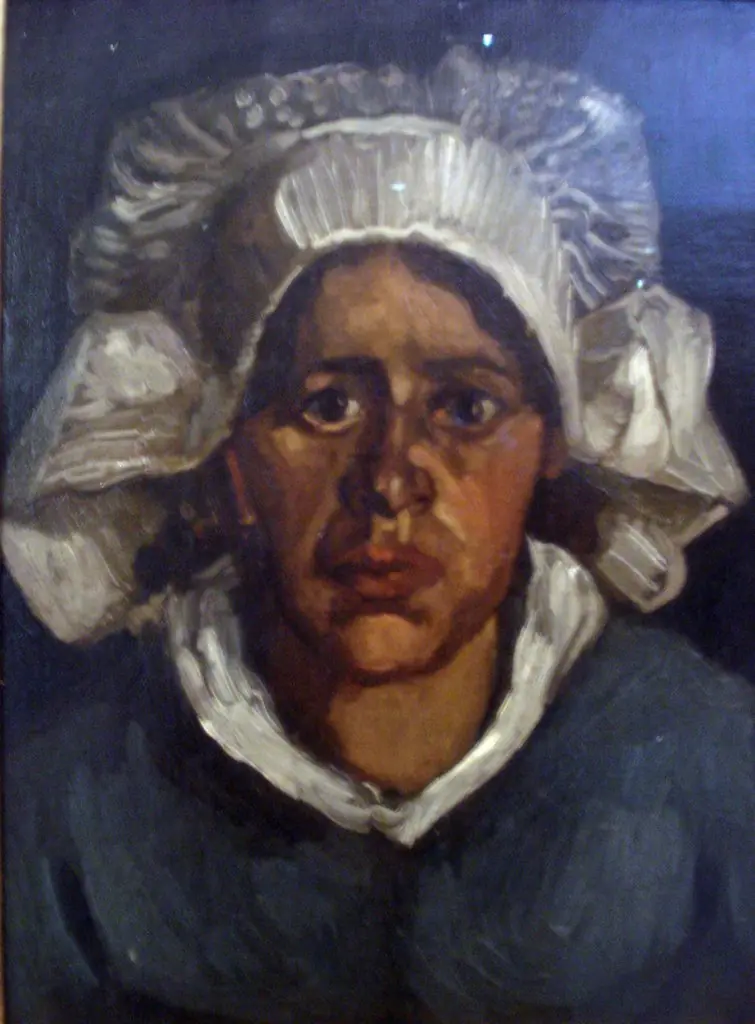
The painting presents a bust-length depiction of a woman facing slightly left, her head turned toward the viewer. She wears an elaborate white cap with patterned texture and ruffled edges that extends beyond her shoulders, framing her face against a flat, nearly black background. Her dark teal or blue-green dress reveals a white collar at the neck. The sitter has been identified as Sien de Groot, a local peasant woman who also appears as a central figure in The Potato Eaters. Van Gogh's choice to depict her in working clothes rather than Sunday attire reflects his stated conviction that he achieved better results by painting peasants in their roughness. The frontal presentation without pretension embodies the artist's ambition to become a painter of working people, capturing what he perceived as the authentic character of rural life. The somber mood and earthy palette underscore the harsh conditions of peasant existence rather than romanticizing it.
Technique & Style
Van Gogh executed the work in oil on canvas laid on millboard, a support he frequently employed during this period of financial constraint. The paint surface exhibits visible and textured brushwork throughout, with thick directional strokes in the cap and looser, more blended handling in the face and background. Light falls from the left, illuminating the left side of the face and cap while the right side recedes into shadow, creating a chiaroscuro effect that models the form. The palette is dominated by earthy browns in the skin, whites and grays in the head covering, and deep blue-greens in the clothing. The brushwork effectively simulates the texture of the bonnet and the weathered quality of the sitter's features. The paint surface shows some age-consistent cracking. This technique reflects Van Gogh's engagement with Realism and his study of Dutch and French masters of peasant painting, while already hinting at the expressive handling that would characterize his later work.
History & Provenance
The painting was created in April 1885 in Nuenen, where Van Gogh lived with his parents and used local neighbors as models. The work served as a study for The Potato Eaters, which he completed in May 1885. It was presented to the Scottish National Gallery by Sir Alexander Maitland in memory of his wife Rosalind in 1960. The painting gained renewed attention in 2022 when a hidden self-portrait by Van Gogh was discovered on its reverse side during an X-ray examination conducted by National Galleries of Scotland as they prepared for an exhibition on Impressionism. The self-portrait, which shows a bearded sitter in a brimmed hat with a neckerchief, had been concealed beneath layers of glue and cardboard. This finding confirmed Van Gogh's practice of reusing canvases by painting on both sides when funds were scarce, a habit that led to several reverse-side works being covered up and lost over time.
Context
The Nuenen period marked a crucial phase in Van Gogh's development. Having arrived in late 1883 after stints in The Hague and Drenthe, he immersed himself in depicting local weavers and peasants. His artistic ambition during these years was shaped by the realism of Jean-François Millet and Gustave Courbet, as well as by German Renaissance masters Albrecht Dürer and Hans Holbein, whose grave frontal portraits had inspired his earlier Heads of the People project of 1882. The social and personal circumstances of the period were turbulent: Van Gogh had recently ended a disastrous affair with Margot Begemann, and local opinion had turned against him, making it difficult to procure models. Despite these obstacles, or perhaps because of them, he produced an extraordinary body of work focused on peasant life. The series of head studies to which this painting belongs represents his most sustained engagement with a single subject prior to his departure for Antwerp later in 1885 and his subsequent move to Paris.
Legacy
The 2022 discovery of the hidden self-portrait on the reverse of Head of a Peasant Woman significantly enhanced scholarly and public understanding of Van Gogh's working methods and self-representation during the Nuenen period. The finding demonstrated how financial necessity drove him to maximize the use of his materials, while also revealing that he continued to produce self-portraits throughout periods not previously associated with this genre. The work remains an important touchstone for understanding Van Gogh's early realism and his empathy for peasant subjects, qualities that would inform his subsequent development even as his palette brightened and his brushwork grew more emphatic in France. As one of approximately forty such head studies from Nuenen, it contributes to a body of work that art historians regard as essential to comprehending the full arc of his career, from the dark tonalities of the Dutch years to the vibrant color of his final period.
Own this work as a print
Artist & collection
Artist
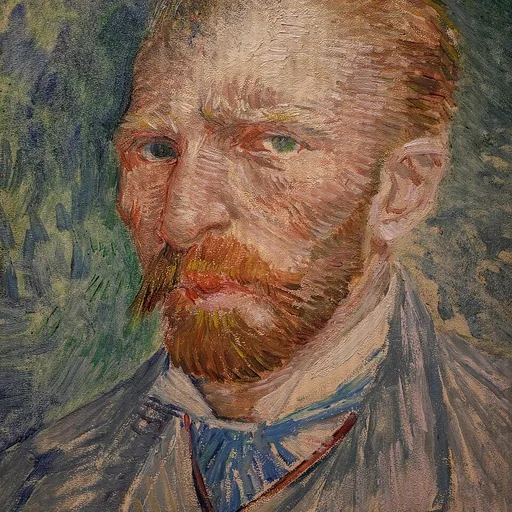
Vincent Willem van Gogh was a Dutch Post-Impressionist painter who is among the most famous and influential figures in the history of Western art.