Artwork
The Ricotta Eaters
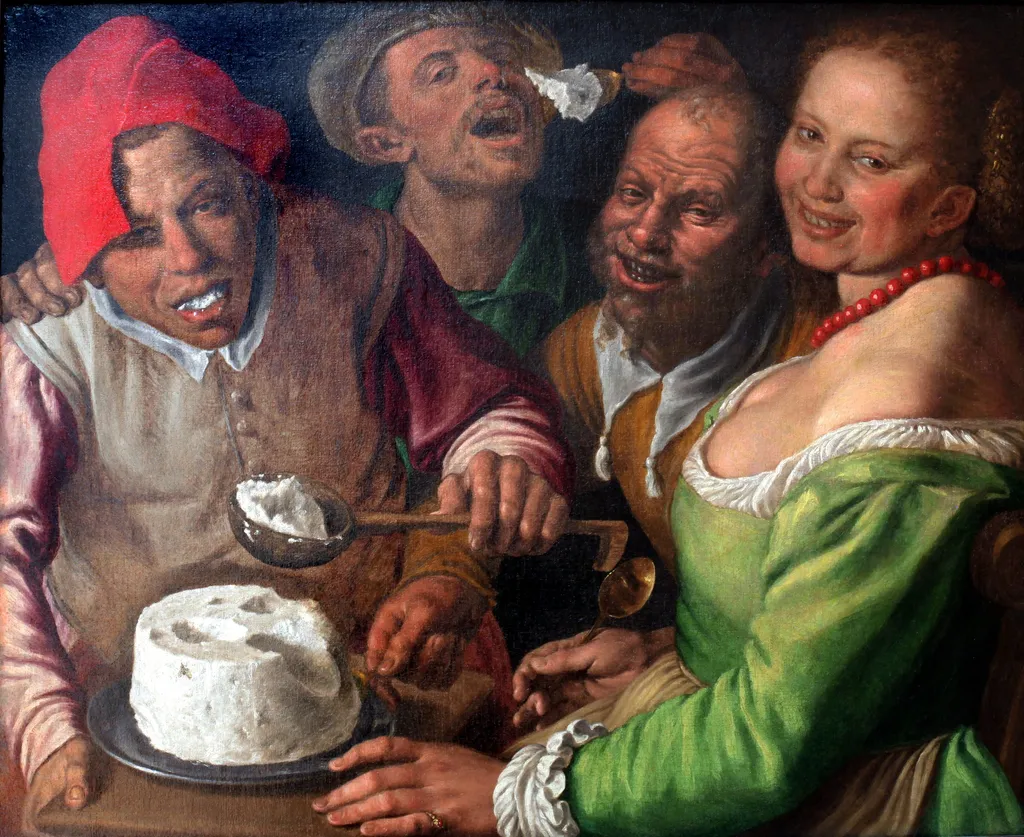
The Ricotta Eaters is an oil painting by the Early Baroque Italian artist Vincenzo Campi. It dates from 1590 and is held in the collection of the Museum of Fine Arts of Lyon.
About this work
Subject & Meaning
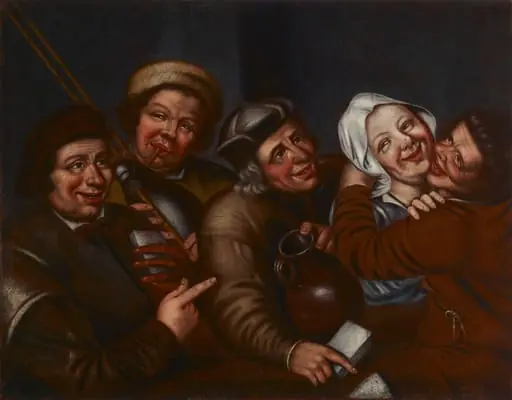
The artist identified the work as Buffonaria, linking its four characters to Commedia dell'arte archetypes and depicting himself as Pantalone in red costume.
The painting shows four figures around a table holding utensils to consume a central dish of ricotta. The artist identified the work as Buffonaria, linking its four characters to Commedia dell'arte archetypes and depicting himself as Pantalone in red costume. The ricotta, hollowed by spoon strokes and marked by a fly, forms a skull-like shape, symbolizing memento mori and vanitas themes that contrast earthly pleasure with mortality. The figures' unrefined attire, exaggerated gestures, and shared laughter reflect a celebration of simple communal joy, while their physical details, visible teeth, humble clothing, and the skull-like ricotta, suggest satire of base appetites and the fleeting nature of pleasure. The composition's frontal framing and tight crop immerse the viewer in the scene, reinforcing the interplay between transience and conviviality.
Technique & Style
The painting is executed in oil on canvas, a medium typical of late 16th-century Italian genre scenes, and measures 77.9 cm in height by 89.4 cm in width. It depicts four figures, three men and one woman, gathered around a table bearing a dish of ricotta, rendered with visible brushstrokes that emphasize texture and chiaroscuro against a dark background. The composition is tightly framed and confrontational, with each figure engaged in a specific act of cheese consumption: the leftmost man holds a full wooden spoon to his mouth, another man braces himself to swallow while touching the shoulder of his companion, a third extends his hand toward the cheese, and the woman, dressed in a green bodice and red necklace, holds a spoon but does not yet serve herself. The work was created circa 1580-1585 by Vincenzo Campi, who titled it Buffonaria, linking its four characters to Commedia dell'arte archetypes, and it was later donated to the Museum of Fine Arts of Lyon in 1875 by Jacques Bernard. Formal analysis notes the stark frontal framing, the modest scale unusual for Campi, and the symbolic rendering of the ricotta’s hollowed surface, which, pierced by spoon strokes and marked by a fly, evokes a skull, reinforcing a vanitas theme that juxtaposes earthly indulgence with transience.
History & Provenance
The painting is dated to the early 1580s, with recent scholarship noting it remained in Vincenzo Campi’s studio until his death in 1591 and was recorded in his widow’s 1611 testament as una buffonaria. After Campi’s death, the work passed to the Hieronymite monks of San Sigismondo in Cremona by 1718, was seized during the monastery’s dissolution in 1798, and later entered the French collection of the Bernard family. It was donated to the Museum of Fine Arts of Lyon in 1875 by Jacques Bernard.
The artist titled the work Buffonaria, aligning its figures with Commedia dell’arte types, and Campi depicted himself as Pantalone. Technical examination during the 1991 restoration confirmed a later addition at the top and removed overpaint, also revealing a fly on the ricotta that strengthens its vanitas reading.
The Ricotta Eaters is held in the collection of the Museum of Fine Arts of Lyon, with the inventory number listed in its Wikidata entry. The painting was presented to the museum by Jacques Bernard in 1875 and has been on display there since, following its donation. It underwent restoration in 1991, during which a 5 cm strip was removed from the top and overpaints on the woman's décolletage were corrected. The work is documented in multiple sources as part of the museum’s holdings, including its entry in Wikidata and French and Dutch Wikipedia articles.
The painting’s provenance includes an earlier mention in the 1611 will of Vincenzo Campi’s widow, Elena Luciani, who referred to it as 'una buffonaria', suggesting it remained in the artist’s atelier until at least the early 17th century. It was later sold and came into the possession of the Bernard family, who donated it to establish the museum’s collection. The work has been exhibited as part of the museum’s permanent display, with its exhibition history tied to its donation and ongoing presentation since 1875.
Context
The Ricotta Eaters occupies a distinctive position in Vincenzo Campi’s oeuvre as a leading figure of late Renaissance Lombard genre painting, blending naturalistic detail with satirical social commentary. The work’s symbolic depth is underscored by recurring motifs such as the skull-like ricotta, which merges memento mori themes with vanitas philosophy, while its Commedia dell’arte-inspired characters, notably the self-portrait of the artist as Pantalone, reflect Campi’s engagement with contemporary theatrical culture. As documented in scholarly sources, the painting’s provenance traces to Jacques Bernard’s 1875 donation to the Museum of Fine Arts of Lyon, where it remains displayed, following earlier ownership by the Bernard family and prior presence in a convent collection. Its stylistic and thematic connections to contemporaries like Joachim Beuckelaer further contextualize Campi’s shift toward profane genre scenes in the 1580s, a transition noted in historical records of his workshop practices and posthumous estate documentation. The work’s dual function as both celebration of quotidian abundance and critique of excess is reinforced through its compositional focus on communal consumption and the grotesque transformation of cheese into a symbol of mortality, a reading supported by material analysis and restoration records.
Legacy
The painting’s later influence centers on its provocative fusion of low-life humor and memento mori, which catalyzed a tradition of satirical genre scenes in Lombardy and beyond. Its attribution to Vincenzo Campi’s posthumous studio practice and its survival in multiple copies, including a Cremonese version judged the best, attest to its resonance with 16th- and 17th-century audiences seeking comic, marketable works. By the late 19th century the original had entered the Museum of Fine Arts of Lyon, where it became a touchstone for studies of Renaissance genre painting and vanitas symbolism. Conservation records from 1956 and 1991 further stabilized its reputation as a pivotal example of Campi’s unorthodox blending of comic theater, still-life, and moral allegory.
Own this work as a print
Artist & collection
Artist
Vincenzo Campi (Italian pronunciation:; c.1530/1535–1591) was a 16th-century Italian painter working in Cremona during the Late Renaissance.