Artwork
Houses at Murnau
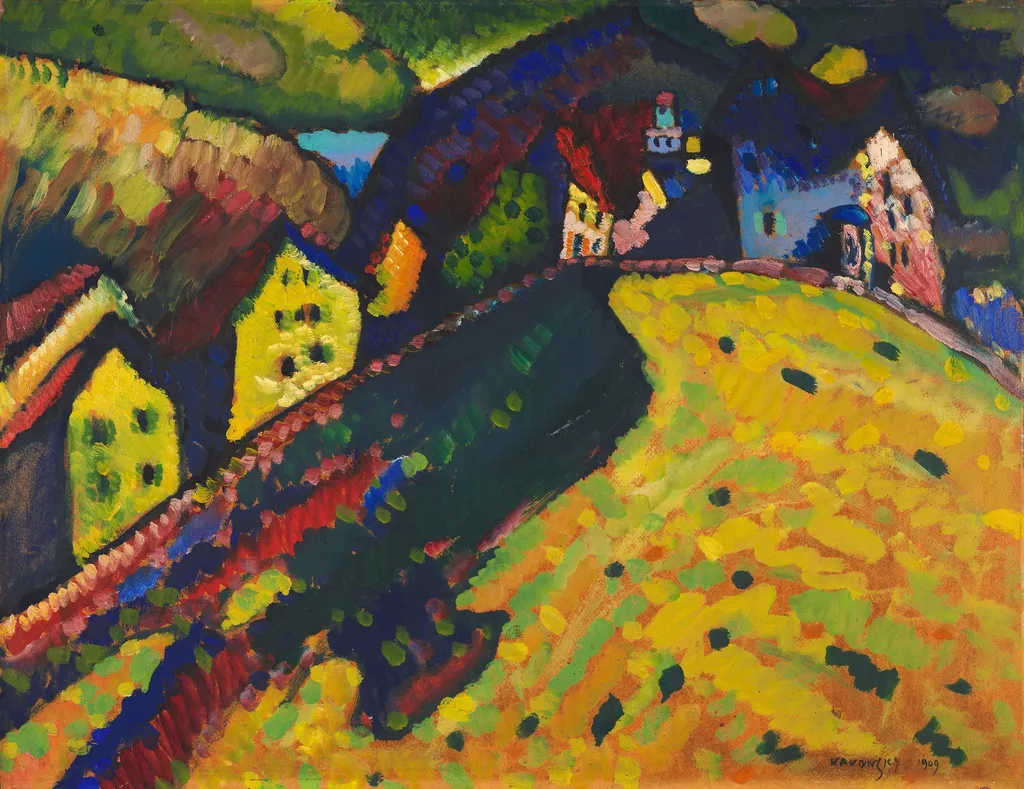
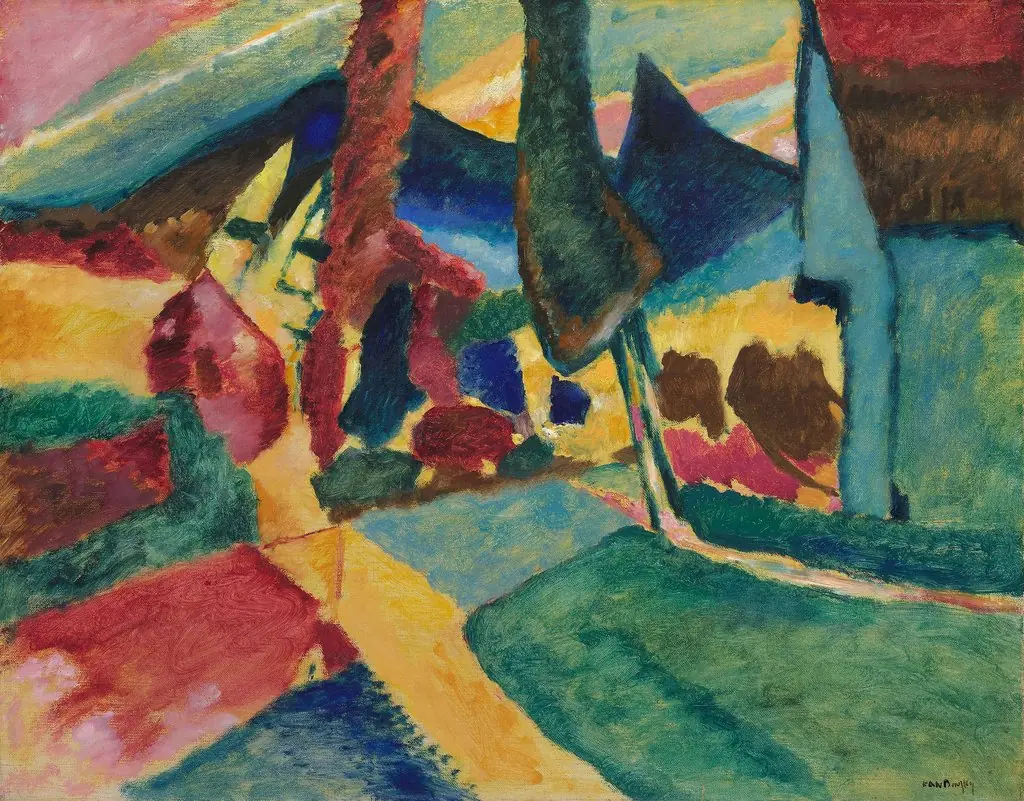
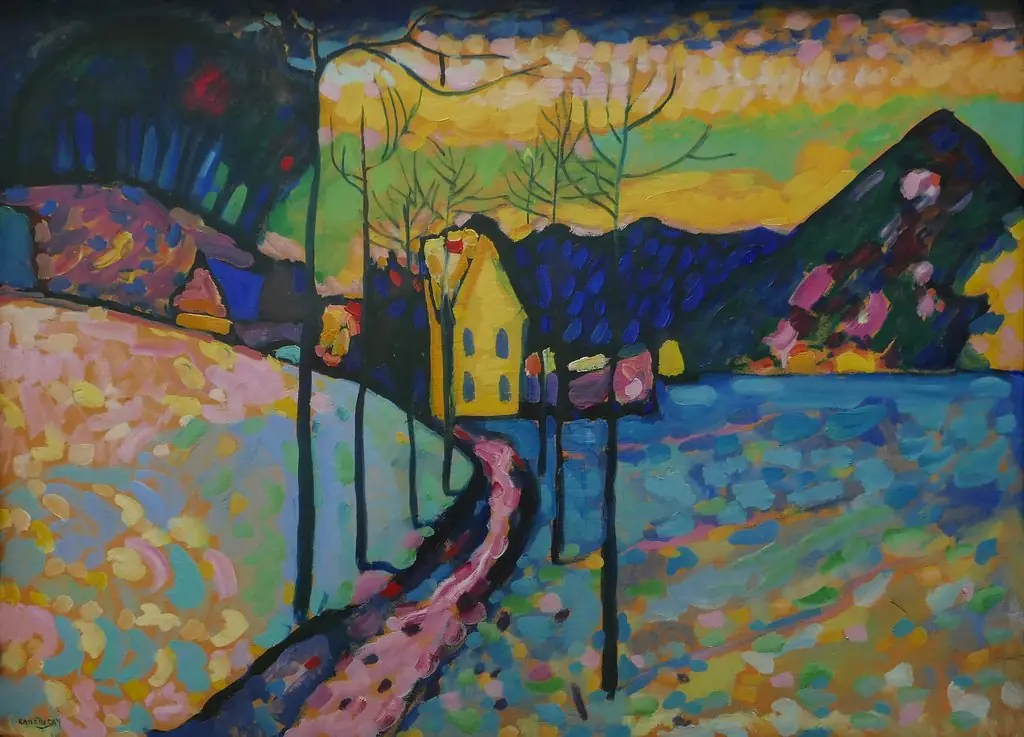
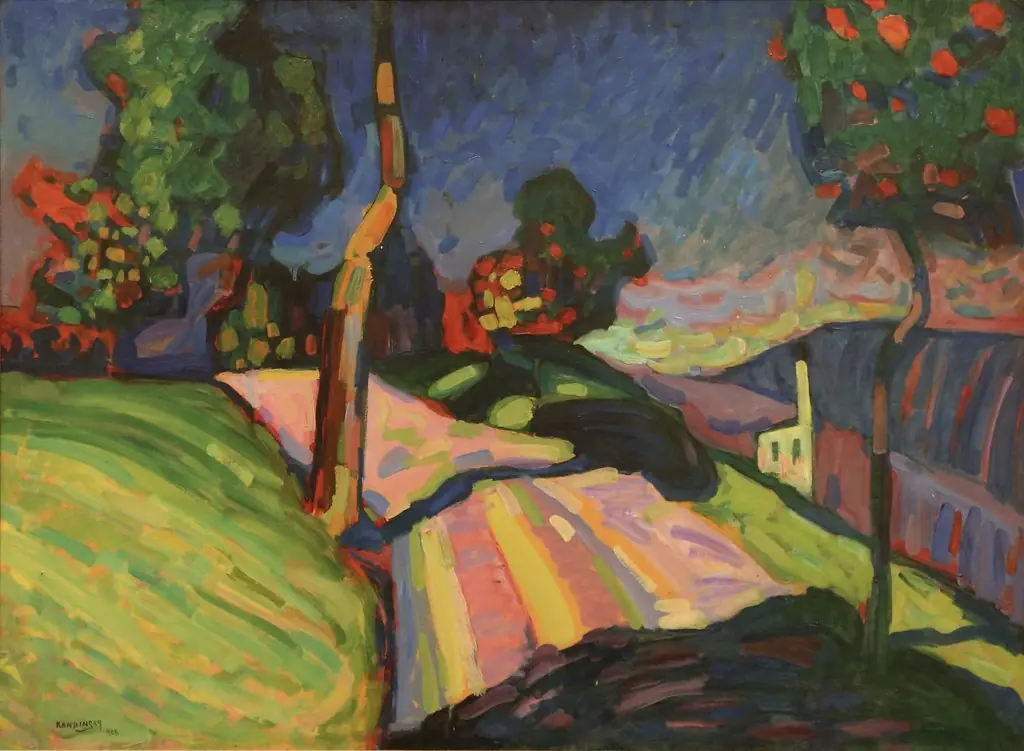
Houses at Murnau is an oil painting by Wassily Kandinsky. It dates from 1909 and is held in the collection of the Art Institute of Chicago.
About this work
Overview
The piece belongs to a transitional period in early 20th-century German art, where representation began to dissolve into symbolic structure.
Wassily Kandinsky completed Houses at Murnau in 1909 using oil on canvas during a formative phase in his artistic development. Painted in the Bavarian village of Murnau, the work captures a rural landscape while signaling a shift away from naturalism. It reflects his growing interest in emotional expression through color and form, preceding his fully abstract compositions.
The piece belongs to a transitional period in early 20th-century German art, where representation began to dissolve into symbolic structure.
Subject & Meaning
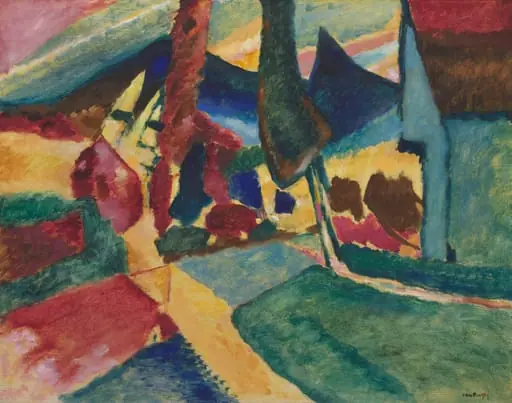
The painting depicts a cluster of village dwellings, winding paths, and surrounding hills, rendered not as a documentary view but as an arrangement of emotional signals. Buildings, trees, and terrain are simplified into interlocking planes, suggesting rhythm rather than realism. Kandinsky sought to convey inner experience through visual harmony, using the familiar motif of a village to explore how color and shape could evoke mood without literal description. The scene becomes a vehicle for spiritual resonance, not topographical accuracy.
Technique & Style
Kandinsky applied thick, expressive brushstrokes and unmodulated hues, vivid reds, blues, and yellows, to define architectural and natural forms. Contours are flattened, volumes reduced to geometric masses, and perspective is deliberately distorted to prioritize visual intensity over spatial logic. The palette, influenced by Fauvism, rejects naturalistic tone in favor of symbolic contrast. Loose, energetic strokes animate the surface, creating a sense of dynamic equilibrium between structure and spontaneity.
History & Provenance
Painted during Kandinsky’s years in Murnau, where he lived with fellow artist Gabriele Münter, the work emerged from a collaborative environment focused on color and form. The couple frequently painted the surrounding landscape, developing a shared visual language that challenged academic conventions. The painting remained in Kandinsky’s possession until his departure from Germany in 1914 and later entered a public collection, where it is now recognized as a key work in his evolution toward abstraction.
Context
In 1909, European art was undergoing radical redefinition. Kandinsky’s work in Murnau coincided with the rise of Expressionism and the dissolution of traditional perspective. He was influenced by folk art, Russian iconography, and contemporary movements like Fauvism, yet sought a uniquely personal visual vocabulary.
This period preceded the founding of Der Blaue Reiter, the avant-garde group he co-founded in 1911, which would champion spiritual abstraction in art.
Legacy
Houses at Murnau stands as a critical milestone in the transition from representational to non-objective painting. It demonstrates how Kandinsky used familiar subjects to test the expressive potential of color and form, laying groundwork for later abstract systems. The painting’s structural boldness and emotional intensity influenced subsequent generations of modernists, reinforcing the idea that art could communicate inner states without depicting the external world literally.
Own this work as a print
Artist & collection
Artist
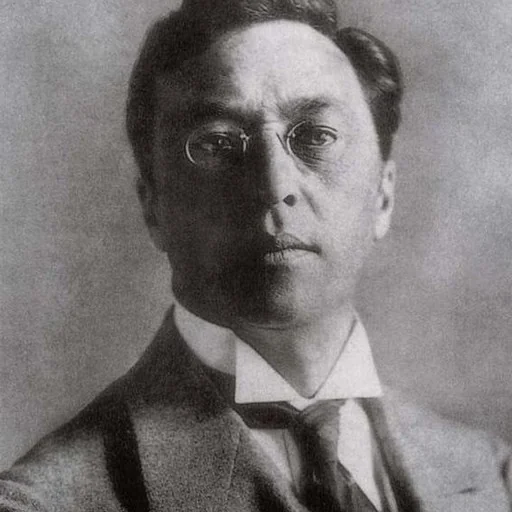
Wassily Wassilyevich Kandinsky (16 December 1866 – 13 December 1944) was a Russian painter and art theorist active in Germany during the late Belle Époque and Interwar eras.